What is Cash Free Debt Free?
Cash Free Debt Free (CFDF) is a transaction structure where the buyer does not assume any debt on the seller’s balance sheet, nor gets to keep any leftover cash.

Cash Free Debt Free (CFDF) is a transaction structure where the buyer does not assume any debt on the seller’s balance sheet, nor gets to keep any leftover cash.
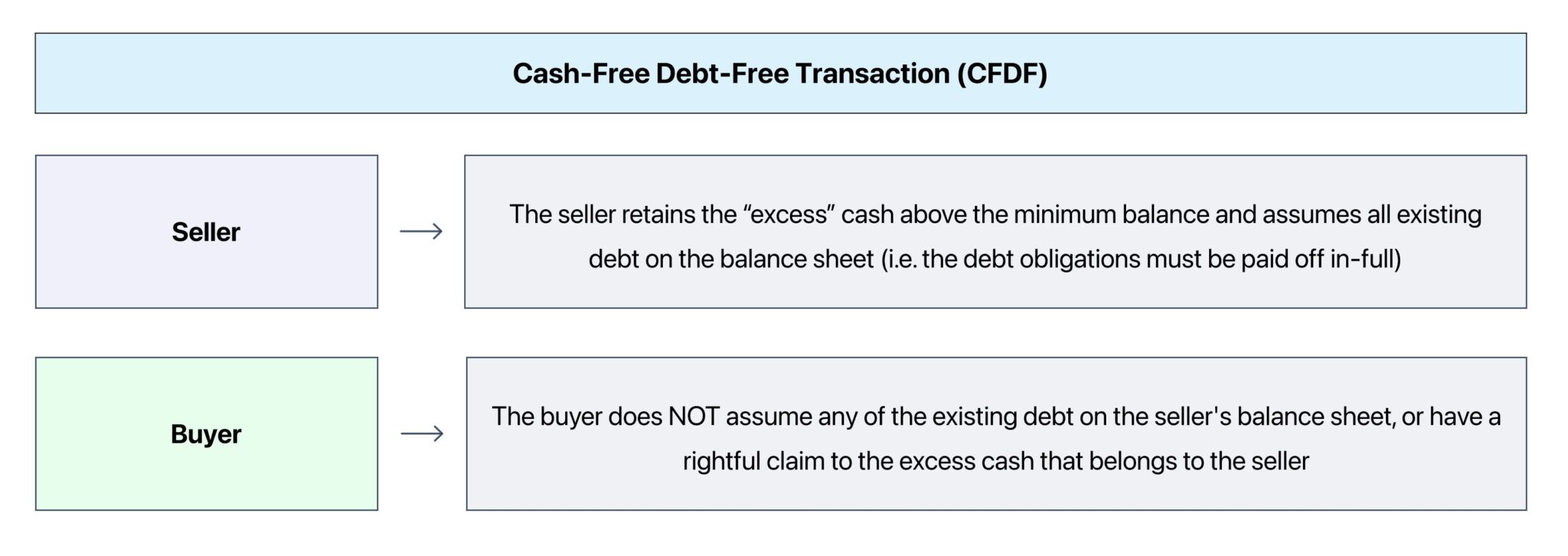
In M&A, the term "Cash-Free Debt-Free" simply means that when an acquirer purchases another company, the transaction will be structured such that the buyer will not assume any of the debt on the seller's balance sheet, nor will the buyer get to keep any of the excess cash on the seller's balance sheet.
From the perspective of the seller, a cash-free debt-free (CFDF) transaction results in the following implications:
If an M&A transaction is structured on a cash-free, debt-free basis, the enterprise value is implied to equal the purchase price.
Because the acquirer does not have to assume the seller's debt (nor get the benefit of the seller's balance sheet cash), the acquirer is simply paying the seller for the value of the core operations of the business, i.e. the enterprise value.
In CFDF deals, the purchase price delivered to the seller is simply the enterprise value (TEV).
By contrast, in an acquisition where the acquirer acquires all the seller's assets (including cash) and assumes all the liabilities (including debt), the purchase price delivered to the seller would need to be adjusted by taking the enterprise value and subtracting out the seller's existing net debt and purchasing just its equity.
Level up your career with the world’s most recognized private equity investing program. Enrollment is open for the upcoming cohort.
In practice, most leveraged buyouts (LBOs) – i.e. the transactions that private equity firms specialize in – are structured on a cash-free debt-free basis (CFDF).
Frequently, the letter of intent (LOI) will contain language to formally establishes that the transaction structure will be on a cash-free debt-free basis (CFDF).
However, the definition of what counts as cash and debt is not finalized and negotiations may continue about this up until the close, making the cash-free debt-free basis structure a sometimes delicate point of negotiations.
For instance, suppose you are a seller thinking you'll get to keep $5 million in cash, but the private firm argues that $3 million of that is intrinsic to the operations of the business and should come over with the company in the late stages of the deal.
We’ll now move to a modeling exercise, which you can access by filling out the form below.

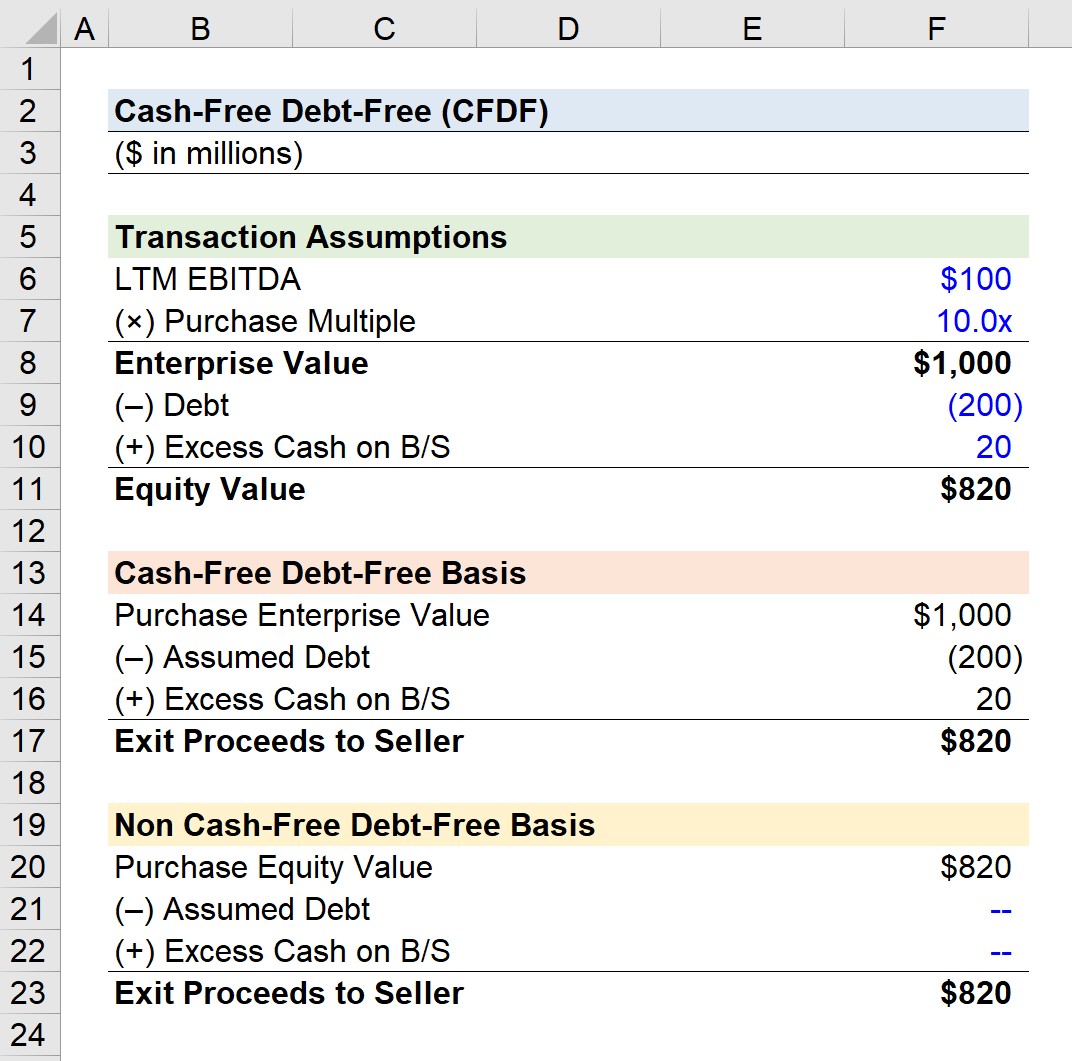
Suppose WSP Capital Partners, a private equity firm, seeks to acquire JoeCo, a coffee wholesaler and retailer.
WSP Capital Partners believes JoeCo deserves an enterprise value of $1 billion, representing 10.0x JoeCo's last twelve months (LTM) EBITDA of $100m.
JoeCo has $200mm in debt on its balance sheet, along with $25m in cash on its balance sheet, of which $5m the buyer and seller jointly agreed to consider “operating cash” that will be delivered to the buyer as part of the sale.
Note: Our illustrative LBO model will ignore all transaction and financing fees for simplicity.
Since the buyer is only buying the enterprise value, the buyer simply defines the purchase price as $1 billion, which is the enterprise value.
From the buyer's perspective, since there's $0 net debt that goes along with this newly acquired business, its equity value is simply $1 billion, i.e. the same as the enterprise value.
So, what happens to the debt and cash on the seller's balance sheet?
The seller receives the $1 billion purchase price and pays off the $180m in net debt ($200m, net of the $20m in excess cash).
The proceeds to the seller amount to $820m, which is equal to the equity value.
In contrast, suppose the same LBO transaction was NOT structured on a CFDF basis.
So, how would things look like if the same LBO deal was instead structured such that the acquirer assumes all liabilities (including debt) and acquires all assets (including cash)?
Given the non-CFDF transaction assumption, the acquirer will assume all seller debt and gets all seller cash.
The enterprise value remains $1 billion, so enterprise value is NOT impacted.
Of course, this time, the buyer is not just buying the enterprise, the buyer also assumes the $200m in debt, slightly offset by $20m in cash. The acquirer is still getting the same business, just with a lot more debt. So, all else equal, the buyer would define the purchase price as:
From the seller's perspective, $820m is received rather than $1 billion, but the seller has no lenders to pay off.
Under either scenario – ignoring any tax or other nuances that usually create a preference for a cash-free debt-free structure (CFDF) – the two approaches are economically identical.
Since most M&A deals are valued off EBITDA, the cash-free debt-free (CFDF) structure is conceptually simpler and aligns with how buyers think about the value of potential targets to acquire.
How so?
EBITDA is a measure of operating profitability independent of cash or debt. In fact, the EBITDA metric is solely a function of the businesses' core operations, regardless of how much excess cash or debt is sitting on the company's books.
In our JoeCo example, the 10.0x EBITDA entry multiple determines the purchase price, aligning the valuation with the purchase price from the acquirer's perspective.
The exception to CFDF structure is when the target company is public (i.e. “go-privates”) or in larger mergers & acquisitions.
In conclusion, those types of M&A deals will not be structured as cash-free debt-free (CFDF). Instead, the acquirer will acquire each share via an offer price per share or acquire all the assets (including cash) and assume all the liabilities (including debt).




Hi team, you indicate that Enterprise value is the the Cash Free Debt Free valuation as it already ignores the capital structure of the company. However, in practice for CFDF deals, it appears that firms typically take the Enterprise Value then deduct debt and add cash to arrive at the CFDF valuation/adjusted purchase price (not withstanding any further NWC or other adjustments).
Are you able to clarify how come Enterprise Value already accounts for CFDF but then again debt is subtracted and cash added to get to the CFDF valuation? Wouldn’t this be double counting? And also doesn’t that indicate that equity value is the CFDF valuation and not enterprise value?
Hi, Will,
When you think of it from the acquirer’s perspective, the EV is the CFDF value, because it is what the acquirer gets from the seller, who has kept the cash and paid off the debt, so naturally, the acquirer is interested in what they have to pay for that value, the EV or CFDF value. Of course the seller cares about how much ends up in their pocket, which is the equity value (what is left once the debt is paid down and the cash is kept).
BB
Thanks Brad, appreciate the reply!
I’m still unclear why acquirers in a CFDF transaction take the EV/CFDF valuation and then deduct debt and add cash to arrive at the actual purchase price if it is already CFDF.
1. In theory the adjusted purchase price is essentially the equity value but in reality parties could agree to different debt items and cash levels to be included in the price adjustment. Therefore the adjusted purchase price may not actually be equal to the equity value – is that correct?
2. Is it correct to say that the CFDF valuation and the adjusted purchase price (ie accounting for debt and cash) are different things ie one is a valuation and the other is a price/settlement figure and not the valuation?
3. When an LOI offer states “X enterprise value, on a cash free debt free basis…”, is it correct to say that the “X” amount has not yet deducted any debt or added any cash and the prospective purchase price adjustments will need to account for this?
Hi, Will,
I too am used to using the term ‘purchase price’ to mean the purchase price of equity in a public company context. However, CFDF purchase price is indeed the agreed upon purchase price for the enterprise value of the company being purchased, not the equity value. The equity value is what remains when the selling owner pays down debt and adds the cash they keep, just as if they sold their house and used the proceeds to pay the mortgage but kept the pile of cash they had in their bedroom safe. The purchase price of the house would not be the equity value.
BB
I actually had this same thought because this article is kind of confusing. Enterprise value includes the value of debt (minus cash), which is why it’s not double counting to remove it in a CFDF deal to get to equity value.
Hi, Chris,
That’s correct, in that the CFDF price being paid for the EV will presumably include enough for the seller to pay off the debt, and what is left (plus the excess cash) is the equity value to the seller.
BB
Hi I have a quick question. If we are a CFDF basis, and the target had A$25m cash (o/w A$5m is minimum cash required and A$20m is excess cash). When we do Sources and Uses table, does it mean the A$20m excess cash is on the sources side to reduce the enterprise value to equity value, while the A$5m cash is on the uses side as this A$5m minimum cash balance need to be funded somehow? Many thanks!
Hi, Tina,
The $25m in cash would actually reduce equity value to enterprise value, not vice versa, because enterprise value is the value of core operations excluding cash, so that is the price we would pay in a CFDF transaction. So, it would not be a source of cash if we are paying for just the enterprise. But you are correct that if we require $5m of cash to run the business, this would be on the uses of cash side, cash that the PE firm would need to raise.
BB
“Seller Keeps Excess Cash → The seller retains the excess cash on their balance sheet at the time of closing, except for a usually negotiated amount of “operating” cash that is considered a minimum amount that needs to transfer over in the sale to keep the operations of the freshly acquired business running smoothly.”
Why are we funding minimum cash and reflecting this under the “Uses” side of the table if it’s already transferred over in the sale as negotiated with the seller?
Hi, Lan,
If the minimum cash is included in the EV and transfers over, then you are correct, it would not be a uses of funds. However, if the seller walks away with all of the cash, then it would lower the purchase price EV by $5 and you would need a $5m as a use of funds.
BB
In the CFDF option what happens to the operating cash of $5M. Does that go to the buyer for WC?
Hi, Yvette,
Yes, the operating cash stays in the business as W/C, only the excess cash goes with the seller.
BB
Hello, in a CFDF deal, how do you treat assets such as buildings or investments which are not directly related to generating EBITDA?
Also, how would you treat a VAT credit?
Hi, Filippo,
The value of such assets would be included in the purchase price if they are transferred to the buyer, otherwise they are excluded along with cash and debt. Same for the VAT credit. If the benefit of it transfers, then it should be part of the purchase price.
BB
Hi Brad, thanks for the response. In my case I have a buyer wanting to purchase 50% of the company and enter as a working partner. We have agreed on a multiplier for EBITDA but the part that i’m struggling with is how do we calculate the rest. They have proposed the NET FINANCIAL POSITION method which I dont really understand.
The assets and liabilities which I dont know how to calculate are related to a large VAT Credit and property which needs to be excluded from the deal (ie I need to buy it from the company).
Hi, Filippo,
That sounds like a complicated situation, and I would need more facts to be able to reason it out consistently, and unfortunately we cannot give that level of response in this forum. Net Financial Position sounds to me something like the FMV of the assets and liabilities to be acquired. I am sorry I cannot help you further without knowing more.
BB
If a public company has $2B Market Cap & $500m Cash,
How much would an acquirer have to pay then?
This is my thinking (& confusion)
Approach 1 (as per the EV bridge): we calculate EV=1,500m.
Analysis:
Approach 2:
Seller says my market cap is 2B and I have 500m cash, so pay me 2.5B and take the cash balance
i.e buyer pays 2.5B and gets balance of 500m, effectively paying 2B
Approach 3
Seller says my market cap is 2B and I have 500m cash that I am going to keep, so pay me my 2B
Buyer pays 2B
Approach 2 & 3 are the same result, but differ than 1 which should be the right one.
Don’t understand why 1 should be right (or I could be wrong)
If the answer is that Market Cap by default implicitly factors cash, I would understand why approach 1 is righ
However in real life, some tech companies have tremendous cash balances greater than the market cap.
This invalidates that Market Cap implicitly factors cash
Hi, Georges,
Approach 1 is correct. A company with a market cap of $2bn will not be able to require that of the buyer and then say they are keeping the cash. The buyer, especially if it is a PE firm, is valuing the business apart from the cash and will pay that much for it (assuming the seller keeps the cash). So 2 and 3 just won’t happen. Cash is implicitly included in market cap. But as for your example of why it is not, there is a risk of what management might do with cash (i.e., something unwise) that may reduce it’s value to shareholders, in which case, the market cap may be less than the cash balance, in which case that company would be ripe for an activist investor.
BB
Maybe already answered but curious as to how Accounts Receivable are handled in CFDF? I assume as AP are considered Debts to be covered then AR will be considered as Cash and so also able to be included in final adjustments?
Hi, Tony,
No, A/R and A/P are operating assets and liabilities that are part of the normal operations of a business and should be transferred with the business, not paid off and/or kept by the seller.
BB
Hi,
so for the CFDF example, where the 5m min cash in transferring over to the buyer, is the Uses: Purchase Price = 1000m and Sources: Equity = 1000m. OR is the Uses side more accurately: Min Cash: 5m, Purchase Price = 995m. Conscious the net result is the same but I’m trying to understand if the min cash balance reduces the EV?
and for the non CFDF: Uses: Purchase Equity = 820m, Existing Debt = 200m (total = 1020m). Sources: Existing Cash = 20m, Sponsor Equity = 1000m (total = 1020m).
Thanks in advance!
Hi, Mia,
We are treating the minimum cash here as part of the EV, so the uses of funds would just be the EV of $1bn, and the sources would be whatever mix of debt and equity WSP came up with to buy the company. For the non-CFDF, you are correct, uses are purchase of equity and refinancing of existing debt, and sources include the $20mm of excess cash and whatever mix of debt and equity WSP comes up with.
BB