Strategic vs. Financial Buyer: What is the Difference?
The other acquirer type is a strategic buyer, or a company seeking to purchase a controlling stake in another company.
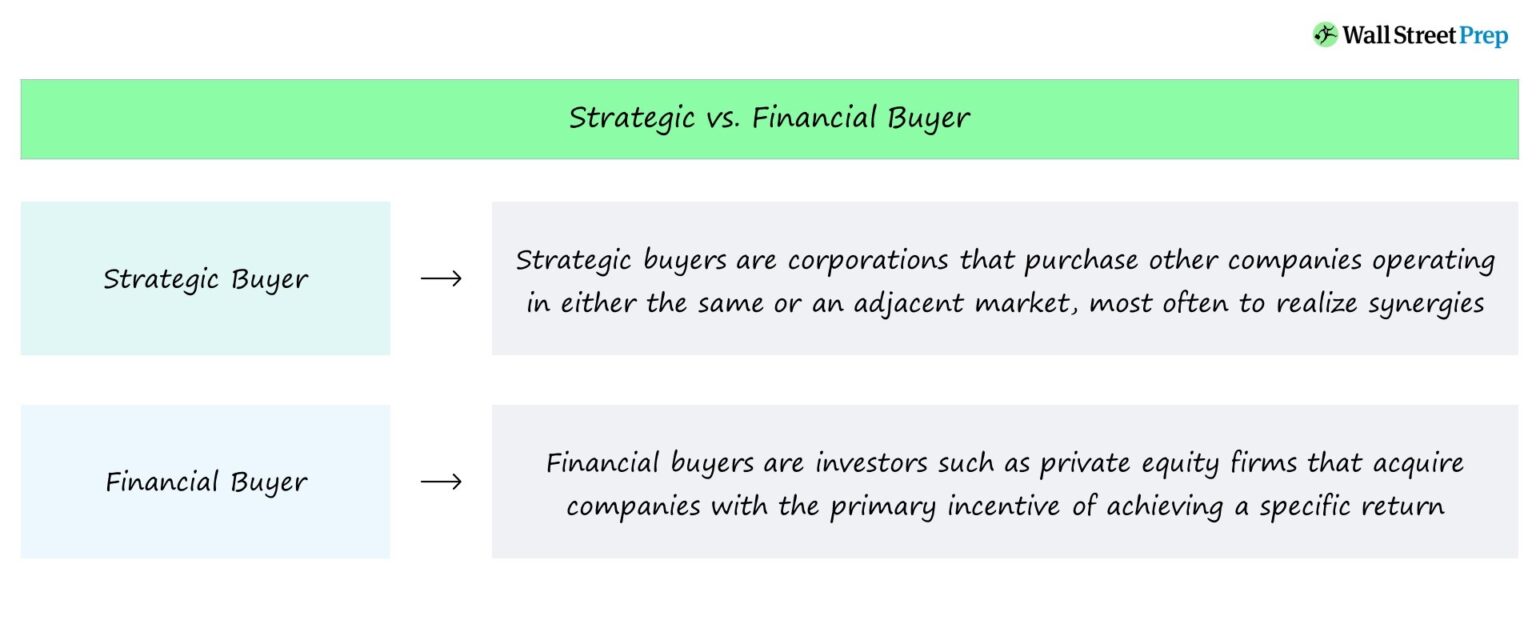
Strategic buyers are corporations acquiring companies that operate in overlapping markets, whereas financial buyers are firms that view the acquisition as an investment.
In contrast to a financial buyer, a strategic buyer – or “strategic” for short – is acquiring the target company for the opportunities to realize synergies post-deal.
Most often, a strategic buyer operates in the same or an adjacent market to the target, creating the potential for the combined entity to benefit from revenue or cost synergies, i.e. the incremental revenue or cost savings from the combination of the two companies.
Strategic buyers can afford to offer higher purchase price premiums because of their ability to benefit from synergies, such as generating more revenue from greater reach in terms of end markets or product capabilities, as well as cost-cutting measures like consolidating overlapping business functions and eliminating operating inefficiencies.
Since strategic buyers have historically paid higher purchase prices than financial buyers and perform diligence more quickly, sellers tend to prefer exiting (i.e. selling) to strategics.
Besides the higher purchase prices, another key difference is the objective of the purchase.
On the date of purchase, the strategic buyer seeks to create long-term value from the acquisition (and the acquisition target becomes part of the larger company).
Private Equity Firms: LBO Investment Horizon and Risks
Financial buyers only acquire a company (LBO) if the potential returns meet its minimum investment threshold.
Specifically, for private equity firms, the internal rate of return (IRR) on the investment is a critical metric – and moreover, the IRR is highly sensitive to the duration of the holding period. As such, financial buyers typically only seek to own a portfolio company for about five to eight years.
The traditional business model of the private equity industry is to exit an investment after around a five to eight-year time horizon.
Therefore, private equity firms proceed with an LBO only if their target return is anticipated to be met under the expected holding period.
While strategic buyers typically have unique value-creation tactics that they could implement, private equity firms are limited in terms of the number of levers they can pull compared to strategics.
Private Equity Industry: Add-On Acquisitions (Buy and Build Strategy)
The strategy of add-on acquisitions – often called the “buy-and-build” strategy – has become increasingly common among financial buyers and the private equity industry.
The trend of add-ons has led to a reduced gap in the purchase premiums paid between strategic and financial buyers, enabling PE firms to be more competitive in auction processes.
In an add-on acquisition, an existing portfolio company (i.e. the “platform”) purchases a smaller-sized target to benefit from synergies.
The platform is essentially playing the role of a strategic buyer that can also benefit from potential synergies, but the notable difference is that a financial buyer owns the platform itself.
Nonetheless, the acquisition premiums paid by financial buyers must still be reasonable, based on the intended strategy for integrating the target company into the long-term business plans of the combined entity.



No comments yet.