What is Assets Under Management?
Assets Under Management (AUM) refers to the market value of the capital contributed to a fund, from which an institutional firm invests on behalf of its clients, i.e. limited partners (LPs).

Assets Under Management (AUM) refers to the market value of the capital contributed to a fund, from which an institutional firm invests on behalf of its clients, i.e. limited partners (LPs).
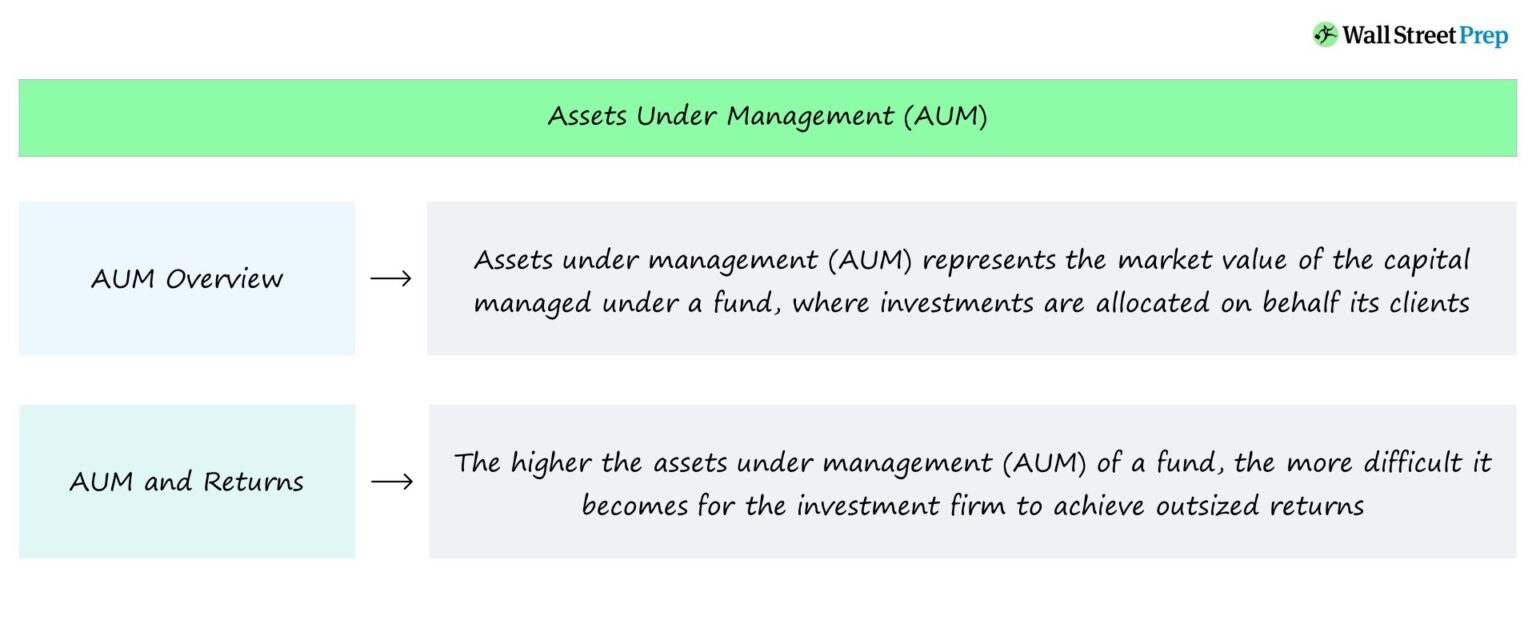
AUM stands for “Assets Under Management” and refers to the amount of capital managed by an investment firm on behalf of its clients, i.e. limited partners (LPs).
If applicable to the scenario, the limited partners (LPs) of a fund are the investors that collectively contribute capital to the fund, which is managed and deployed by the general partners (GPs) to generate a return.
Common examples of investment firms in the financial services industry where the AUM metric pertains include the following types:
The frequency at which the assets under management (AUM) change in industry-specific. Likewise, the method to calculate the metric is also distinct to each industry.
Learn how institutional investors identify high-potential undervalued stocks. Enrollment is open for the upcoming cohort.
The greater the assets under management (AUM), the more difficult it becomes for a private equity firm, i.e. financial sponsor, to achieve outsized returns because the number of potential investment opportunities declines and the capital at risk is greater.
Therefore, most if not all large institutional asset management firms are “multi-strat”, a catch-all term referring to firms that utilize diversified investment strategies, most often in separate investment vehicles.
Given the sheer magnitude of the capital managed, these institutional firms must become more risk-averse over time and diversify into various asset classes. Considering the wide range of strategies employed for diversification and risk management, the multi-strat approach offers more stability in returns in exchange for less risk and more downside protection, as each different fund strategy essentially functions as a hedge against all other funds.
For instance, a multi-strat firm can invest in public equities, bonds, private equity, and real estate to allocate the risk across different asset classes and overall de-risk its portfolio holdings.
Considering the fund's AUM, capital preservation frequently takes priority over achieving outsized returns – albeit, certain funds might take a more aggressive approach to achieving higher returns, which is offset by the other strategies.
On the flip side, certain firms intentionally place a “cap” on the total amount of capital raised per fund to prevent their returns profile from deteriorating.
For example, it would be unusual for a lower middle market (LMM) private equity firm to compete with a mega-fund to acquire an LBO target valued around $200 million, as that range of valuation (and potential returns) is insufficient to interest larger firms.
In fact, even if PE firms in the lower middle market (LMM) space could raise more capital, their priority is typically achieving high returns for their LPs rather than maximizing their fund size, which coincides with a strategically determined cap on the amount to raise, as well as charging lower management fees (%).
Likewise, the top institutional hedge funds that manage billions in total capital, such as Point72, will also not invest in small-cap stocks, despite the fact that there are more opportunities for arbitrage and mispricing in the market.
The abundance of opportunities to capitalize on is due to reduced market liquidity (i.e. trading volume) and less coverage from equity research analysts and the press (e.g. media).
To reiterate from earlier, achieving excess returns becomes increasingly challenging as the assets under management (AUM) of a firm increase.
One reason is that it becomes near impossible for the hedge fund — an influential “market mover” here — to sell its stake (and realize its gains) without the stock price of the small-cap company declining, which effectively reduces its returns.
Each move by hedge funds is closely followed by the market, and the sheer dollar amount of their investments alone can cause the stock price of a small-cap company to move up or down.
If a large institutional hedge fund sells its shares, other investors in the market assume the firm – considering it has more connections, resources, and information – is selling its stake for a rational reason, possibly resulting in less buying interest from the broader market.
Therefore, the largest hedge funds in terms of AUM are limited to investing in only large-cap stocks. And since equity research analysts widely follow large-cap stocks and retail investors alike, those stocks tend to be more efficiently priced.
Interested in accessing our comprehensive database of 400 hedge funds and investment firms in the public equities market?
Fill out the form below to download the Excel spreadsheet at no cost.


BlackRock (NYSE: BLK) is a global, multi-strategy investment firm and one of the largest global asset managers, with over $10 trillion in assets under management (AUM).
The screenshot below shows BlackRock’s AUM as of June 2022 segmented on the basis of:
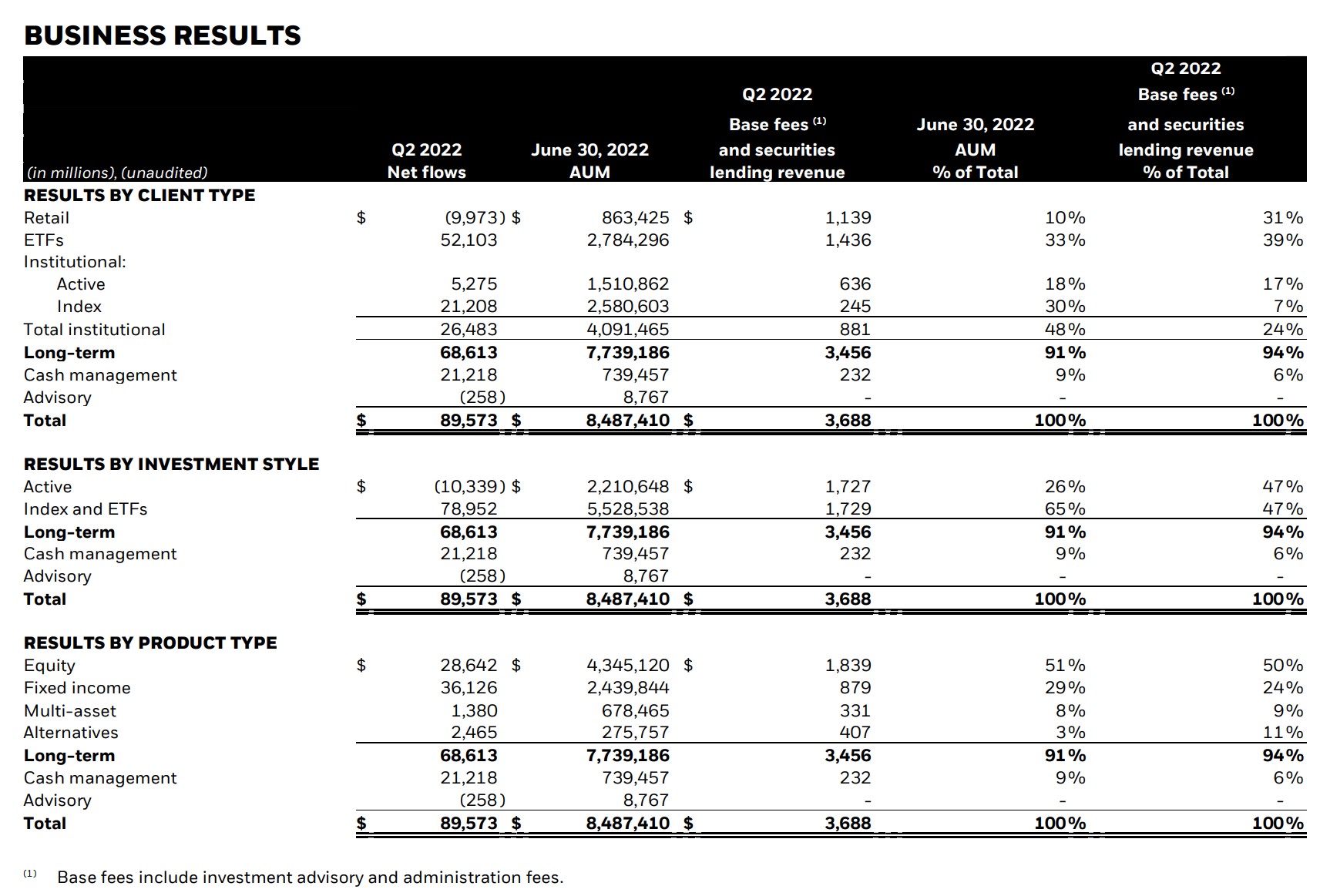
BlackRock Q2 2022 Earnings Release (Source: BlackRock)
A common misconception is that assets under management (AUM) and net asset value (NAV) are identical.
To summarize, the assets under management (AUM) is the total value of assets managed by a firm — of which a significant portion could be sitting on the sidelines — as opposed to a mutual fund or ETF like the net asset value (NAV).


Any thought on whether it’s legit to compare fund NAV to AUM as a percentage? Like let’s say you want to describe what percent of an asset manager’s AUM is invested in a certain type of strategy: would you just sum the NAVs of the funds in that strategy bucket and divide the total by firm AUM, or would you argue there’s a more apples-to-apples way to do this comparison?
Hi, Robert,
I suppose it would give you the ratio for the assets after leverage (since NAV deducts liabilities) over total assets, which might be useful. As for various strategy buckets, I suppose either measure could in theory be divided across the various strategies of the firm.
BB