What is Take-Private?
Take-Private refers to the transaction structure, wherein a publicly-traded company is acquired and the target’s shares are de-listed from a public exchange post-closing (or privatization).

Take-Private refers to the transaction structure, wherein a publicly-traded company is acquired and the target’s shares are de-listed from a public exchange post-closing (or privatization).

In M&A, a take-private describes a transaction where a public company is taken private and its shares are then delisted from a stock exchange.
Once the privatization is complete (post–closing), the shares of the target are no longer traded in the open markets and the formerly public company is now officially a private company.
Usually, the target of a take-private transaction is an underperforming company that has fallen out of favor with the public markets, i.e. its share price has suffered a steep decline.
Given the negative market sentiment and long-term outlook among investors, an investor – most often a private equity firm, a financial sponsor – can view the reduction in valuation as an opportunity to acquire the public company at a discount and realize a profit at a later date.
Since public companies are still worth far more than private companies—even after sustaining a substantial drop-off in their valuation—the investor is frequently a consortium of investors or a publicly traded company, as opposed to an individual investor.
To reiterate from earlier, a private equity firm (PE) typically participates and has a critical role in a take-private transaction as either 1) the lead investor or 2) a co-investor backing the deal in most cases, which is partly because of the need to raise a significant amount of debt capital to finance the transaction.
The occurrence of take-private deals tends to coincide with dry powder piling up on the sidelines among private investors, i.e. the build-up of unused capital raised by investment firms waiting to be deployed.
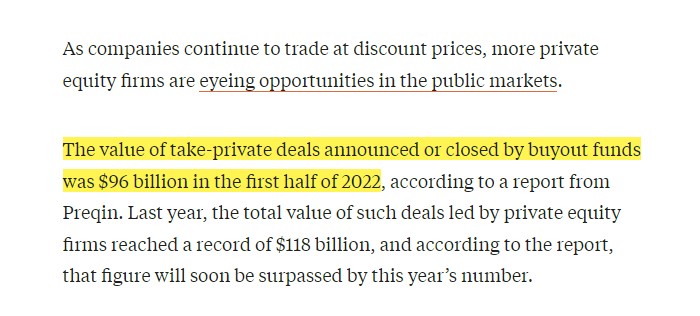
“Take-Private Deals Are on a Record Pace” (Source: Institutional Investor)
Level up your career with the world’s most recognized private equity investing program. Enrollment is open for the upcoming cohort.
While most are familiar with the concept of “going public”, which can be achieved via an initial public offering (IPO) or direct listing, the reverse process is termed privatization.
Many private companies raise capital from venture capital (VC) firms and growth equity firms with the goal of someday becoming a publicly traded company.
Becoming a public company is a significant achievement that provides many benefits, such as access to more capital and providing existing investors with a liquidity event.
However, there are drawbacks to the decision to go public, which tend to become most apparent for underperforming companies.
There are three types of take-private deal structures:
A 13-G filing in March 2022 revealed that Elon Musk—the co-founder and CEO of Tesla—owned a 9.2% stake in Twitter, effectively making Musk its largest shareholder.
Musk was initially offered a board seat, which he declined, only to later unexpectedly announce his intent to purchase Twitter.
In response to the tender offer, Twitter unsuccessfully attempted to fend off the acquisition, using the poison pill defense tactic to dilute Musk’s stake and make the purchase more costly.
Musk continued his efforts to pursue the acquisition in a hostile takeover, and Twitter eventually announced it had entered into a definitive agreement to be acquired by Musk in late April 2022.
The takeover was estimated to be worth $44 billion, with an offer value per share of $54.20 in cash, with financing provided by banks such as Morgan Stanley and Bank of America.
In an odd sequence of events, Musk took a sudden U-turn and tried to pull out of the deal, citing claims of fraud over the supposed number of “bots” on the platform.
The entire ordeal seemed to be on course to be settled in Court—as Twitter filed a lawsuit to force Musk to stick to his initial acquisition agreement—until Musk sent a letter formally re-stating his intention to honor his initial agreement at the original $54.20 per share right before a scheduled deposition.
Elon Musk closed his $44 billion purchase of Twitter on October 27, 2022, and the shares of Twitter were soon after de-listed.
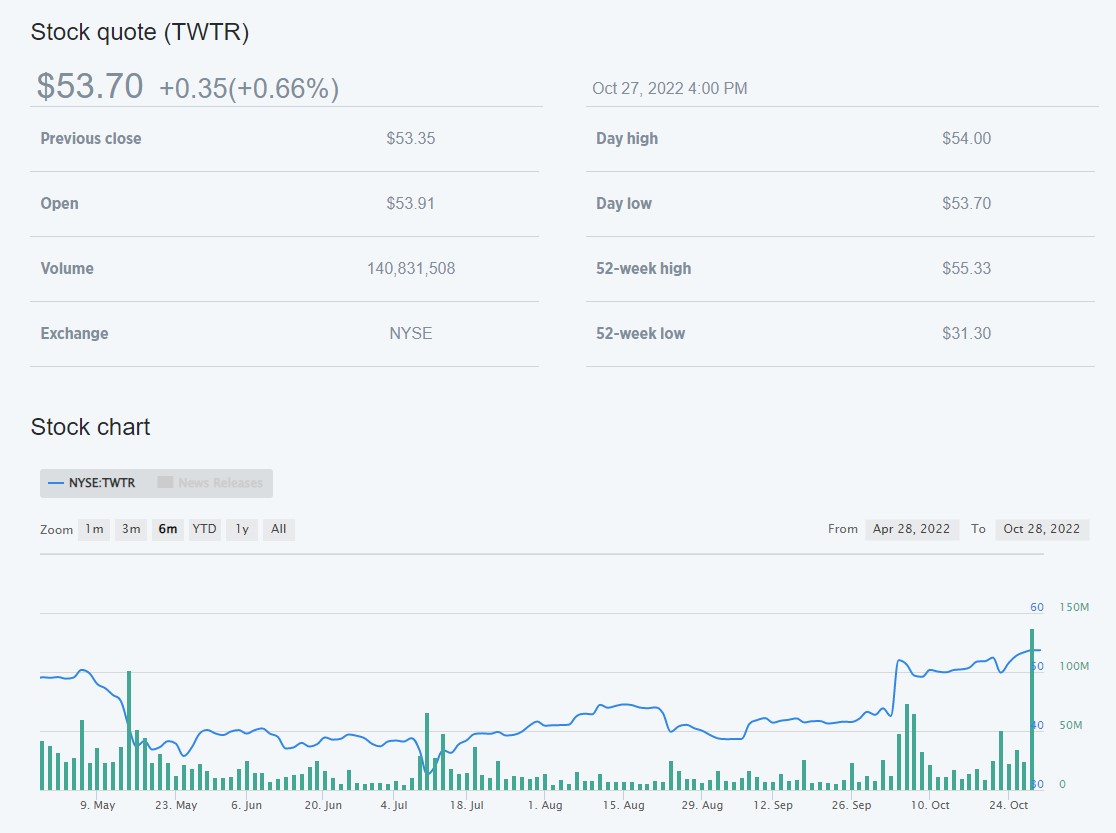
Twitter Stock Price Pre-Delisting (Source: TWTR)


Smooth reading! Thanks for including the recent Twitter- Musk deal!
You’re welcome!