What Makes a Good LBO Candidate?
LBO Candidates are characterized by strong, predictable free cash flow (FCF) generation, recurring revenue, and high profit margins from favorable unit economics.

LBO Candidates are characterized by strong, predictable free cash flow (FCF) generation, recurring revenue, and high profit margins from favorable unit economics.
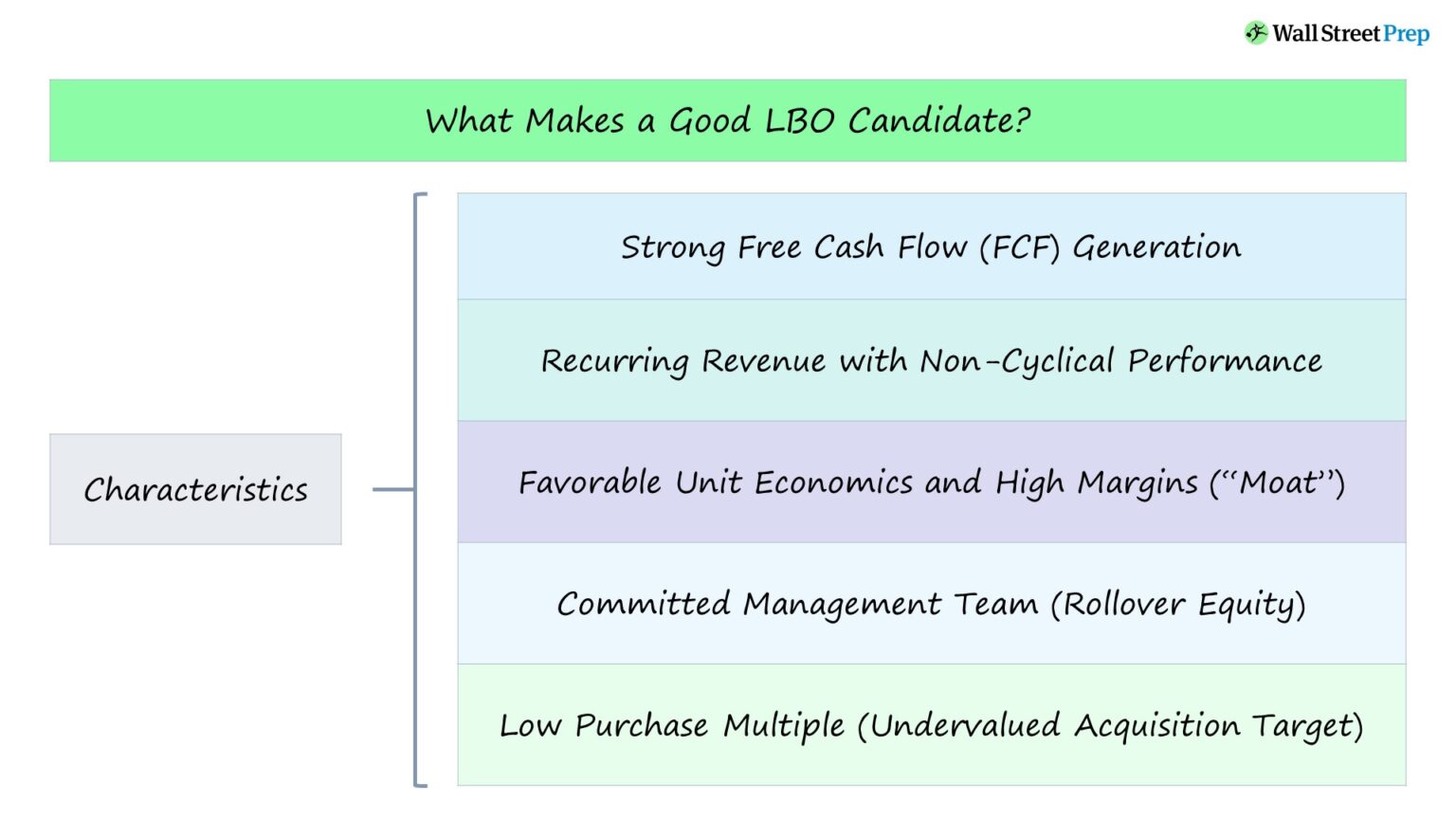
In a leveraged buyout (LBO), a private equity firm – often referred to as a “financial sponsor” – acquires a target company with a significant portion of the purchase price funded using debt.
The reliance on debt securities like loans and bonds to fund the transaction causes there to be fixed financial costs (e.g. interest expense, principal repayment). Such a transaction structure determines which type of companies are usually deemed to be “good” LBO candidates.
Before an LBO can occur, the sponsor must first secure the necessary financing commitments from financial institutions such as corporate banks and specialty lenders.
The financial sponsor must convince the lenders that the prospective LBO target is capable of handling the post-LBO debt load in order to raise the amount of financing needed to fund the transaction.
To protect their downside risk and potential for capital loss, lenders must be adequately assured that the borrower (i.e. the LBO target) is unlikely to default on its financial obligations.
One of the main LBO levers that drive returns is deleveraging – i.e. the paydown of debt during the holding period – which causes the value of the private equity firm’s equity contribution to rise in value over time as more debt principal is paid down using the free cash flows (FCFs) of the target.
The remaining funds needed to finance the transaction are contributed by the private equity firm in the form of equity.
Moreover, the less the initial capital contribution necessary by the sponsor to fund the LBO, the higher the returns – all else being equal.
Why? The cost of debt is lower than the cost of equity because debt is higher up on the capital structure in terms of priority (i.e. bankruptcy proceed distribution waterfall) and because of the “tax shield” from tax-deductible interest expense.
Therefore, sponsors attempt to finance LBOs with as much debt as possible but still within reason to avoid placing an unmanageable debt level that would put the company at a high risk of default, e.g. causing a missed interest expense payment or missed mandatory principal amortization.
Level up your career with the world’s most recognized private equity investing program. Enrollment is open for the upcoming cohort.
The standard LBO capital structure is cyclical and fluctuates substantially based on the prevailing financing environment, but there has been a structural shift from debt-to-equity ratios of 80/20 in the 1980s to a more conservative 60/40 mix in recent years.
The different debt tranches used to fund LBOs – in order of descending seniority – is shown below:
The majority of the debt raised will consist of senior, secured loans from banks and institutional investors before riskier types of debt are used.
As for the equity component, the equity contribution from the private equity firm represents the largest source of LBO equity.
In most LBOs, the existing management team remains onboard post-buyout. There are exceptions, but management wanting to rollover a portion of their equity to participate in the potential upside is perceived as a positive signal to PE investors.
The willingness of management to rollover equity is proof of their confidence in actual value creation opportunities, as pitched in the sale process of the company.
By staying on to continue running the company, the firm can also structure an earn-out, i.e. performance-based compensation contingent on meeting targets, typically on EBITDA, as an additional incentive to outperform.
For an LBO to pan out well, the management team (and their relationship with the sponsor) is critical, i.e. management is ultimately responsible for executing the strategic plan on the front lines.
Certain industries attract significantly more LBO deal flow than others – for example, industrial technology, B2B enterprise software, and healthcare services.
There are several recurring themes that make certain industries more appealing to private equity firms, such as the following:
The quality of a company's cash flows is a function of its predictability and defensibility – as well as the certainty of occurrence with minimal risks.
Private equity firms seek product or service offerings that fit their fund strategy, i.e. industry focus, firm-specific criteria, and the specific post-LBO strategies employed.
Still, certain product or service attributes are commonly found across almost all LBO targets.


No comments yet.