What is Acquisition Financing?
Acquisition Financing refers to the initial capital sources obtained to fund the purchase of a target business, (i.e. the mix of debt and equity in the capital structure).

Acquisition Financing refers to the initial capital sources obtained to fund the purchase of a target business, (i.e. the mix of debt and equity in the capital structure).
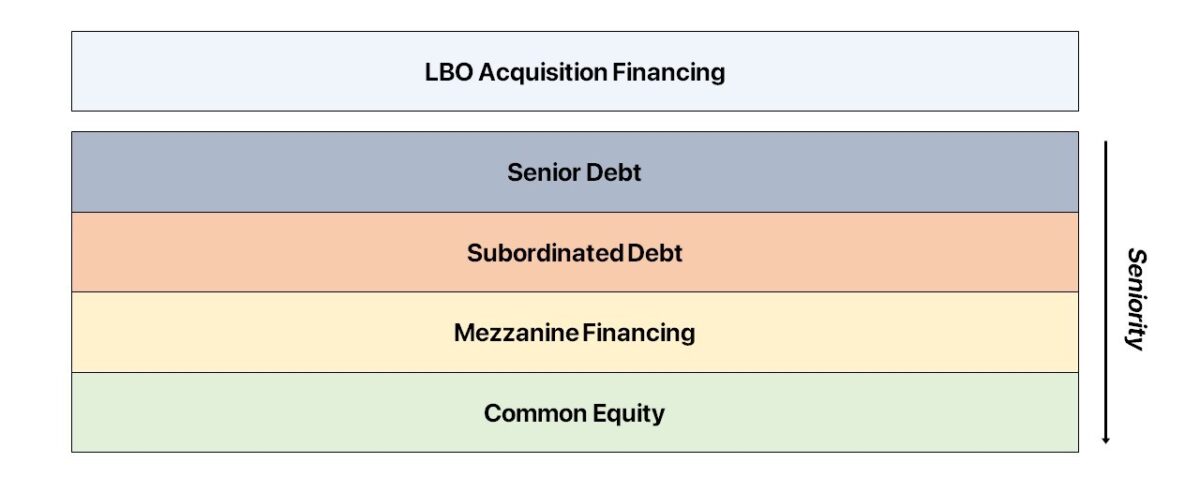
In the field of M&A, acquisition financing is the process by which an investment firm, such as a private equity firm, obtains capital to fund a merger or acquisition.
Unlike other forms of transactions, acquisition financing often requires a blend of different funding sources, including equity financing (e.g. common stock, preferred equity), debt financing (e.g. bonds, loans), and mezzanine financing (e.g. convertible debt), particularly when non-traditional lenders are engaged.
The challenge in acquisition financing boils down to securing the optimal mix of financing that minimizes the cost of capital (WACC).
Companies seeking to acquire other businesses must analyze the financing structure to ensure there is alignment with their strategic objectives (and a sufficient cushion to adapt to unforeseeable circumstances).
At its core, the term "acquisition financing" refers to obtaining capital to facilitate the purchase of another company (i.e. the subject of the acquisition).
Companies actively in pursuit of M&A focus on identifying and implementing the most efficient and optimal financing and deal structure to support their long-term strategic goals and maximize value creation.
A leveraged buyout (LBO) is a transaction where a financial sponsor – i.e. a private equity firm – purchases a business, with debt constituting a significant proportion of the acquisition financing.
Historically, the percentage of debt raised relative to the total capitalization ranged from 60% to 80% of the total purchase price. But over the course of time, the reliance on debt to achieve the target return has decreased in the private equity industry, albeit the debt component still remains a core value driver of returns in LBOs.
The participants in LBO transactions, such as private equity firms, family offices, and the lending institutions that underwrite the debt financing (e.g. corporate bank lenders, institutional investors) are nowadays more risk-averse and systematic when performing credit risk diligence.
Therefore, the capitalization of LBOs in the 1980s – wherein the traditional debt to equity ratio (D/E) typically consisted of an 80% to 20% split – has since undergone a structural shift downward to 60% to 40%.
The acquisition financing of LBOs tends to be cyclical and fluctuate based on several internal and external variables:
The “Sources and Uses of Funds” section of an LBO model outlines the total cost of the acquisition – i.e. the estimated financing required to purchase the target company, including the incurred transaction costs and financing fees – followed by the specific details regarding where the capital will be obtained.
Since the “Uses” side estimates the total amount of capital that must be raised from external financing sources (and the equity contribution by the sponsor), it should be intuitive to start here prior to the “Sources” side. As an analogy, if a buyer was interested in purchasing an item from a store, the first course of action is to determine the pricing of the item before figuring out a plan to budget and obtain enough funds to purchase the item.
If the two sides of the “Sources and Uses” table are equal, the financial sponsor (and other participants) has enough funds to proceed with the acquisition. However, obtaining the necessary capital is not enough by itself for the completion of an LBO to make sense economically.
Instead, the initial outlay of cash by the sponsor – the required equity contribution – is utilized to determine if the fund’s minimum return threshold is met, i.e. the “hurdle rate” set by the firm, which is usually about 20% under a base case scenario.
Level up your career with the world’s most recognized private equity investing program. Enrollment is open for the upcoming cohort.
The capital structure of an LBO is among the most critical return drivers because of the financial sponsor’s role of “plugging” the remaining gap in necessary funds in the form of an equity investment.
The returns earned by the financial sponsor on an LBO tend to increase if the initial equity contribution declines, all else being equal.
The implied returns on a leveraged buyout (LBO) – i.e. the internal rate of return (IRR) and the multiple on money (MoM) – are a function of the growth in the sponsor’s initial equity contribution starting from the date of purchase to the date of exit.
The top of the capital structure consists of senior debt – frequently used interchangeably with the term “bank debt” – which is most often issued by risk-averse traditional bank lenders that require the borrower to pledge collateral as part of the financing arrangement.
Senior lenders tend to possess a lien on the collateral of the borrower and are far more likely to be “made-whole” in the event of bankruptcy, so the pricing of the interest rate (%) on such debt tends to be the lowest.
In contrast, the lower the claim held in relation to the entire capital stack in terms of seniority, the higher the minimum rate of return required by the capital provider to compensate for the incremental risk undertaken. With that said, common equity is placed at the bottom of the capital structure, so the required rate of return – i.e. the cost of equity (ke) – is the highest.
The equity component of LBO acquisition financing consists of rollover equity – i.e. when the existing management team re-invests their exit proceeds post-sale into the new entity to participate in the upside of the LBO – followed by the equity investment by the financial sponsor to complete the LBO. For larger-sized LBOs, co-investors can also participate and contribute capital, which reduces the equity contribution of the primary private equity firm, which is called the "lead sponsor" in such transactions.
The formula to calculate the acquisition financing of an LBO – i.e., the total capitalization ratio (i.e. the ratio between debt and the sum of debt and equity) – is as follows.
The initial LBO debt refers to the total debt financing raised as part of the transaction, whereas the total sources of funds represents the sum of the total debt and total equity contribution.
We’ll now move on to a modeling exercise, which you can access by filling out the form below.


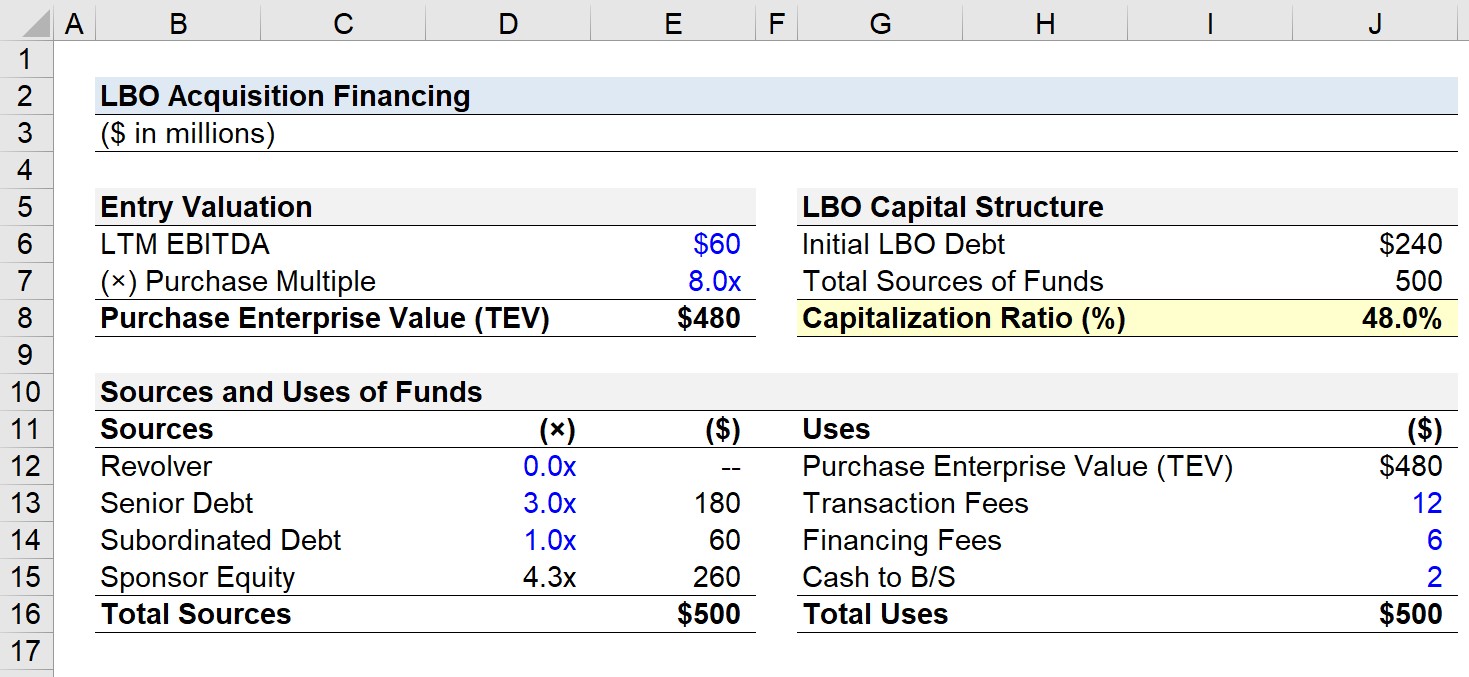
Suppose a private equity firm is interested in acquiring a company that generated $60 million in LTM EBITDA at a purchase multiple of 8.0x.
The purchase enterprise value (TEV) can be determined by multiplying the LTM EBITDA by the entry multiple, which comes out to $480 million.
On the "Uses" side of our schedule, there are three more outflows aside from the purchase price itself:
The "Total Uses" is the sum of all four parts that we have computed thus far, which amounts to $500 million.
Note: The LBO transaction is assumed to be structured on a cash-free, debt-free (CFDF) basis, i.e. the purchase price is equal to the enterprise value.
Since we've quantified the total amount of funds required in the prior section, the next step is to complete the "Sources" side of our LBO model, which summarizes the acquisition financing of the purchase.
Of the financing sources, there are three tranches of debt with the following leverage ratio assumptions on the date of initial purchase.
The revolving credit facility, or "revolver", is left undrawn on the date of initial purchase.
The senior leverage ratio is 3.0x while the subordinated debt ratio is 1.0x, so the debt raised in each tranche is $180 million and $60 million, respectively.
The total debt raised amounts to $240 million, so the remaining capital necessary – the total uses of funds minus the sum of debt raised – is the implied equity contribution from the sponsor, which comes out to $260 million.
Once acquired, the free cash flows (FCFs) generated by the post-LBO company (i.e. the “portfolio company”) are used to meet the payments on the debt raised as part of funding the transaction, which is formally referred to as “deleveraging”.
In the final part of our exercise, we'll calculate the capitalization ratio based on the values derived from the "Sources and Uses" section of our LBO model.
The initial LBO debt is $240 million, whereas the total sources of funds is $500 million.
Thus, the capitalization ratio of our hypothetical LBO – the initial acquisition financing attributable to debt, expressed as a percentage – is 48.0%.


No comments yet.