What is Enterprise Value?
The Enterprise Value (TEV) is the value of a company’s operations to all stakeholders, such as common equity shareholders, preferred stockholders, and lenders of debt capital.

The Enterprise Value (TEV) is the value of a company’s operations to all stakeholders, such as common equity shareholders, preferred stockholders, and lenders of debt capital.

The enterprise value measures the value of a company’s operations to all stakeholders, including equity and debt capital providers. Hence, the enterprise value is considered a capital structure-neutral metric.
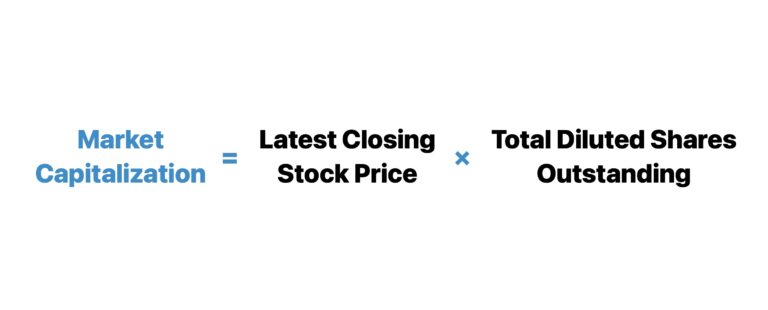
Unlike the equity value metric, often used interchangeably with the term market capitalization (or "market cap") – the enterprise value is unaffected by the discretionary financing decisions of the management team.
In effect, enterprise value reflects the value of the core operations of a business, irrespective of its capitalization (i.e. financing mix), which facilitates more accurate comparisons between companies due to being independent of their different capital structures.
Conceptually, enterprise value quantifies how much the core operating business is worth (i.e. operating assets minus operating liabilities) to all stakeholders.
For instance, if a company’s debt-to-equity ratio (D/E) increased after raising more debt capital, its enterprise value should theoretically remain unchanged – despite some minor impacts on the company's financial statements.
The steps to calculate enterprise value are as follows.
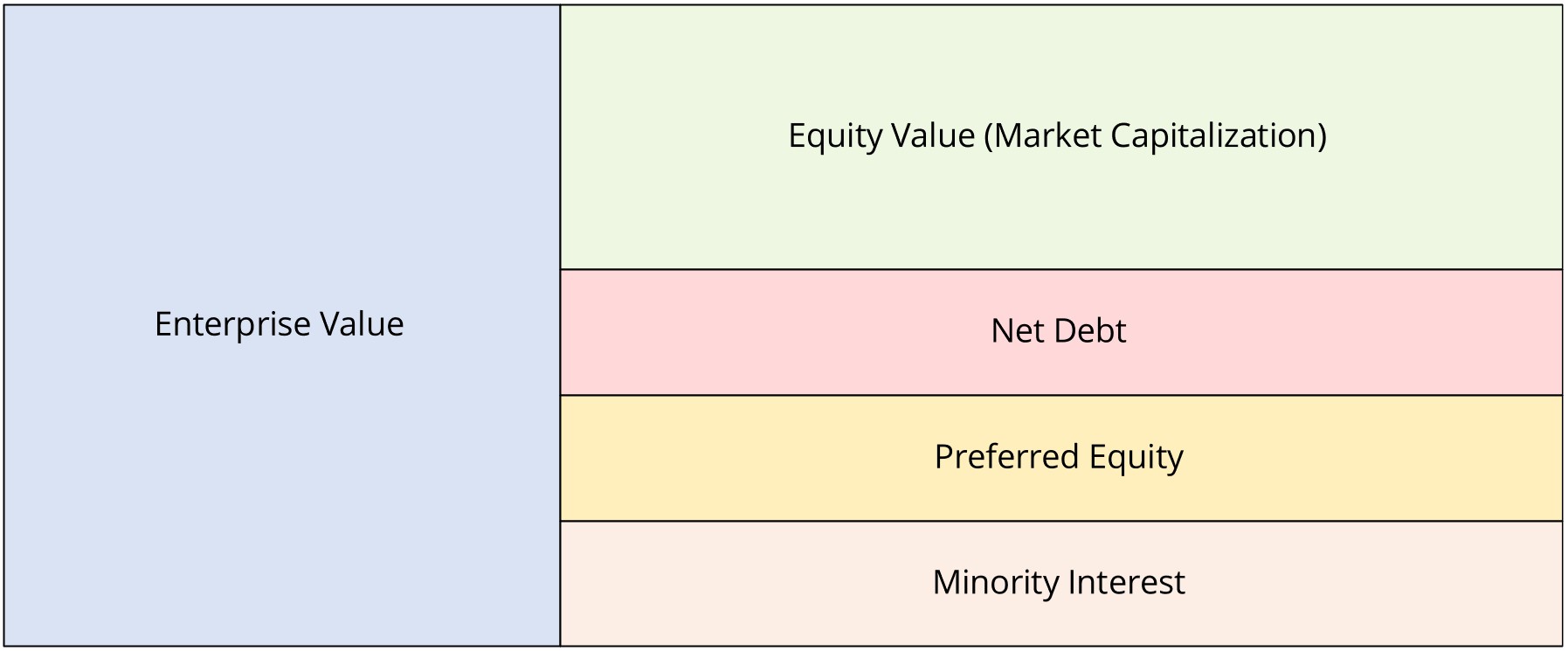
The formula to calculate enterprise value is equal to the sum of equity value and net debt, followed by adding back any other non-equity claims like preferred stock and minority interest.
Where:
So, why is cash subtracted from enterprise value?
The rationale behind incorporating net debt rather than gross debt is that the cash sitting on a company’s balance sheet could hypothetically be used to pay down outstanding debt if deemed necessary.
To calculate equity value from TEV, the reverse calculation should be performed, in which net debt is first subtracted, and then all non-common equity claims are deducted (i.e. removing the claims of preferred shareholders).
The image below illustrates the relationship between enterprise value and equity value (i.e. “market cap”).
One of the most common valuation multiples is the TEV/EBITDA multiple, which compares the total value of a company’s operations (EV) relative to its EBITDA.
With that said, EBITDA in valuation multiples is particularly useful for capital-intensive companies, where significant capital is allocated to the purchase of fixed assets.
Given how D&A is a direct function of a company’s capital expenditures, companies with asset-heavy business models are susceptible to periodic fluctuations in performance that can skew GAAP financial results.
The TEV/EBITDA multiple answers the following question: “For each dollar of EBITDA generated, how much are the company’s investors currently willing to pay?”
To compute a company’s enterprise value (TEV) using the TEV/EBITDA multiple, the company’s EBITDA is multiplied by the EBITDA multiple to arrive at the implied valuation.
Because of the fact enterprise value is capital structure neutral, the metric is the most widely used measure of value in relative valuation, in which TEV-based multiples are used far more frequently in practice than equity value multiples – especially in the context of M&A.
The most common enterprise value-based multiples are the following:
Like the numerator, the denominator (e.g. EBITDA, EBIT) also represents all stakeholders in a company, as opposed to a single stakeholder group like in the case of net income – whereas TEV/Net Income is not a viable valuation multiple due to the mismatch in the applicable investor groups.
Along the same lines, the enterprise value corresponds to the weighted average cost of capital (WACC), which is the weighted discount rate (i.e. hurdle rate), with all capital providers in mind.
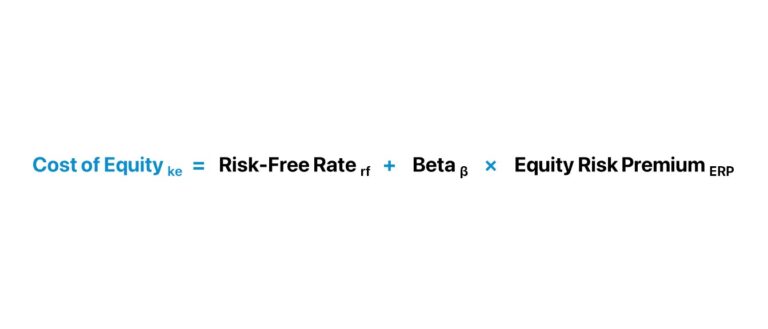
In contrast, the cost of equity is the appropriate discount rate when calculating the equity value.
The key takeaway is that the equity value of a company is the residual value left for common shareholders, while the enterprise value represents all capital contributors.
If a company has a negative enterprise value, that means the company has a net cash balance (i.e. the total cash minus the total debt) that exceeds its equity value. While a company with a negative enterprise value is an irregular occurrence, it can occasionally occur.
We’ll now move on to a modeling exercise, which you can access by filling out the form below.


Suppose we’re looking at three different companies with identical share prices as well as share counts.
With those two assumptions stated, we can calculate that the equity value of all three companies is $10 billion.
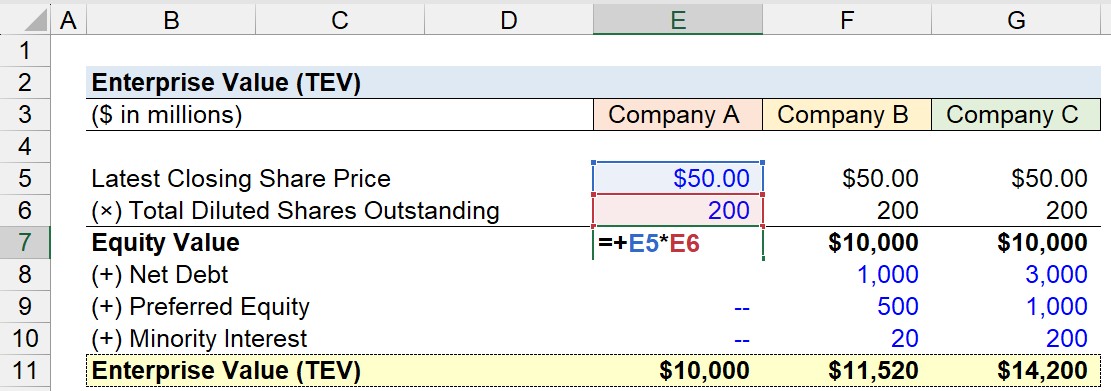
In the prior step, we calculated the equity value, so we now just need the remaining assumptions to calculate the enterprise value of each company.
Company A Financials
Company B Financials
Company C Financials
Given the assumptions above, the pattern to note is how the company's capital structure becomes increasingly complex, from Company A to Company C.
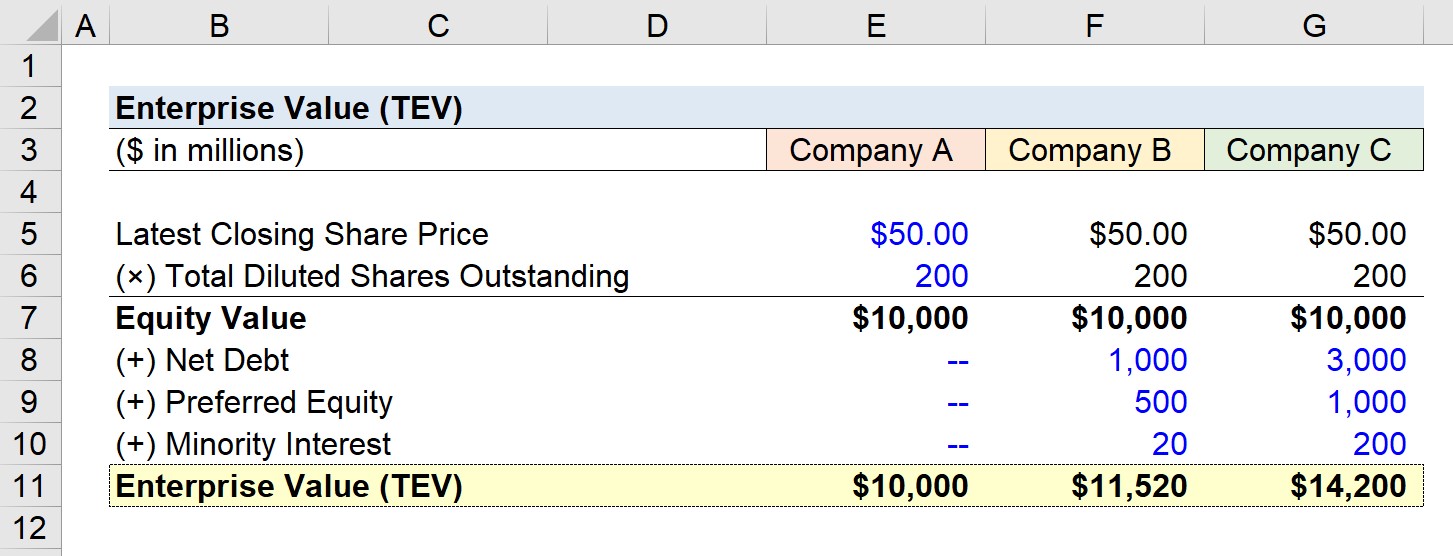
In the case of Company A, since all three assumptions regarding the non-common equity claims are zero, the enterprise value is equivalent to the equity value, i.e. Company A is an all-equity firm.
With all the necessary data listed, we can input each assumption into our model and calculate the enterprise value for each company, as shown below.
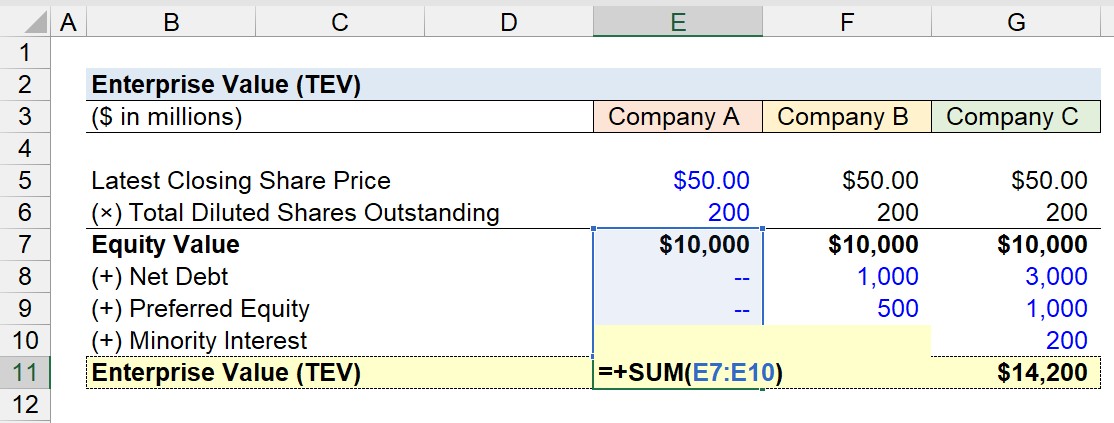
The implied enterprise value for the three companies is as follows:
Our three hypothetical companies, despite having the same equity value, have very different operating values (i.e. enterprise values).
More specifically, the value of Company C's core operating business is $4.2bn greater than Company A's.
Compared to the equity value, the enterprise value (EV) is closer to the real value of a company, since the valuation metric accounts for all ownership stakes, rather than just equity owners.
At this point, a common misunderstanding occurs: Students will look at the spreadsheet above and may ask themselves: “Why does adding debt or preferred equity increase a company's enterprise value?”
The short answer is that the addition of debt or preferred equity does not increase enterprise value, contrary to a frequent misconception.
By raising capital via debt financing, the company also brings cash onto the books, meaning the net debt remains the same if all that a company has done is take on more debt.

Enroll in The Premium Package: Learn Financial Statement Modeling, DCF, M&A, LBO and Comps. The same training program used at top investment banks.


No comments yet.