Market Value
Step-by-Step Guide to Understanding Market Value of Equity (MVE)
How to Calculate Market Value of Equity
The market value, or “market capitalization”, is the fair value of a public company’s common equity, which can be expressed as a standalone metric or on a per-share basis.
The market value of an underlying asset—the shares issued by a publicly traded company that represents partial ownership in the issuer’s common equity—depicts not only the general perception by the financial markets of how much each share is worth but also the actual prices paid.
That said, the share price of a company is ultimately set by market participants who engage in transactions in the open markets.
Thus, the market value per share fluctuates based on the current conditions and certain forward-looking factors, such as investor sentiment regarding the company’s outlook, the developing industry or secular trends of relevance, and the market’s perception of company fundamentals (e.g. profit margins, growth prospects, risk profile).
External factors like current market conditions and the economic outlook (e.g. fear of recession, Fed interest rate policy predictions) can also cause a company’s share price to fluctuate, which are out of the direct control of the company.
Current share prices can be readily observed in real-time via market data resources and news outlets such as Bloomberg, the Wall Street Journal (WSJ), and CNBC.
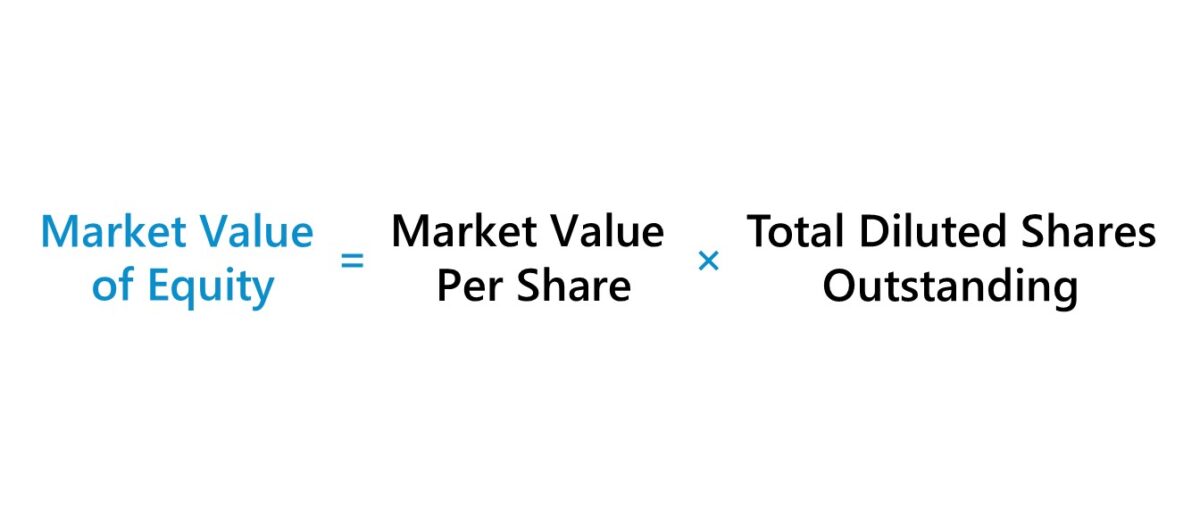
The formula to calculate the market value of equity is the market value per share multiplied by the total number of diluted shares outstanding.
Market Value of Equity = Market Value Per Share × Total Diluted Shares Outstanding
When calculating the market cap, the common share count should be determined on a fully diluted basis, which refers to the inclusion of the effects of potentially dilutive securities like options, warrants, and convertible debt instruments.
In practice, the treasury stock method (TSM) is used to estimate the fully diluted share count.
The market value per share can be derived by rearranging the formula.
The market value per share, or equity value per share, is equal to the market capitalization divided by the total number of diluted shares outstanding.
Market Value Per Share = Market Capitalization ÷ Total Diluted Shares Outstanding
In short, the market value per share reflects the stock price of a company at present.
What is a Good Market Value?
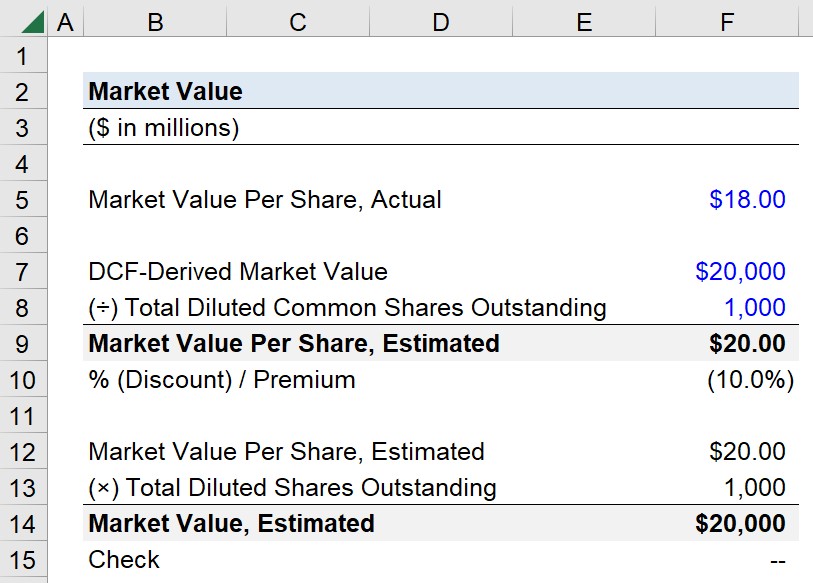
One common use case for manually calculating the market value per share would be if the market capitalization were also calculated manually in a discounted cash flow model (DCF), as opposed to pulling the figure directly from a third-party resource.
The calculated market value per share can be compared to the actual share price to determine whether the company’s shares are currently undervalued, overvalued, or priced fairly by the market.
- Implied Share Price > Market Share Price ➝ Undervalued
- Implied Share Price < Market Share Price ➝ Overvalued
- Implied Share Price = Market Share Price ➝ Fairly Valued





No comments yet.