What are Assets?
Assets are resources with positive economic value that can either be sold for money if liquidated or be used to generate future monetary benefits.

Assets are resources with positive economic value that can either be sold for money if liquidated or be used to generate future monetary benefits.
Assets are resources containing economic value or can be used to produce future benefits, such as generating revenue on behalf of the company on a later date.
The assets section is one of the three components of the balance sheet, and consists of line items representing positive economic benefits.
The assets section of the balance sheet is separated into two components:
On the balance sheet, the assets section is ordered on the basis of how quickly each item can be liquidated. Hence, "Cash and Cash Equivalents" is the first line item listed on the current assets section.
Current assets are often called short-term assets, since most are liquid and expected to be converted into cash within one fiscal year (i.e. twelve months).
Generally, the current assets of a company are the working capital required by a company for its daily operations (e.g. accounts receivable, inventory).
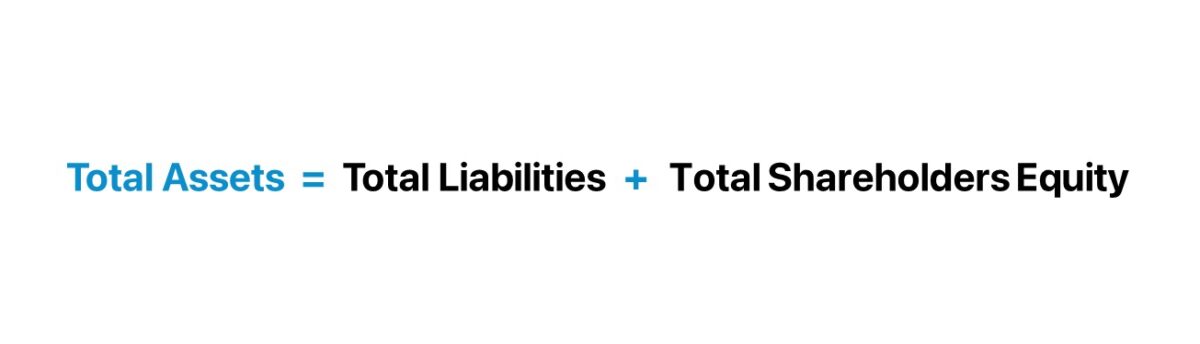
The fundamental accounting equation expresses the relationship between assets, liabilities, and shareholders' equity.
That accounting equation, or "balance sheet equation", states that the assets will always be equal to the sum of the liabilities and equity.
Conceptually, the formula indicates that a company's purchase of assets is financed with either:
The assets section comprises items considered cash outflows ("uses"), and the liabilities section is deemed cash inflows ("sources").
The following table inserted below elaborates on the common types of current assets found on the balance sheet.
| Current Assets | Description |
|---|---|
| Cash and Cash Equivalents |
|
| Accounts Receivable (A/R) |
|
| Inventory |
|
| Prepaid Expenses |
|
The non-current assets section includes the long-term investments of the company, whose potential benefits will not be realized in a single year.
Unlike current assets, non-current assets tend to be illiquid, which means these types of assets cannot easily be sold and converted into cash in the market.
But rather, non-current assets provide benefits for more than one year.
Therefore, long-term assets – namely fixed assets (or "PP&E") and certain intangible assets – are capitalized and expensed on the income statement across their useful life assumption.
If an asset can be physically touched, it is classified as a "tangible" asset (e.g. PP&E, inventory).
But if the asset has no physical form and cannot be touched, it is considered an "intangible" asset (e.g. patents, branding, copyrights, customer lists).
The chart below lists examples of non-current assets on the balance sheet.
| Non-Current Assets | Description |
|---|---|
| Property, Plant & Equipment (PP&E) |
|
| Intangible Assets |
|
| Goodwill |
|
There is one final distinction to be aware of, which is the classification between operating and non-operating assets.
The operating assets belonging to a company play an integral role in the core financial performance.
For example, the machinery and equipment owned by a manufacturing company would be considered "operating" assets.
Conversely, if the manufacturing company invested some of its cash in short-term investments and marketable securities (i.e. public market stocks), such assets would be considered "non-operating" assets.
When conducting diligence on a company to arrive at an implied valuation, it is standard to evaluate the performance of operating assets to isolate the company's core operations.
Enroll in The Premium Package: Learn Financial Statement Modeling, DCF, M&A, LBO and Comps. The same training program used at top investment banks.


No comments yet.