What is a Certificate of Deposit?
A Certificate of Deposit (CD) offers higher interest rates than traditional savings accounts in exchange for restricting the access to the funds.

A Certificate of Deposit (CD) offers higher interest rates than traditional savings accounts in exchange for restricting the access to the funds.
A certificate of deposit (CD) is a type of savings account that offers a predetermined interest rate in exchange for the saver not requesting the funds back for a fixed period of time.
Most often, a certificate of deposit (CD) is issued by financial institutions like commercial banks and credit unions, with either physical or electronic paperwork stating the specific terms:
The deposited funds must be kept in the account for the full allotted time. Past the maturity date, the funds can be withdrawn without incurring fees.
CDs can range widely in length – from a couple of months to ten years – but the typical term tends to be around three to five years.
The deposit is expected to remain in the possession of the financial institution for the entire term, and early withdrawal can result in additional fees.
From the initial deposit date until maturity, the funds must be kept in the account in order to earn the total expected interest.
Compared to the interest rate earned on traditional bank accounts, the interest rate earned on a certificate of deposit (CD) is higher, which is the primary appeal of CDs.
However, the interest rate is higher because of the constraints placed on the funds deposited, i.e. that the funds will not be withdrawn for a set period of time.
While there are certain CD accounts with adjusting rates, most pay fixed interest which can provide a consistent, predictable source of income.
If the funds are withdrawn before the stated maturity date, the issuer typically charges a fee to penalize the early withdrawal.
Early withdrawal fees can be avoided by opting for a no-penalty certificate of deposit (CD), but the interest rate for such instruments is lower, as one might reasonably expect.
CDs are primarily intended for risk-averse investors seeking a safe investment with returns above that of standard savings accounts but lower than riskier options such as stocks and bonds.
Established by the Federal Open Market Committee (FOMC), which meets eight times per year to set a target interest rate, the federal funds rate has broad implications on the pricing of such financial products.
The interest rate on a CD does not track the federal funds rate precisely, but it is impacted by broader rate changes – so if the federal funds rate rises, the rate of CDs also rises (and vice versa).
Other than the federal funds rate, the following factors can influence the rate on a certificate of deposit (CD).
The longer the duration of the deposit term and the larger the deposit size, the higher the interest rate.
The minimum deposit amount tends to be substantially higher for high-yield CD accounts – moreover, the higher the stated fees for early withdrawals, the higher the interest rate.
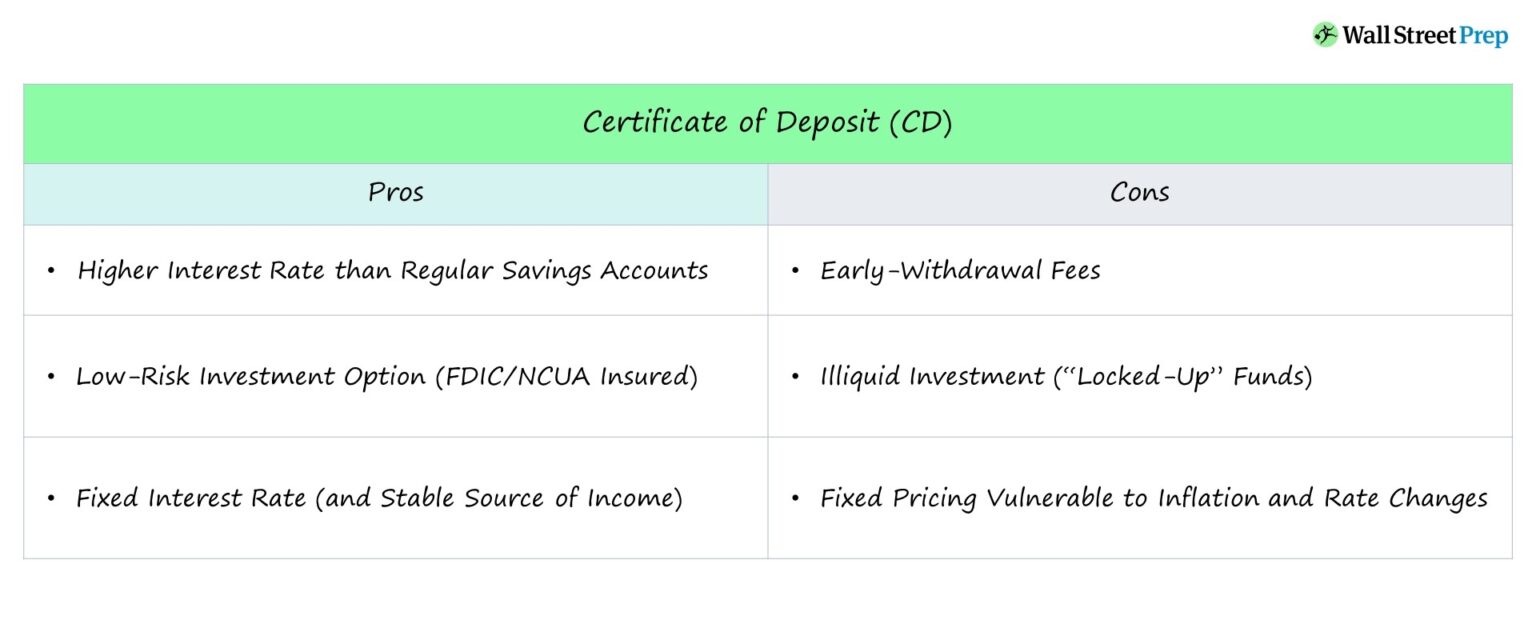
The advantages of a certificate of deposit (CD) are the following:
On the other hand, the drawbacks to CDs are the following:

Enroll in The Premium Package: Learn Financial Statement Modeling, DCF, M&A, LBO and Comps. The same training program used at top investment banks.


No comments yet.