What is Tangible Book Value?
The Tangible Book Value (TBV) represents the value of a company’s tangible assets, net of any intangible assets such as goodwill.

The Tangible Book Value (TBV) represents the value of a company’s tangible assets, net of any intangible assets such as goodwill.
The tangible book value (TBV) measures how much a company’s tangible assets are worth, excluding its intangible assets.
Conceptually, the tangible book value (TBV) is the residual net value of a company that belongs to common shareholders post-liquidation, i.e. the remaining value once all outstanding liabilities like debt are repaid.
Intangible assets are excluded from the tangible book value calculation because such assets cannot be liquidated and sold off.
For instance, an intangible asset like goodwill is recognized on a company’s balance sheet for accounting purposes to capture the excess purchase price paid over the fair market value (FMV) of an asset.
Since only tangible assets are included in the calculation, the TBV is a closer estimate of the value of a company if it were to hypothetically file for bankruptcy and undergo a liquidation.
However, TBV is still an approximation rather than the actual value of a liquidated company, since certain intangible assets can still in fact be sold and the liquidation value of tangible assets is rarely perfectly equal to the full value recorded on the books.
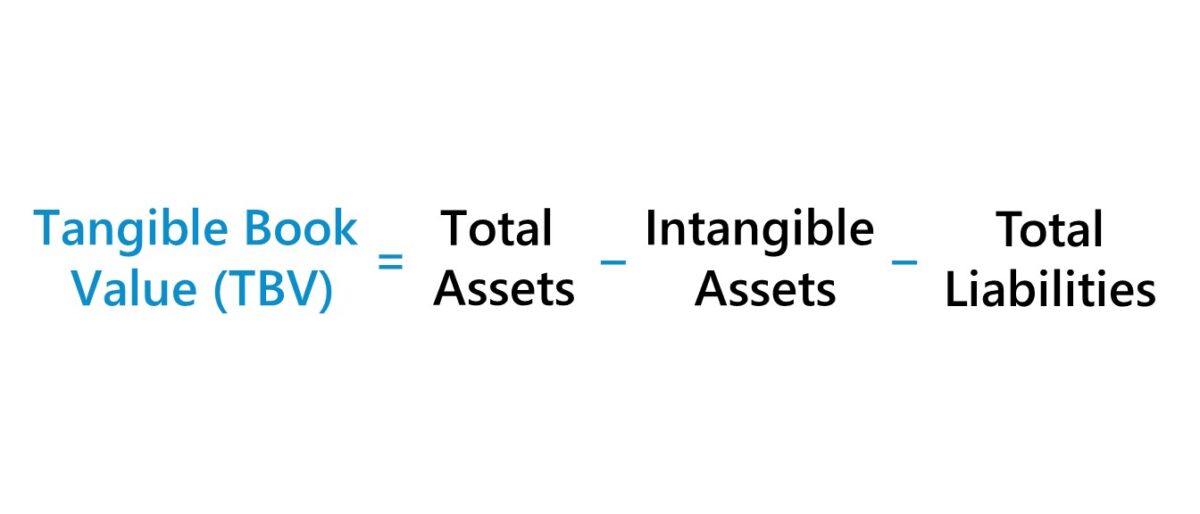
The formula to calculate the tangible book value (TBV) is as follows.
The first part of the equation – i.e. total assets minus intangible assets – results in the value of a company’s tangible assets.
The value of all outstanding liabilities is then deducted from the value of the company's tangible assets because claims such as debt and accounts payable are of higher priority and must be fulfilled before any proceeds can be distributed to common equity shareholders.
We’ll now move on to a modeling exercise, which you can access by filling out the form below.

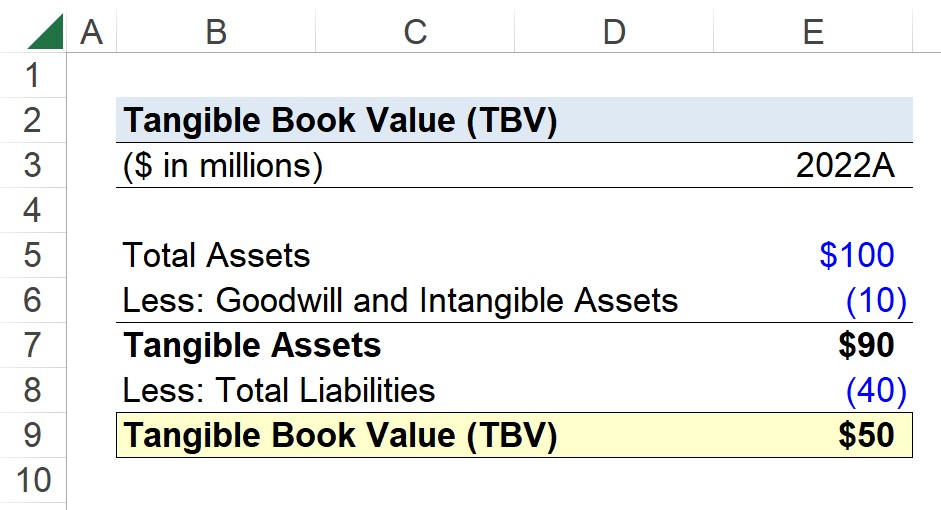
Suppose you’re tasked with calculating the tangible book value (TBV) of a company with the following balance sheet data.
To start, we’ll deduct goodwill and intangible assets from total assets, which results in $90 million of tangible assets.
From there, the next step is to net the company’s tangible assets against its total liabilities.
In conclusion, the tangible book value (TBV) of our hypothetical company is $50 million.

Enroll in The Premium Package: Learn Financial Statement Modeling, DCF, M&A, LBO and Comps. The same training program used at top investment banks.


No comments yet.