What is Payables vs. Receivables?
Payables represents a company’s unmet payment obligations to suppliers/vendors, whereas receivables refers to the cash owed from customers for products and services already delivered.

Payables represents a company’s unmet payment obligations to suppliers/vendors, whereas receivables refers to the cash owed from customers for products and services already delivered.
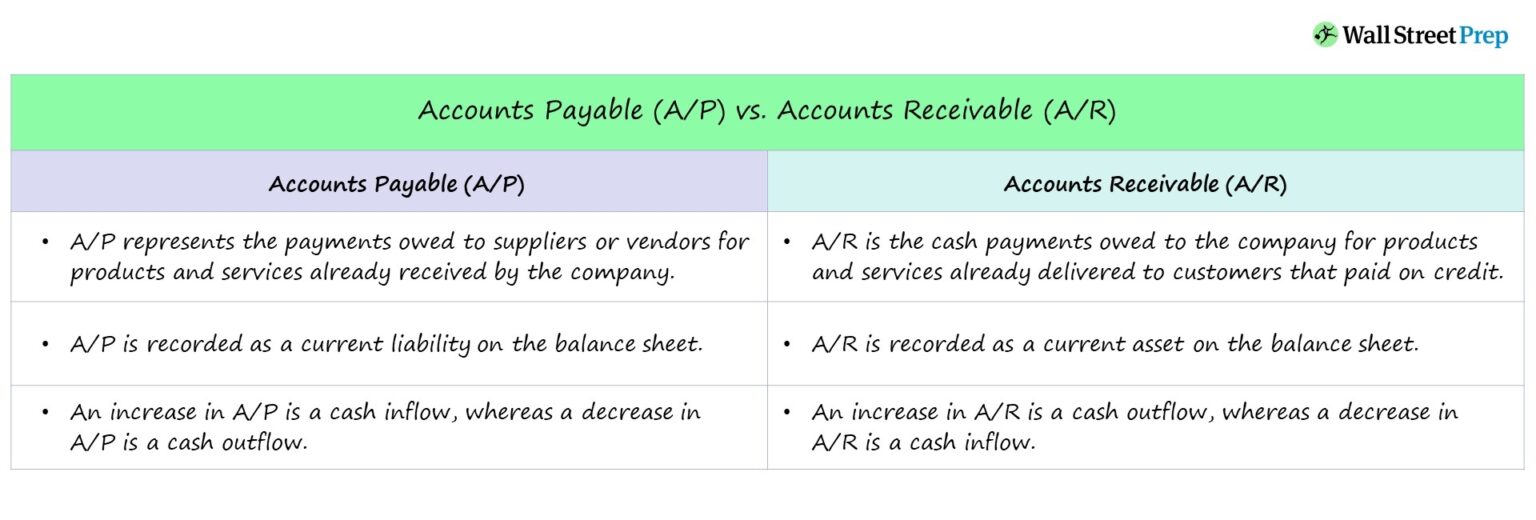
Briefly, the definitions of the two terms, payables and receivables, are as follows:
For bookkeeping purposes, both payables and receivables represent key working capital line items:
By tracking A/P and A/P, a company can monitor the amount of money it currently owes to suppliers/vendors and how much is owed to them from its customers.
Under accrual accounting, supplier/vendor bills are recorded on the income statement once the invoice is sent to the company, even if the company has not yet paid in cash.
The unpaid obligations are recorded in the accounts payable line item on the balance sheet.
Similarly, for revenue recognition under accrual accounting, sales are recognized once products/services are delivered (i.e. "earned").
If the customer does not pay upfront with cash, the non-cash portion of the revenue is captured as accounts receivable on the balance sheet until cash payment is ultimately received.
As for the differences between accounts payable and accounts receivable, the former is recorded as a current liability while the latter is categorized as a current asset on the balance sheet.
While accounts payable represents payment obligations that must be met (i.e. future cash outflows), accounts receivable refers to cash payments not yet received from customers that paid on credit (i.e. future cash inflows).
In other words, accounts payable represents a future economic cost to the company, but A/R represents a future economic benefit to the company.
Unique to accounts receivable, A/R can also be offset by an allowance for doubtful accounts, which represents the amount of A/R deemed unlikely to be recovered (i.e. customers who may never pay).
If a company's accounts receivable balance increases, more customers must have paid on credit, so more cash collections must be made in the future.
But if a company's A/R balance decreases, then customers that previously paid on credit have fulfilled their end of the transaction by completing the cash payment.
Delayed payments from customers can cause the accounts receivables on the balance sheet to increase.
For accounts payable, an increase in A/P means that more payments to suppliers/vendors were made on credit; thus, more future cash is owed.
From the perspective of companies attempting to maximize their free cash flow (FCF), the objective is typically to extend payables and reduce receivables as much as possible – as doing so implies delayed supplier/vendor payments and efficient collection of cash from customers for credit purchases.
| Payables | Receivables |
|---|---|
|
|
|
|
To summarize, a company's balance sheet lists accounts payable (A/P) in the short-term liabilities section since it represents future unmet obligations for purchases from suppliers/vendors.
On the other hand, accounts receivable (A/R) is listed in the current assets section as it refers to the cash payments that a company expects to receive from customers.

Enroll in The Premium Package: Learn Financial Statement Modeling, DCF, M&A, LBO and Comps. The same training program used at top investment banks.


No comments yet.