What is Allowance for Doubtful Accounts?
The Allowance for Doubtful Accounts is a contra-asset account that estimates the future losses incurred from uncollectible accounts receivable (A/R).

The Allowance for Doubtful Accounts is a contra-asset account that estimates the future losses incurred from uncollectible accounts receivable (A/R).

The allowance for doubtful accounts (or the “bad debt” reserve) appears on the balance sheet to anticipate credit sales where the customer cannot fulfill their payment obligations.
Credit sales all come with some degree of risk that the customer might not hold up their end of the transaction (i.e. when cash payments left unmet).
In accordance with GAAP revenue recognition policies, the company must still record credit sales (i.e. not cash) as revenue on the income statement and accounts receivable on the balance sheet.
The allowance for doubtful accounts is then used to approximate the percentage of "uncollectible" accounts receivable (A/R).
The allowance for doubtful accounts is management’s objective estimate of their company’s receivables that are unlikely to be paid by customers.
On the balance sheet, an allowance for doubtful accounts is considered a “contra-asset” because an increase reduces the accounts receivable (A/R) account.
The allowance reserve is set in the period in which the revenue was "earned," but the estimation occurs before the actual transactions and customers can be identified.
The actual payment behavior of customers, or lack thereof, can differ from management estimates, but management's predictions should improve over time as more data is collected.
GAAP allows for this provision to mitigate the risk of volatility in share price movements caused by sudden changes on the balance sheet, which is the A/R balance in this context.
The projected bad debt expense is matched to the same period as the sale itself so that a more accurate portrayal of revenue and expenses is recorded on financial statements.
In effect, the allowance for doubtful accounts leads to the A/R balance recorded on the balance sheet to reflect a value closer to reality.
Otherwise, it could be misleading to investors who might falsely assume the entire A/R balance recorded will eventually be received in cash (i.e. bad debt expense acts as a "cushion" for losses).
The allowance method estimates the “bad debt” expense near the end of a period and relies on adjusting entries to write off certain customer accounts determined as uncollectable.
The most prevalent approach — called the "percent of sales method" — uses a pre-determined percentage of total sales assumption to forecast the uncollectible credit sales.
Management projects the amount of bad debt by referencing historical data such as the following:
The journal entries for recording the uncollectible A/R are as follows:
Note that the accounts receivable (A/R) account is NOT credited, but rather the allowance account for doubtful accounts, which indirectly reduces A/R.
Most balance sheets report them separately by showing the gross A/R balance and then subtracting the allowance for doubtful accounts balance, resulting in the “Accounts Receivable, net” line item.
"The allowance for doubtful accounts reflects our best estimate of probable losses inherent in the accounts receivable balance. We determine the allowance based on known troubled accounts, historical experience, and other currently available evidence"
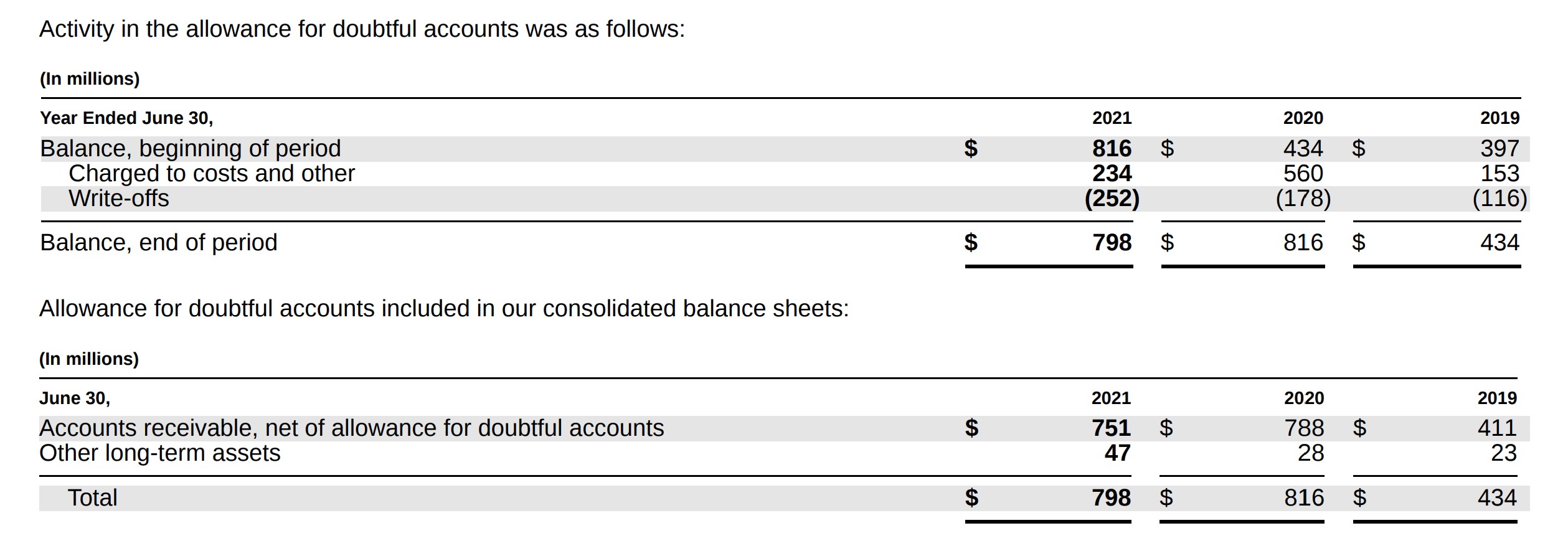
Allowance for Doubtful Accounts Schedule (Source: MSFT 10-K)
The write-off method violates the matching principle under U.S. GAAP since the expense is recognized in a different period as when the revenue was earned.
Moreover, using the direct write-off method is prohibited for reporting purposes if the company’s business model is characterized by a significant amount of credit sales (i.e. paid on credit) with large A/R balances.
But if the company’s total revenue is primarily from cash sales rather than credit sales, and the receivables balance is minimal — the company could potentially opt to use the direct write-off method when calculating the expense pending approval.
Suppose a company generated $1 million of credit sales in Year 1 but projects that 5% of those sales are very likely to be uncollectible based on historical experience.
Given the $50,000 of projected bad debts, the accounting journal entries at the end of Year 1 are as follows:
| Adjusting Entry | Debit | Credit |
|---|---|---|
| Bad Debt Expense | $50,000 | |
| Allowance for Doubtful Accounts | $50,000 |
The bad debt expense is entered as a debit to increase the expense, whereas the allowance for doubtful accounts is a credit to increase the contra-asset balance.
As companies report their financial statements near the end of the fiscal period, adjusting entries are necessary to arrive at the "Accounts Receivable, net" balance and recognize a “Bad Debt” expense in the corresponding period.

Enroll in The Premium Package: Learn Financial Statement Modeling, DCF, M&A, LBO and Comps. The same training program used at top investment banks.


No comments yet.