What is Contra Account?
A Contra Account carries a balance (i.e. debit or credit) that offsets the normal account, thereby reducing the paired account’s value.

A Contra Account carries a balance (i.e. debit or credit) that offsets the normal account, thereby reducing the paired account’s value.
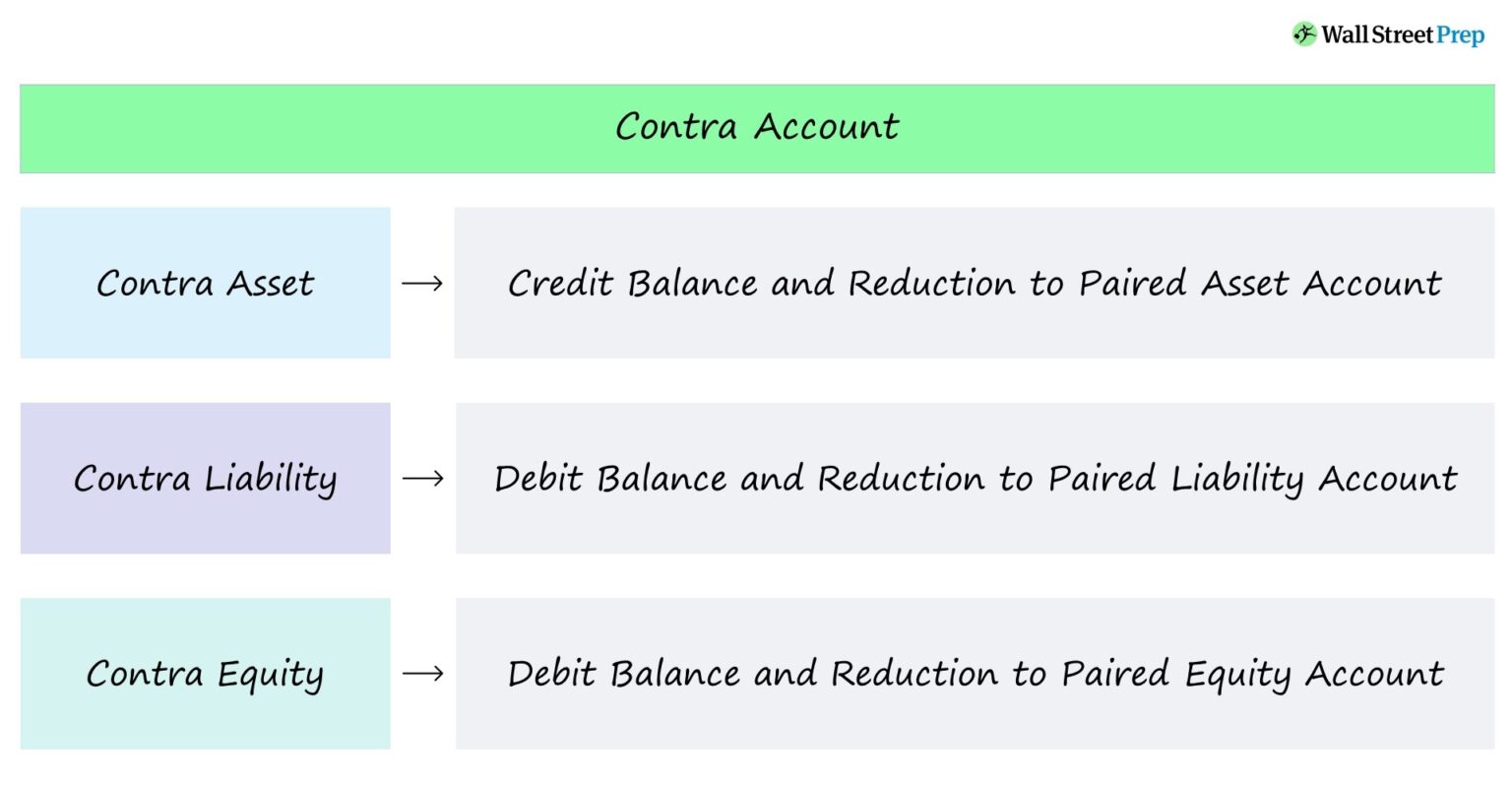
A contra account is an entry on the general ledger with a balance contrary to the normal balance for that categorization (i.e. asset, liability, or equity).
The normal balances and impact on the carrying value are as follows:
By contrast, contra accounts have the following balances and impact on an account's carrying value:
A contra account enables a company to report the original amount while also reporting the appropriate downward adjustment.
For example, accumulated depreciation is a contra asset that reduces the value of a company's fixed assets, resulting in net assets.
On a company's financial statements, the two items – the contra account and paired account – are often presented on a "net" basis:
Still, the dollar amounts are separately broken out in the supplementary sections most of the time for greater transparency in financial reporting.
The net amount – i.e. the difference between the account balance post-adjustment of the contra account balance – represents the book value shown on the balance sheet.
For instance, under U.S. GAAP, the allowance for doubtful accounts represents management’s estimate of the percentage of "uncollectible" accounts receivable (i.e. the credit purchases from customers that are not expected to be paid).
The allowance for doubtful accounts – often called a "bad debt reserve" – would be considered a contra asset since it causes the accounts receivable (A/R) balance to decline.
Hence, the "Accounts Receivable, net" line item on the balance sheet adjusts for the allowance to display a more realistic value of A/R and the cash payments to be received, so investors are not misled or caught off guard by sudden decreases in a company's A/R.
| Journal Entry | Debit | Credit |
|---|---|---|
| Accounts Receivable Account | $100,000 | |
| Allowance for Doubtful Accounts | $10,000 |
Accounts receivable (A/R) has a debit balance, but the allowance for doubtful accounts carries a credit
balance.
We can see how the $10,000 allowance for doubtful accounts offsets the $100,000 A/R account from our illustrative example above (i.e. the account decreases the carrying value of A/R).
On the balance sheet, the "Accounts Receivable, net" balance would be $90,000.
There are three distinct contra-accounts, as shown in the table below.
| Contra Asset |
|
| Contra Liability |
|
| Contra Equity |
|
The most common examples of contra-accounts are the following:
| Contra Asset |
|
| Contra Liability |
|
| Contra Equity |
|
Another type of contra account is known as "contra revenue," which is used to adjust gross revenue to calculate net revenue, i.e. the "final" revenue figure listed on the income statement.
Contra revenue generally carries a debit balance, rather than the credit balance seen in normal revenue.
The most common contra revenue accounts are the following:

Enroll in The Premium Package: Learn Financial Statement Modeling, DCF, M&A, LBO and Comps. The same training program used at top investment banks.


Very useful in real-life working. In fact, things we learned from text book, usually do not broadly explain and make us understand how to apply, posting, step by step up to the destination. These help us much to understand better ways. Let’s have a try to learn something more from here.
Thanks, Ronjon, glad to hear it was helpful!
BB