What is Depreciable Cost?
The Depreciable Cost is the cost basis of the depreciation expense following a capital expenditure (Capex).

The Depreciable Cost is the cost basis of the depreciation expense following a capital expenditure (Capex).
The depreciable cost of a fixed asset represents the total value of the asset that can be depreciated over its useful life assumption.
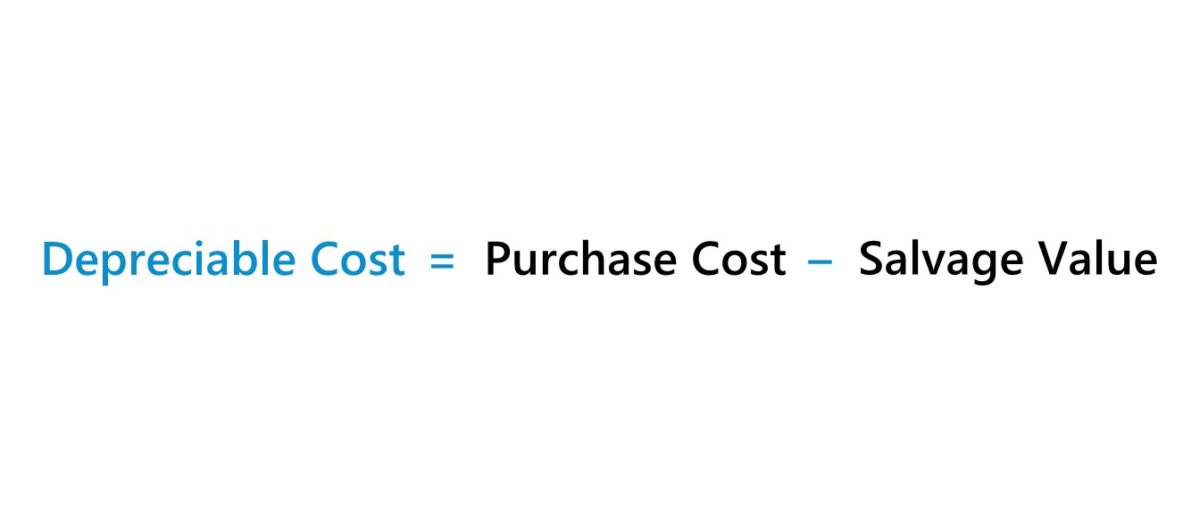
The depreciable cost can be calculated as the purchase cost of the fixed asset minus its salvage value assumption.
All else being equal, a higher depreciable cost coupled with a shorter useful life assumption and lower salvage value contribute towards a greater annual depreciation expense being recognized on the income statement.
The formula to calculate the depreciable cost is as follows.
Assuming the straight-line depreciation method (i.e. the equal allocation of the capital expenditure across its useful life), the depreciation expense is equal to the depreciable cost multiplied by the depreciation rate (%).
We’ll now move on to a modeling exercise, which you can access by filling out the form below.

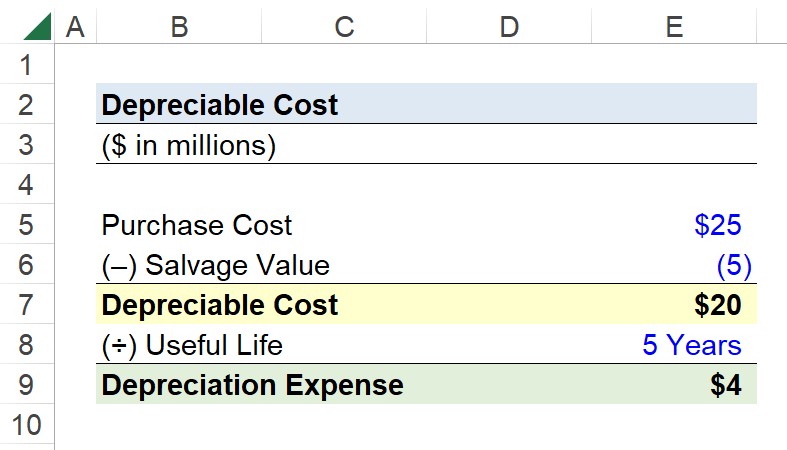
Suppose you're tasked with calculating the depreciable cost of a fixed asset that was purchased for $25 million.
The salvage value of the fixed asset is assumed to be $5 million, while its useful life assumption is 5 years.
The depreciable cost is the difference between the purchase cost and salvage value, which comes out to $20 million.
With the depreciable cost determined, we can divide it by the useful life assumption to arrive at an annual depreciation expense of $4 million under the straight-line method.

Enroll in The Premium Package: Learn Financial Statement Modeling, DCF, M&A, LBO and Comps. The same training program used at top investment banks.


No comments yet.