A Prospectus is a formal document filed with the Securities and Exchange Commission (SEC) by companies intending to raise capital by offering securities to the public.
How Does a Prospectus Work in Finance?
The prospectus filing, often used interchangeably with the term “S-1”, contains all the necessary details about a public company’s proposed offering in order to help investors make an informed investment decision.
The prospectus is a mandatory part of the registration process for a new share issuance in the U.S., i.e. an initial public offering (IPO).
The topics covered in the prospectus include the nature of the business, the company’s origins, the background of the management team, historical financial performance, and the company's anticipated growth outlook.
What are the Different Types of Prospectus Filings?
There are two primary types of prospectus documents that companies put together during the process of raising capital.
Preliminary Prospectus → The preliminary prospectus, or “red herring”, provides prospective institutional investors with information regarding an upcoming IPO but is less formal, and there is still time for changes to be implemented based on the initial feedback received.
Final Prospectus → The final prospectus, or the “S-1”, is the version filed with the SEC for final approval. Compared to the preliminary prospectus that preceded it, this document is far more detailed and is meant to be the "official" filing right before a new offering of securities is completed.
The preliminary prospectus comes before the S-1 filing and is circulated among institutional investors during the “quiet period” until the registration becomes official with the SEC.
What is the Purpose of the IPO Prospectus?
The purpose of the preliminary prospectus is to gauge investor interest and adjust terms if deemed necessary, i.e. its function is similar to that of a marketing document.
Once the company and its advisors are prepared to issue new securities to the public, the final prospectus is submitted.
The final prospectus — a more complete document with changes implemented based on feedback from investors and the SEC — is far more in-depth than the red herring.
Often, SEC regulators can request specific material to be added to the document to ensure there are no missing pieces of information that could potentially mislead investors.
Before the company in question can proceed with its planned IPO and distribution of new shares, the official final prospectus must first be filed with formal approval from the SEC.
S-1 vs. S-3 Prospectus Filing: What is the Difference?
If a company is issuing securities to the public markets for the first time, the S-1 regulatory document must be filed with the SEC.
But if we suppose an already-public company intends to raise more capital, the far less time-consuming and simplified S-3 report would be filed instead.
S-1 Filing → Initial Public Offering (IPO)
S-3 Filing → Secondary Offering (Post-IPO)
What are the Sections of a Prospectus Filing?
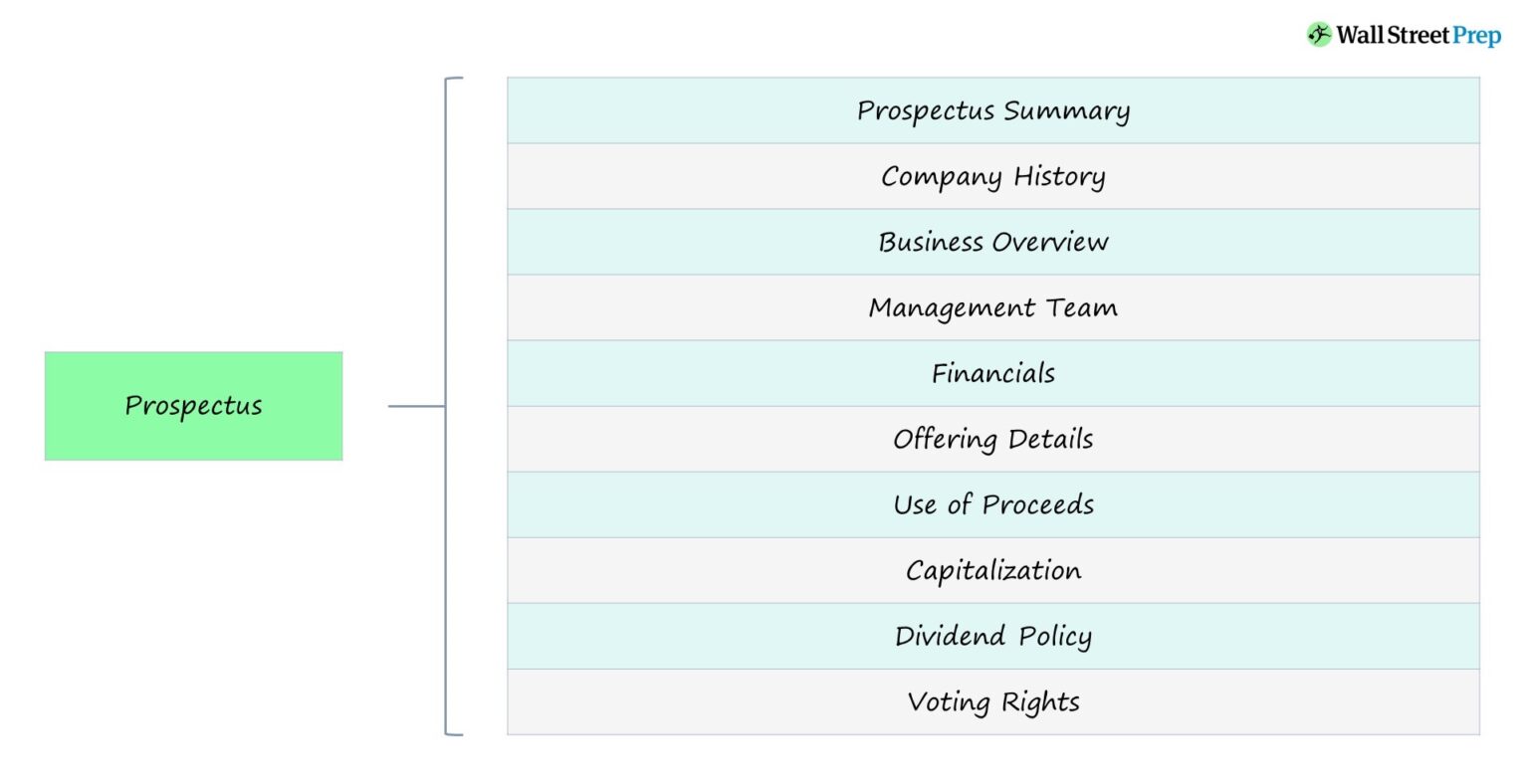
The table below summarizes the key components of a prospectus that investors (and the SEC) tend to pay the most attention to.
Section
Description
Prospectus Summary
The “Prospectus Summary” section summarizes the proposed offering and highlights the main points of the S-1.
Company History
The prospectus will contain a section offering an overview of the company, such as its mission statement (i.e. long-term vision) and the dates of important events that shaped the company, e.g. its incorporation date and major milestones.
Business Overview
The “Business Overview” section details the company's general business model, such as the products or services that the company sells to generate revenue and the customers (and end markets) served.
Management Team
The “Management Team” section is straightforward, as information is presented about its leadership team.
Since the S-1 is meant for capital raising, the background information tends to focus on each executive's positive attributes and qualifications.
Financials
The “Financials” section consists of the company’s core three financial statements — i.e. the income statement, balance sheet, and cash flow statement — to show its historical performance since inception.
Other supplementary sections are also filed as part of the prospectus to support full transparency.
Risk Factors
The “Risk Factors” section is intended to help potential investors understand the perceived risks associated with participating in the offering, such as external threats, competitors, industry headwinds, disruption risk, etc.
Offering Details
The “Offering Details” section contains the details of the proposed security offering, namely the number of securities issued, the offering price per security, the anticipated timeline, and how investors can participate in the offering.
Use of Proceeds
The “Use of Proceeds” section addresses the question of how the company intends to put the newly raised capital to use.
For instance, the company could outline how these proceeds will fund its day-to-day operations, expansion plans into new markets (or geographies), M&A activity, and certain types of reinvestment (i.e. capital expenditures).
Capitalization
The “Capitalization” section summarizes the company’s current and post-IPO capital structure.
Broadly, the purpose of this section is to provide investors with a sense of the company's existing ownership claims (and potential dilution post-IPO), which can be influential to an investor’s returns.
Dividend Policy
If applicable to the offering, i.e. for a stock prospectus, the “Dividend Policy” section supplies information about the company’s current and forward-looking dividend policy, such as outlining any potential plans to change the existing policy.
Voting Rights
The “Voting Rights” section contains information on the various classes of shares issued by the company to date, including the ones on the verge of issuance.
For example, public companies often structure their common stock into distinct classes, such as Class A and Class B stocks, where the share class is what sets the parameters around voting rights.
IPO Prospectus Example: Coinbase S-1 Filing (PDF)
Each company's S-1 report is unique, because the information considered "material" is specific to each individual company (and the industry it operates in).
An example of a prospectus filing can be viewed by filling out the form below. The S-1 was filed before the initial public offering (IPO) of Coinbase (NASDAQ: COIN) in early 2021.
Get the Coinbase Prospectus S-1 Filing
You’re logged in! Form submission not required. Access your file below.




No comments yet.