What is Paid-In Capital?
Paid-In Capital, or “Contributed Capital”, measures the funds raised via stock issuances, where shares are exchanged to investors for partial ownership in the issuer’s equity.

Paid-In Capital, or “Contributed Capital”, measures the funds raised via stock issuances, where shares are exchanged to investors for partial ownership in the issuer’s equity.
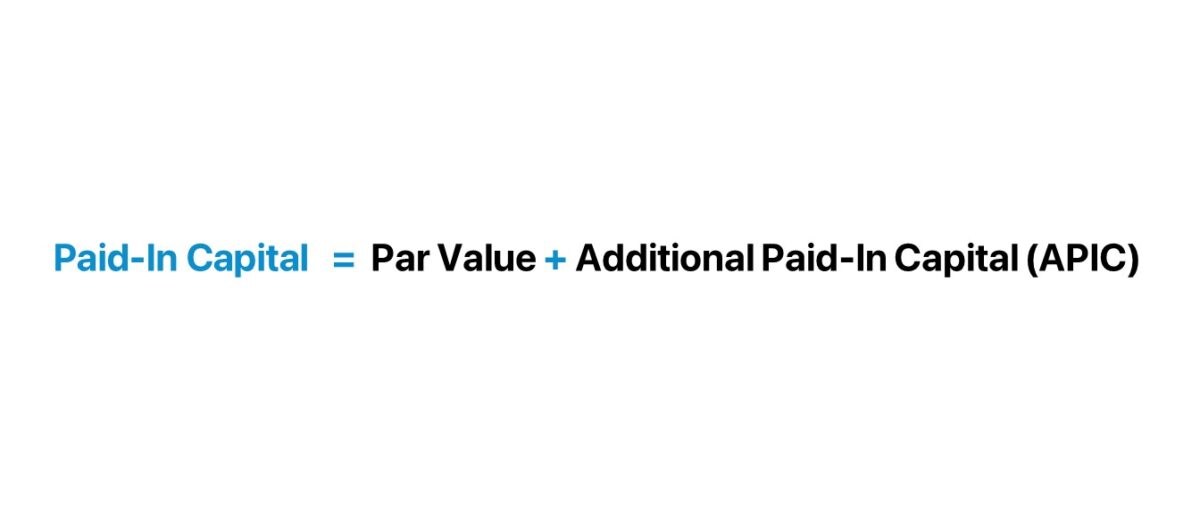
The paid-in capital of a company measures the total cash that shareholders contributed to the company in exchange for the receipt of shares in the company.
The paid-in capital of a company is recorded on its balance sheet in the shareholders' equity section.
However, the section must be presented separately to abide by SEC filing requirements, with supplementary disclosures to provide more details beyond the information as stated on the balance sheet.
There are two components to the paid-in capital concept in accrual accounting (U.S. GAAP), and for the preparation of the financial statements.
The paid-in capital formula is the sum of the par value of common stock and the additional paid-in capital (APIC).
Conversely, the paid-in capital can be computed as the product of the total number of shares issued and the issuance price per share.
Briefly, the journal entries used to record paid-in capital are as follows – which we'll further illustrate in a "hand-on" exercise later on.
| Journal Entries | Type | Formula |
|---|---|---|
| Cash |
|
|
| Common Stock (Par Value) |
|
|
| Additional Paid-In Capital (APIC) |
|
|
Suppose a public company decided to issue 10,000 shares of common stock with a par value of $0.01 per share to raise capital in the form of equity capital.
The investors that participated in the capital raise paid $10.00 per common share.
Given those assumptions, where the company issued 10,000 shares at $10.00 per share with a par value of $0.01, the following journal entries are recorded post-transaction.
| Journal Entries | Debit | Credit |
|---|---|---|
| Cash | $100,000 | -- |
| Common Stock (Par Value) | -- | $100 |
| Additional Paid-In Capital (APIC) | -- | $99,900 |
To elaborate on the prior section, the debit to the cash account captures the total cash proceeds retrieved from shareholders. Since the shares are sold at $10.00 each for 10,000 shares, the company raised $100,000 in the transaction.
The credit to the common stock (par value) account reflects the par value of the shares issued. Considering the par value per share is $0.01 (and 10,000 shares were distributed), the value of the common stock is $100.
The credit to the additional paid-in capital (APIC) account captures the excess paid over the par value. Therefore, the difference between the credit to the cash account and the common stock (par value) is the amount recorded in the APIC account, which is $99.9k.
In conclusion, the total paid-in capital from our hypothetical transaction is $100k, composed of $100 in common stock (par value) and $99.9k in additional paid-in capital (APIC).
Simply put, a stock cannot be issued below its par value. Thus, if the par value of a common share is $1.00, issuing stock to an investor at a price less than the market value is legally prohibited (cannot be <$1.00).
There are legal ramifications pertaining to the risk of share issuances where the market price of the common stock per unit is less than the par value stated on the common stock certificate (and supporting documentation).
In an effort to mitigate that risk, corporations nowadays set the par value as low as possible, e.g. to $0.01 per share, or issue shares with no par value.
As a real-world example, the par value of common stock from Apple (NASDAQ: AAPL) is $0.00001 per share. In contrast, the share price of Apple as of the latest closing date (11/15/2023) was $188.01.
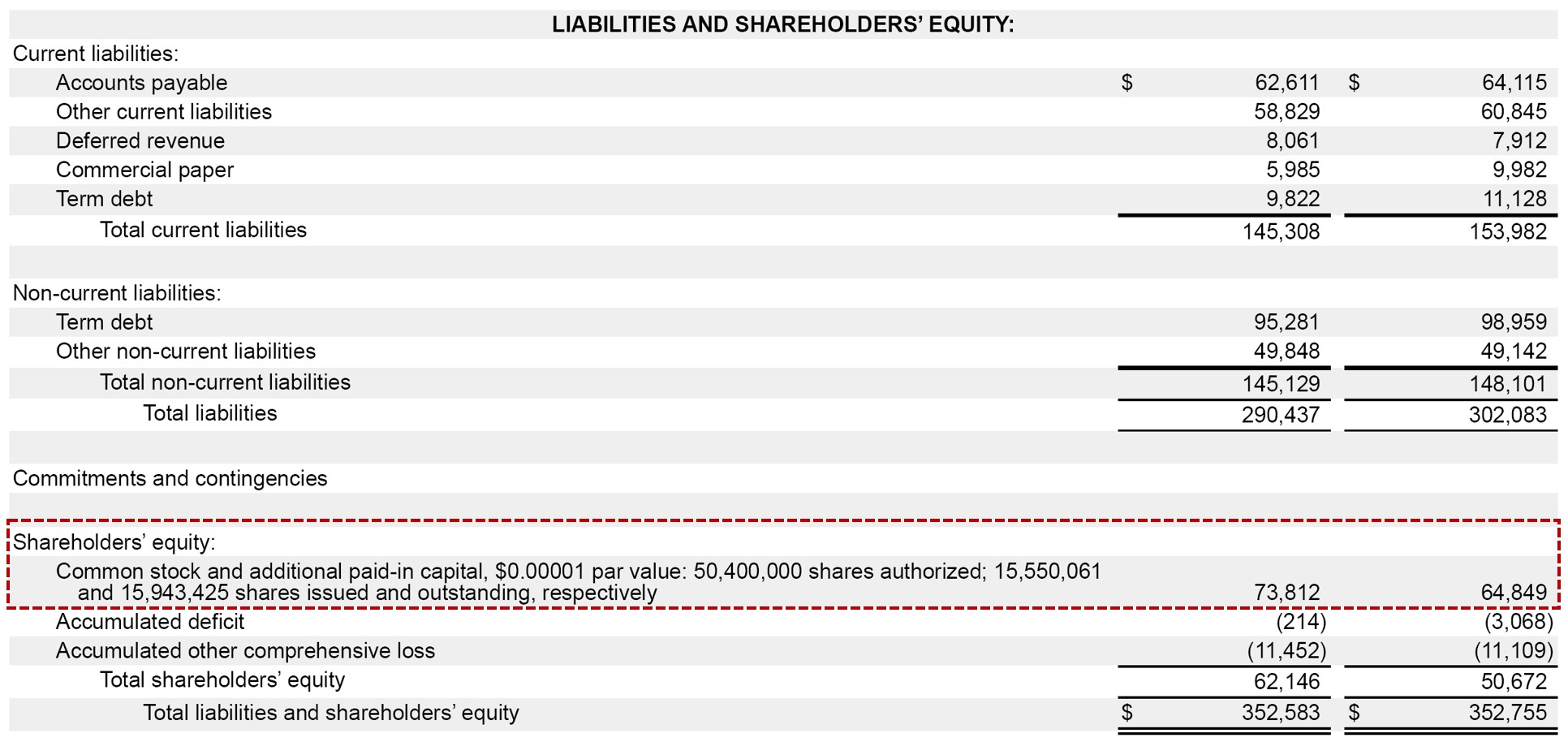
Common Stock and Additional Paid-In Capital (Source: Apple, Inc. 2023 10-K)
In the context of financial modeling, the common stock and additional paid-in capital (APIC) line items are often consolidated as a general best practice.
Hence, the “Common Stock and APIC” line item is prevalent in most financial models as used in practice.
Why? The roll-forward schedule for common stock and additional paid-in capital (APIC) is impacted by the same underlying drivers.
The separation of the two components woud needlessly complicate the financial model with no tangible improvements to the accuracy of the model.
Enroll in The Premium Package: Learn Financial Statement Modeling, DCF, M&A, LBO and Comps. The same training program used at top investment banks.


No comments yet.