Owner’s Equity is the residual value of an owner’s claim on the assets of their respective business upon deducting total liabilities.
Conceptually, owner’s equity—often referred to as “Shareholders’ Equity”—reflects the net worth of a company, calculated by subtracting total liabilities from assets.
How to Calculate Owner’s Equity
The owner’s equity is a fundamental accounting concept that measures the value of an owner’s stake in their business (or “net worth”).
In short, owner’s equity represents the residual interest in a company’s assets after deducting all liabilities, recorded for bookkeeping purposes.
Therefore, the net difference between the total assets belonging to a business and total liabilities reflects the concept of owner’s equity.
Simply put, the owner’s equity is the remaining value attributable to the owner in the event of a hypothetical liquidation, in which the leftover funds are returned to the business owner.
From the perspective of the business owner—or in other circumstances, shareholders with a stake in the equity of a company—the owner’s equity is critical to continuously monitor in order to track the book value of their equity interest over time.
In particular, common shareholders in a corporation must constantly monitor the value of the issuer's common equity because borrowing capital (or leverage), which is measured via credit ratios like the debt to equity (D/E) ratio, impacts on the return on their investment.
Not to mention, common equity is placed at the bottom of the capital structure, so if a corporation were to hypothetically default and become insolvent, the recovery rate (i.e. recoup the initial investment) is improbably, especially if there are multiple classes of stakeholders.
Owner’s equity is a metric that measures the book value of value (BVE)—in contrast to the market value of equity (or market capitalization, i.e. “market cap”)—so, the recorded balance is constant and updated periodically rather than constantly fluctuating in value.
Hence, the “Owner’s Equity” line item is recorded on the balance sheet of a company, akin to the “Shareholders’ Equity” line item.
The step-by-step process to calculate owner’s equity, at its simplest, is as follows:
Step 1 ➝ Calculate Total Assets (Current + Non-Current Assets)
Step 2 ➝ Calculate Total Liabilities (Current + Non-Current Liabilities)
Step 3 ➝ Subtract Total Liabilities from Total Assets
What are the Components of Owner's Equity?
The components of owner's equity for a sole initial capital investments, retained earnings, and additional owner contributions, minus any withdrawals or distributions.
Each component of owner's equity—including the impact—is described in the following table.
Component
Definition
Initial Capital Contribution
The initial capital contribution refers to the funds that the owner invests in the business at inception (i.e. the founding date).
The initial contribution, including any follow-on investments, directly increases owner’s equity since the funds represent the owner’s financial stake in the company.
Retained Earnings
The retained earnings refer to the accumulated profits that a company retains and reinvests into the business rather than distributing the profit to shareholders as dividends.
The increase in a company's retained earnings, driven by the generation of more net income (and a higher retention rate), increases owner’s equity over time as the company generates and retains more profits — however, the equity of the business, in all likelihood, belongs to multiple shareholders.
Owner Withdrawals or Distributions
Owner withdrawals or distributions are the amounts taken out of the business by the owner for personal use.
The discretionary decision to withdraw or distribute funds—often for personal expenses—reduces the owner’s equity since those actions represent a cash outflow (and thus, decline in the owner’s financial stake in the company).
Common Stock
Common stock represents the ownership shares issued to shareholders in exchange for capital.
The issuance of common stock increases owner’s equity because the whole point of the capital raise is to bring in additional funds into the company.
Preferred Stock
Preferred stock is a hybrid equity security that grants certain shareholders preferential treatment in dividends, asset liquidation, and a potential “equity kicker” in the structure.
Like common equity, the issuance of preferred stock causes owner’s equity to rise, considering the funds represent additional capital to the company.
Additional Paid-In Capital (APIC)
APIC refers to the excess amount paid by investors over the par value of the stock.
If the recorded value of APIC were to rise, owner’s equity would also increase because that implies additional capital was contributed by shareholders beyond the nominal value of the shares.
Treasury Stock
Treasury stock measures the value of the shares that the company decided to repurchase from shareholders post-issuance, which reduces the dilution in the equity ownership.
The decision to repurchase stock reduces owner’s equity because the corporate action reflects a return of capital to shareholders (and a reduction in the number of outstanding shares).
Owner’s Equity Formula
The formula to calculate owner’s equity subtracts a company’s total liabilities from total assets.
Owner’s Equity = Total Assets – Total Liabilities
Where:
Total Assets ➝ The total assets of a company refer to the resources belonging to a company with positive economic utility.
Total Liabilities ➝ The total liabilities are the unmet payment obligations owed by a company to third-parties, such as suppliers, vendors, and debt lenders.
The logic that underpins the owner's equity formula is rooted in the fundamental accounting equation, , which states that total assets must equal to the sum of total liabilities and equity.
Assets = Liabilities + Shareholders Equity
In short, the owner’s equity formula is derived by re-arranging the basic balance sheet equation to solve for shareholders' equity.
However, the term “Owner’s Equity” is most commonly used in the context of a sole proprietorship—which is the simplest business structure—wherein the entity is managed by one business owner, like an entrepreneur.
While a generalized sweeping statement, the owner and the business can be perceived as “one and the same” in a sole proprietorship.
In contrast, the standard term used for limited liability corporations (LLCs) and corporations is “Shareholders’ Equity" (or ”Stockholder’s Equity”).
LLCs and corporations seldom use the term “Owner’s Equity” in practice — albeit, the two terms are practically the same conceptually.
The distinction in the usage of the term pertains more to the corporate structure of the business (and the applicable taxation policies).
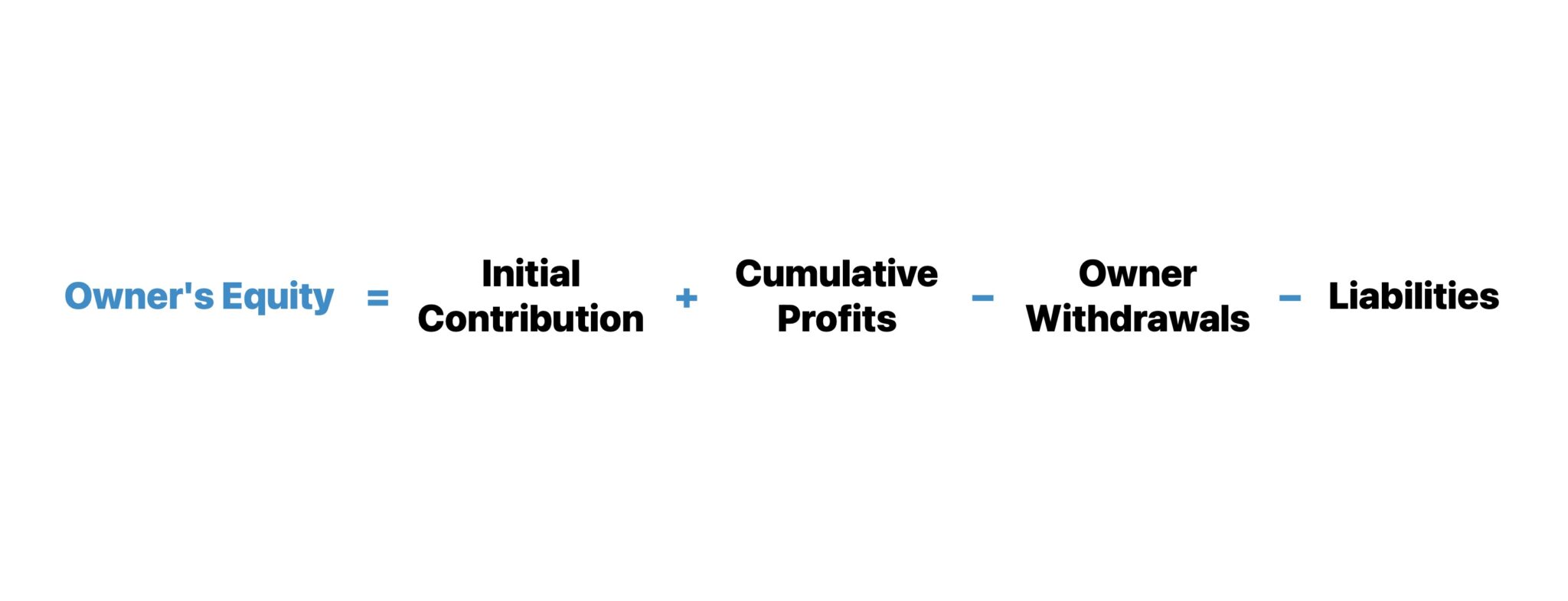
The formula to calculate owner’s equity for a sole proprietorship equals the sum of the initial investment and cumulative profits earned to date, subtracted by the sum of any owner withdrawals and liabilities.
Initial Capital Contribution ➝ The initial investment contributed by the owner of the business (i.e. funding source to get the business up and running)
Cumulative Profits ➝ The accumulated profits retained by the business since the date of inception.
Owner Withdrawals ➝ The discretionary funds taken out of the business by the owner.
Liabilities ➝ The payment obligations owed to 3rd parties, such as suppliers and vendors.
Owner’s Equity Calculation Example
Suppose we're tasked with calculating the owner's equity of an HVAC company in Florida.
The HVAC provider—a business structured as a sole proprietorship—recorded the following financial date at the end of 2024.
2024 Selected Financial Data
Initial Capital Contribution = $100,000
Cumulative Profits = $300,000
Owner Withdrawals = $80,000
Total Liabilities = $120,000
In the first step, we'll add the initial capital contribution and the cumulative profits to date, or retained earnings, which comes out to $400k ($100,000 + $300,000)
From which, we'll subtract the owner withdrawals, which were stated earlier as $80k, yielding $320k ($400,000 — $80,000).
In the final step, we'll subtract $320k by $120k, the total liabilities of the business, so we arrive at an owner's equity of $200k for our hypothetical HVAC business in our illustrative exercise.
Owner's Equity = $320,000 — $120,000 = $200,000
The owner’s equity of $200,000 for the HVAC company based in Florida implies that represents the net value of the business from the owner’s perspective (or the residual value attributable to the business owner).
In closing, the owner's equity value was derived after considering the initial investment, accumulated profits, withdrawals made by the owner, and the company’s liabilities. Therefore, a positive owner’s equity of $200k is likely to be perceived positively, considering that is the remaining value after paying off all liabilities (i.e. the owner still has a substantial residual interest in the business).



No comments yet.