What is Inventory?
Inventory refers to the raw materials used by a company to produce goods, unfinished work-in-process (WIP) goods, and finished goods available for sale.

Inventory refers to the raw materials used by a company to produce goods, unfinished work-in-process (WIP) goods, and finished goods available for sale.
In accounting, inventory describes a wide array of materials used in the production of goods and the finished goods waiting to be sold.
The carrying value of a company's inventory is recorded on the current assets section of the balance sheet (or "statement of financial position).
Unlike fixed assets (PP&E), which have useful lives of greater than one year (>12 months), a company's inventory is expected to be cycled out (and sold to customers) rather quickly within one year.
The beginning inventory is the starting point in the calculation of the ending inventory recognized on the balance sheet.
The inventory balance as of the beginning-of-period (BoP) is carried over from the end-of-period (EoP) inventory balance from the prior period.
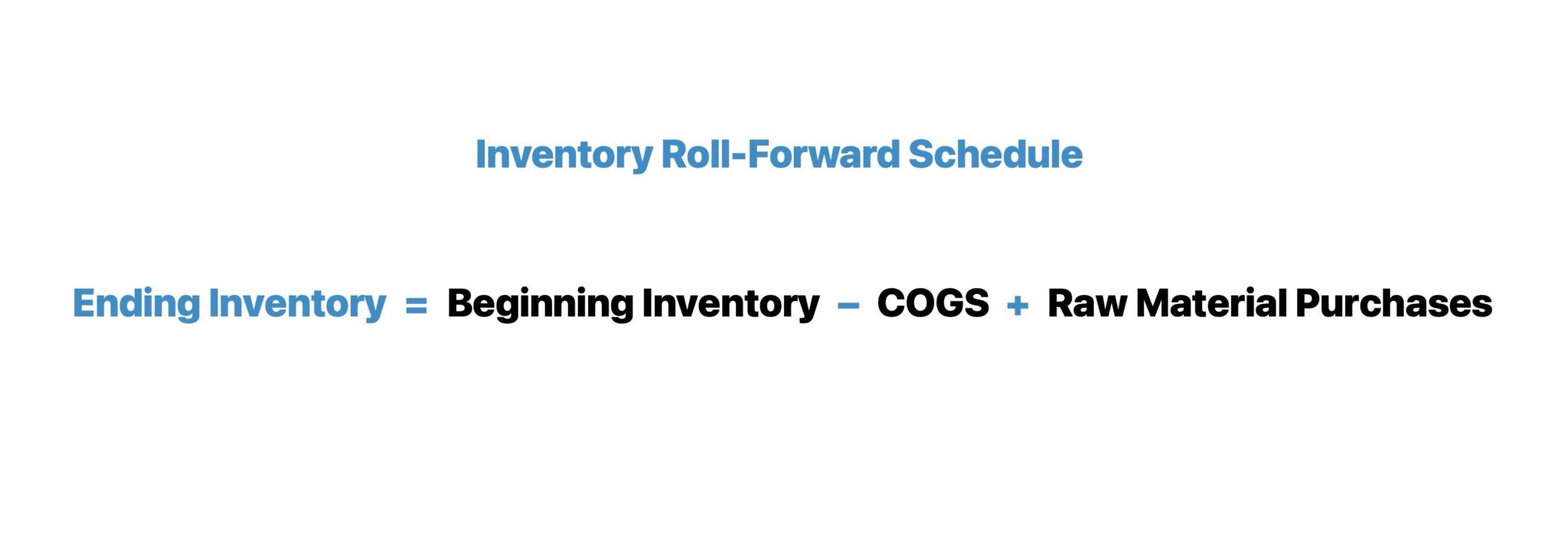
The next step is to deduct the cost of goods sold (COGS) from the beginning inventory balance. The COGS incurred by the company can be retrieved from the current period income statement.
In the final step, the resulting figure obtained after subtracting COGS from the beginning inventory balance is added to the value of new raw material purchases to arrive at the ending inventory balance.
The steps to calculate inventory are as follows:
Note: The raw material purchases metric must be adjusted downward to account for any returns or allowances.
Generally speaking, the four different types of inventories are raw materials, work-in-progress (WIP), finished goods (available for sale), and maintenance, repair, and operating supplies (MRO).
The formula to calculate the ending inventory balance is equal to the beginning inventory balance subtracted by the COGS incurred in the current period, which is then added by raw material purchases.
The carrying value of a company’s inventory recognized on the balance sheet is affected by two main factors: the cost of goods sold (COGS) and raw material purchases.
There is no inventory line item on the income statement, but it is indirectly captured in the cost of goods sold (COGS) or operating expenses (Opex) section—irrespective of whether the corresponding inventories were purchased in the matching period.
The cost of goods sold (COGS) always reflects a portion of the inventories since the recognition on the income statement occurs when a good or service is delivered to the customer ("earned" revenue) per GAAP accounting standards.
On the cash flow statement, the change in inventories line item is captured in the cash from operations section (and reflects the net difference between the beginning and ending carrying values).
By ordering materials on an as-needed basis and minimizing the time that inventories remain idle on shelves until being sold, the company has less free cash flow (FCF) tied up in operations (and thus more cash available to execute other initiatives).
LIFO and FIFO are the two most common accounting methods for recognizing the value of inventories sold in a given period.
The impact on net income depends on how the price of inventories has changed over time.
| LIFO vs. FIFO | Last In, First Out (LIFO) | First In, First Out (FIFO) |
|---|---|---|
| Rising Inventory Costs |
|
|
| Declining Inventory Costs |
|
|
The weighted average cost method (WAC) is the third most widely used accounting method after LIFO and FIFO.
Under the weighted-average method, the cost of the inventories recognized is based on a weighted average calculation, in which the total production costs are added and then divided by the total number of items produced in the period.
Since each product cost is treated as equivalent and the costs are “spread out” equally in even amounts, the date of purchase or production is ignored.
Hence, the method is often criticized as too simplistic of a compromise between LIFO and FIFO, especially if the product characteristics (e.g. prices) have undergone significant changes over time.
Under U.S. GAAP, FIFO, LIFO, and the Weighted Average Method are all permitted, but note that IFRS does not allow LIFO.
The cost of goods sold (COGS) is recognized in the period by which a good or service is sold to a customer.
However, unforeseeable events can occur that have a material impact on the inventory's fair value, which must be adjusted for bookkeeping purposes to abide by accrual accounting standards (US GAAP).
The days inventory outstanding (DIO) measures the average number of days it takes for a company to sell off its inventories.
Companies aim to optimize their days inventory outstanding (DIO), or "Inventory Days", by quickly selling their inventories on hand (i.e. a lower DIO implies the company is more efficient at inventory management).
The days inventory outstanding (DIO) formula is equal to the inventory balance divided by COGS, which is then multiplied by 365 days.
The inventory turnover ratio measures how often a company has sold and replaced its inventories in a specified period, i.e. the number of times inventories were "turned over".
When interpreting the KPIs above, the following rules are generally true:
In order to project a company's inventory balance, most financial models grow it in line with COGS, especially since DIO tends to decline over time as most companies become more efficient as they mature.
Initially, the days inventory outstanding (DIO) is calculated for the trailing periods to have historical data to reference.
The operating assumptions in a financial model will be set based on the historical trends of the company's days inventory outstanding (DIO) to guide the pro-forma forecast.
The projected inventories balance equals the DIO assumption divided by 365, which is then multiplied by the forecasted COGS amount.
We’ll now move to a modeling exercise, which you can access by filling out the form below.

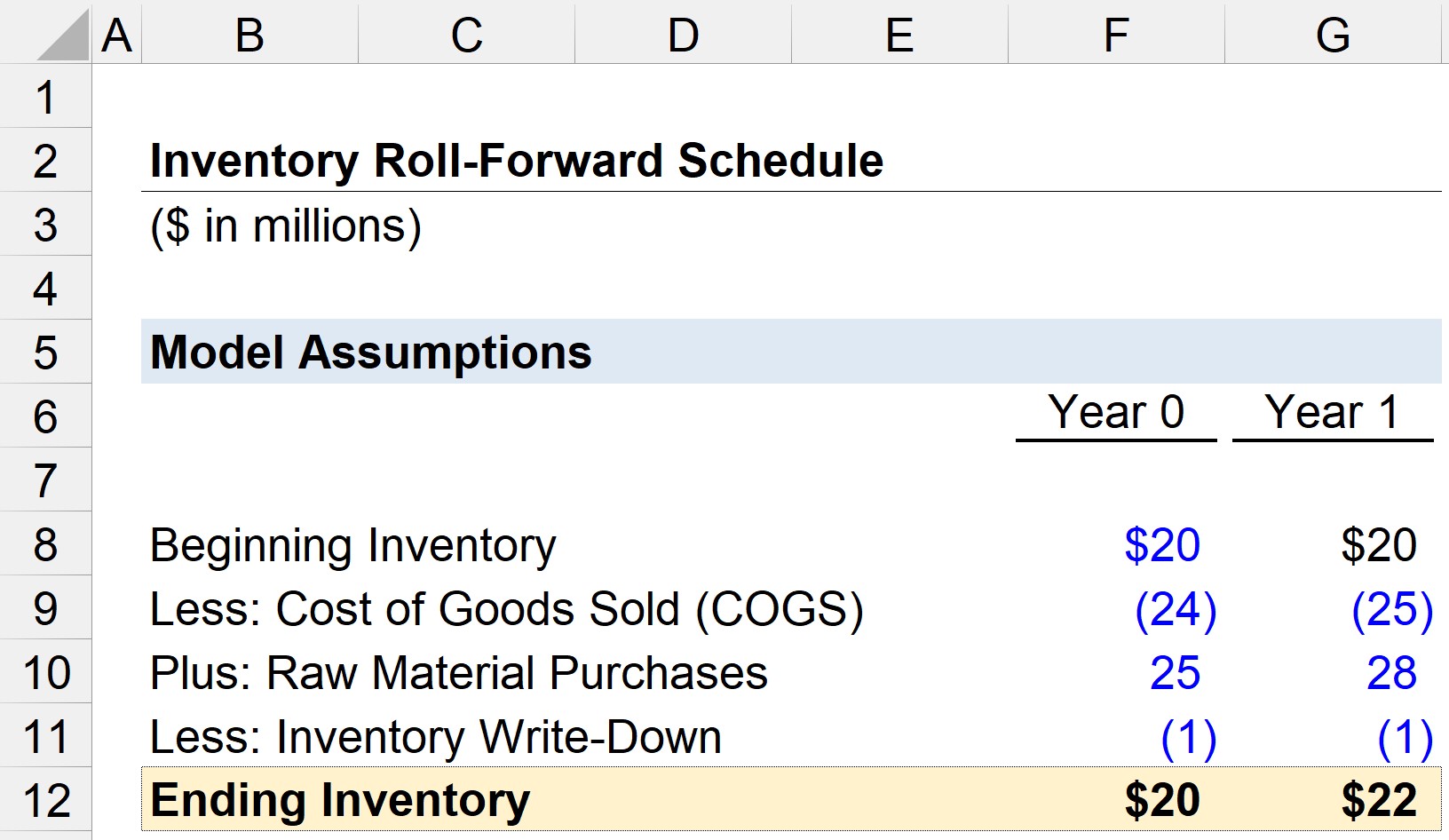
Suppose we are building a roll-forward schedule of a company’s inventories.
Starting off, we’ll assume that the beginning of period (BOP) balance of inventories is $20 million, which is impacted by the following factors:
COGS and the write-down reduce the carrying value of the company's inventories, whereas the purchase of raw materials increases the carrying value.
The net change in inventories during Year 0 was zero, as the reductions were offset by the purchases of new raw materials.
For Year 1, the beginning balance is first linked to the ending balance of the prior year, $20 million — which will be affected by the following changes in the period.
Using the same equation from earlier, we arrive at $22 million for the ending inventory balance in Year 1.
Enroll in The Premium Package: Learn Financial Statement Modeling, DCF, M&A, LBO and Comps. The same training program used at top investment banks.


No comments yet.