What is TVPI?
The Total Value to Paid-In Capital (TVPI) ratio compares the distributions returned to investors by a fund and the residual value not yet realized relative to the contributed paid-in capital.

The Total Value to Paid-In Capital (TVPI) ratio compares the distributions returned to investors by a fund and the residual value not yet realized relative to the contributed paid-in capital.
TVPI, shorthand for the “Total Value to Paid-In” capital multiple, is a metric used to measure the returns performance of a fund.
Formulaically, the TVPI multiple is the ratio between the total value of the fund’s realized distributions and unrealized holdings, compared to the paid-in capital from the limited partners (LPs).
From the perspective of the investor, the TVPI answers, "How does the firm’s total realized and unrealized profits compare to the initial paid-in capital amount?"
Calculating the TVPI is relatively straightforward as it involves comparing the total value —i.e. realized profits and unrealized potential profits of the fund – relative to the capital contributed by the investor.
Therefore, to calculate TVPI, the total realized distributions to date and the estimated fair value of the remaining investments within the fund’s holdings are divided by the capital contributed to the fund to date.
While funds raise capital from LPs, the capital is not provided to the general partners (GPs) immediately.
The GPs must make a capital call to the LPs to request the committed capital.
Hence, the paid-in capital of an LP increases over the lifespan of the fund as the LPs contribute more of their committed capital.
The important takeaway here is that paid-in capital is NOT the same concept as committed capital.
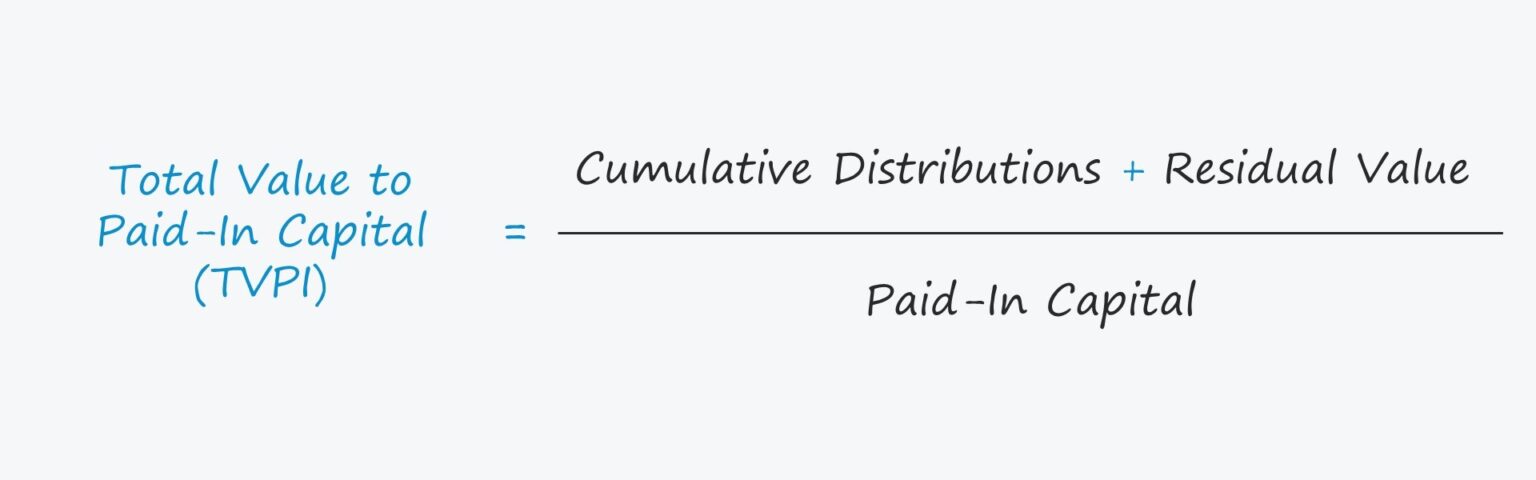
The formula for calculating the total value to paid-in capital multiple (TVPI) is as follows.
The TVPI formula, as expressed above, is the ratio between the sum of a fund's cumulative distributions and residual value to its paid-in capital.
Level up your career with the world’s most recognized private equity investing program. Enrollment is open for the upcoming cohort.
TVPI in most cases is a “net” measure, meaning management fees, carried interest (i.e. “carry”), and other expenses to LPs that reduce returns are taken into account.
Funds may occasionally report TVPI on a gross basis, but it is typically standard for the metric to be presented net of fees and expenses.
For instance, if an LP invested $100k and the total value of realized and unrealized returns amounts to $260k and there were $10k in fees and carried interest, the net TVPI multiple would be 2.5x.
The TVPI multiple is widely used to evaluate the performance of an investment fund by its limited partners (LPs).
As a general guideline, a TVPI equal to 1.0x means no profits – neither realized nor unrealized – were obtained in excess of fees.
The main drawback to the TVPI is that the time value of money (TVM) is neglected, so it must be measured alongside the internal rate of return (IRR).
We’ll now move to a modeling exercise, which you can access by filling out the form below.


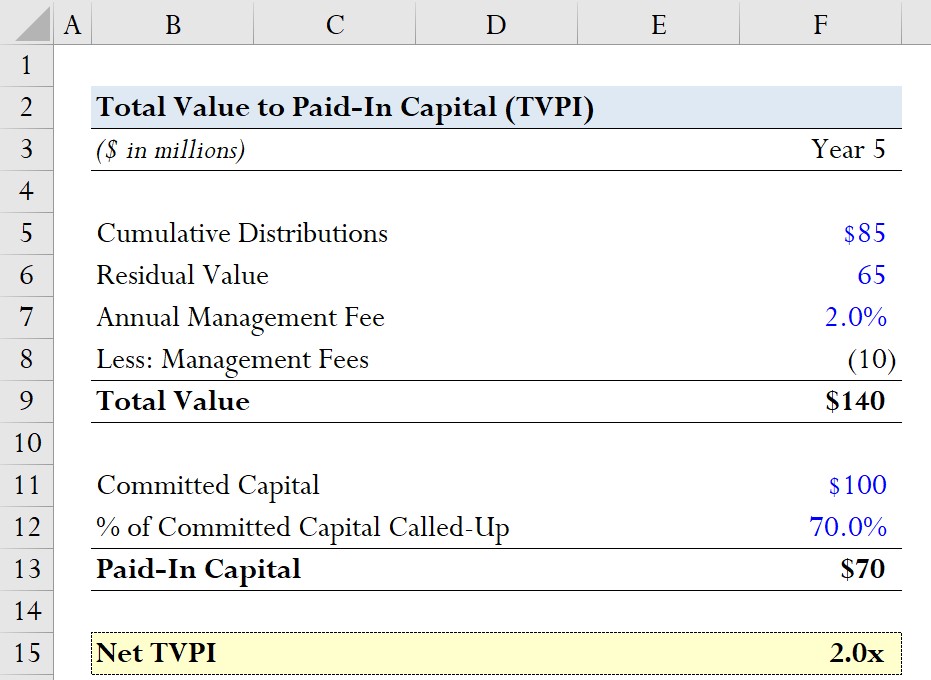
Suppose there is a private equity fund (PE) with a total of $100 million in committed capital from their LPs.
Of the $100 million, 70% of the committed capital has been called as of Year 5, so the paid-in capital is $70 million.
Calculating the numerator will consist of adding together the cumulative distributions and the residual value, which we’ll assume to be $85 million and $65 million, respectively.
Since we're calculating the net TVPI in our modeling exercise, we must also deduct any management fees accumulated to date.
We’ll assume the annual management fees are 2.0% of the total commitment capital, so the management fees equal $10 million.
The total value of the fund as of Year 5 is $140 million.
Since the fund returns are not fully realized and only $85 million was distributed relative to the $100 million in committed capital – i.e. there is still uncalled capital and “unrealized” residual value – the GPs have not received any carried interest yet.
GPs earn carry only after the LPs have been distributed the entirety of their initial capital contribution (i.e. the return of their original capital commitment) and then the LPs receive 100% of the proceeds until the preferred return (or “hurdle rate”) is met.
The preferred return in private equity is typically 8.0% and once the minimum threshold is met, the GP “catch-up” clause is triggered with the traditional 80/20 distribution split applied to proceeds thereafter.
Upon dividing the total value of $140 million by the $70 million in paid-in capital, we arrive at a net TVPI of 2.0x as of Year 5.


No comments yet.