Strategic vs. Financial Buyer: What is the Difference?
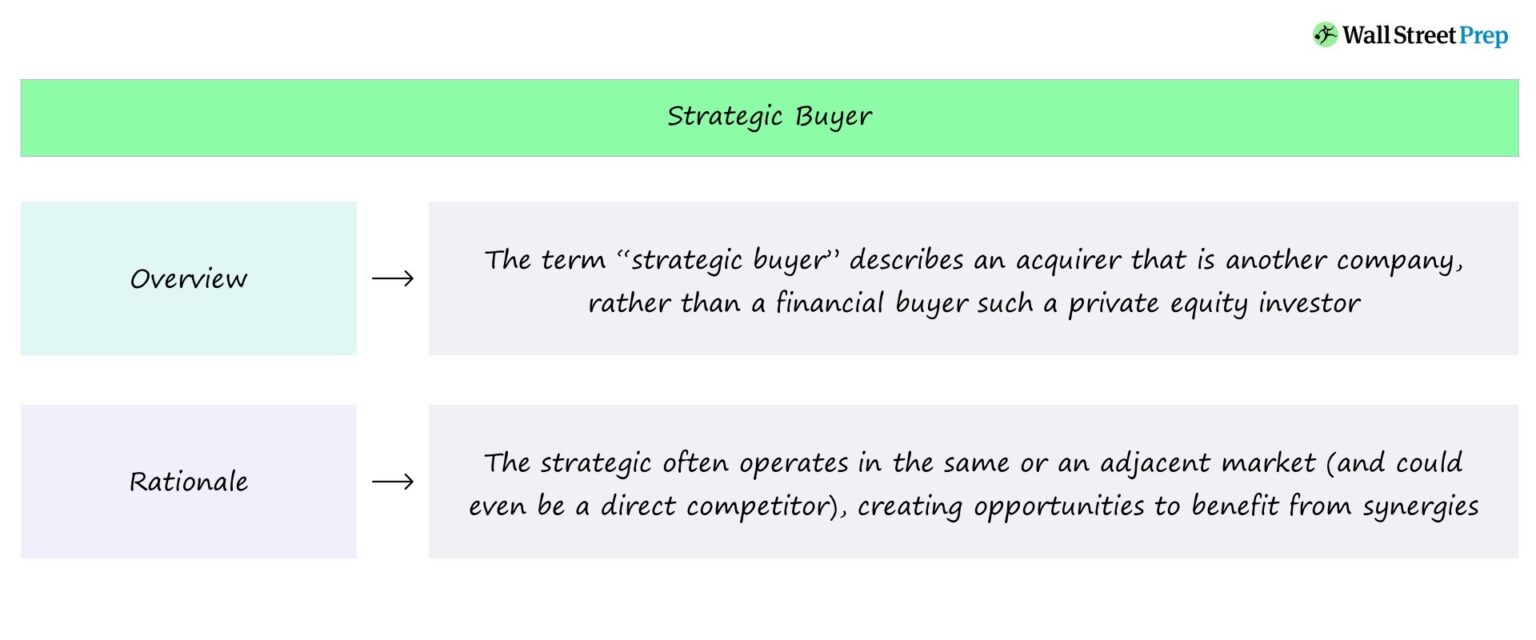
Strategic buyers represent companies operating in overlapping markets, while financial buyers seek to acquire LBO targets as more of an investment, with an exit strategy and date in mind on the date of initial buyout.
In recent years, the most active type of acquirer has been private equity firms, which are also known as financial sponsors.
The private equity industry comprises investment firms that acquire privately-held (or public) companies using a substantial amount of debt to fund the purchase. Hence, the acquisitions completed by PE firms are termed “leveraged buyouts”, or “LBOs” for short.
Given the capital structure of the post-LBO company, there is a significant burden placed on the company to perform well in order to meet interest payments and repay debt principal on the date of maturity.
On that note, financial buyers must be careful with the companies they acquire to avoid mismanaging the company and causing it to default on its debt obligations.
Transactions dealing with financial buyers tend to be more time-consuming because of the amount of extensive diligence required, as well as obtaining the necessary debt financing commitments from lenders.
In contrast, the core objective of a strategic buyer is to create long-term value from the acquisition, which can stem from horizontal integration, vertical integration, or building a conglomerate among various other potential strategies.
Strategic buyers usually enter negotiations with a unique value proposition in mind, which rationalizes the acquisition.
The investment horizon for a strategic tends to be longer. In fact, most strategics merge the companies entirely post-deal and never intend to sell the acquired company unless the transaction falls short of expectations and destroys value for all stakeholders, resulting in a divestiture in such a case.
Compared to strategic acquirers, financial buyers are much more returns-oriented, and it is part of their business model to exit the investment typically in a five to eight-year time frame.
From the perspective of the seller, most management teams (and their sell-side advisor) prefer exiting to a strategic rather than to a financial buyer when seeking to undergo a liquidity event.
The aforementioned preference is namely due to the higher premiums that can be fetched from strategics, in addition to the quicker diligence process.
Private Equity Industry Trend: Add-On Acquisitions (Buy and Build)
In recent times, the strategy of add-ons (i.e. “buy-and-build”) by financial buyers has helped close the gap between the purchase price offered between strategic and financial buyers and made them more competitive in auction processes.
By making add-on acquisitions, which is when an existing portfolio company called the “platform” acquires a smaller-sized target, this enables the financial buyer – or the portfolio company, more specifically – to benefit from synergies, similar to strategic acquirers.
Strategic buyers are interested in integrating the target company into their long-term business plans, and add-ons enable the portfolio companies of financial buyers to do so, as well.



No comments yet.