What is a Divestiture?
A Divestiture occurs when a corporation proceeds with either a partial or an outright sale of a business segment and the assets belonging to the unit.

A Divestiture occurs when a corporation proceeds with either a partial or an outright sale of a business segment and the assets belonging to the unit.
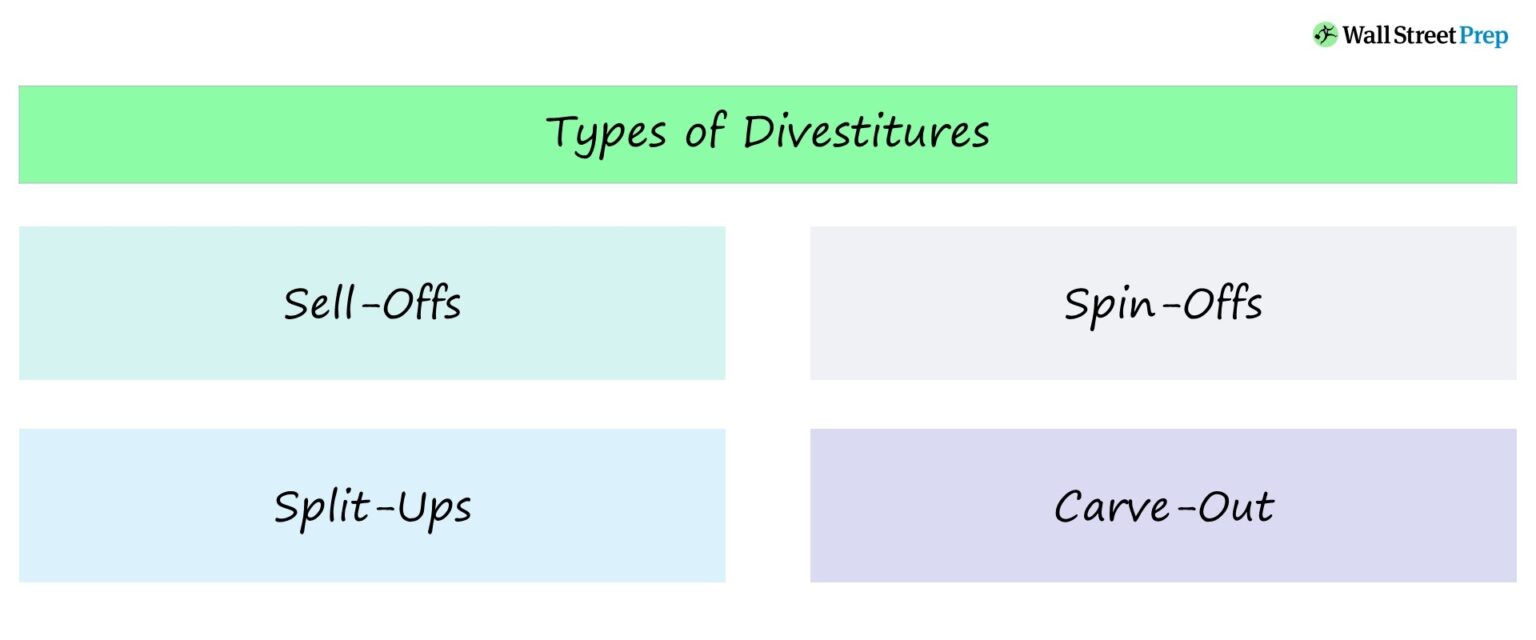
Divestitures in M&A are when a company sells a collection of assets or an entire business division.
Generally, the strategic rationale of divestitures include:
The decision to divest an asset or business segment most often stems from management’s determination that insufficient value is contributed by the segment to the company's core operations.
Companies should theoretically divest a business division only if misaligned with their core strategy, or if the assets possess more value if sold or operated as an independent entity than if retained.
For instance, a business division could be deemed redundant, non-complementary to other divisions, or distracting from core operations.
From the perspective of existing shareholders and other investors, divestitures can be interpreted as management admitting defeat in a failed strategy in that the non-core business fell short in delivering the originally expected benefits.
A divestiture decision implies that a turnaround of the division is not plausible (or not worth the effort), as the priority is instead to generate cash proceeds to fund reinvestments or to reposition themselves strategically.
After completing the divestiture, the parent company can reduce costs and shift its focus to its core division, which is a common issue that market-leading companies encounter.
If a merger or acquisition is poorly executed, the value of the combined entities is less than the value of the standalone entities, meaning that the two entities are better off operating individually.
More specifically, the acquisition of companies without a long-term plan for integration can lead to so-called “negative synergies," wherein shareholder value declines post-deal.
In effect, divestitures could leave the parent company (i.e. the seller) with:
Divestitures are thereby a form of cost-cutting and operational restructuring – plus, the divested business unit can unlock "hidden" value creation that was hindered by being mismanaged by the parent company.
If an activist investor sees a certain business segment has been underperforming, a spin-off of the unit could be pitched to improve the parent company’s profit margins and let the division thrive under new management.
Many divestitures are thus influenced by activists pushing for the sale of a non-core business and then requesting a capital distribution to shareholders (i.e. direct proceeds, more cash for reinvestments, more focus by management).
Anti-trust regulatory pressure can result in a forced divestiture, typically related to efforts to prevent the creation of monopolies.
One frequently cited case study for anti-trust divestitures is the break-up of AT&T (Ma Bell).
In 1974, the U.S. Justice Department filed an anti-trust lawsuit against AT&T that remained unresolved until the early 1980s, in which AT&T agreed to divest its local-distance services as part of the landmark settlement.
The divested regional units, collectively called the “Baby Bells,” were newly-formed telephone companies created after the anti-trust suit against AT&T’s monopoly.
In hindsight, the forced divestiture is criticized by many as the suit only reduced the roll-out of high-speed internet technologies for all U.S. consumers.
Once the regulatory environment in the telecommunications sector loosened, many of those companies returned to being part of the AT&T conglomerate, alongside other cellular carriers and cable providers.
The prevalent view is that the break-up was unnecessary, as the “deregulation” that forced AT&T to be broken up just led to the company only becoming a more diversified, natural monopoly.
A wide range of different transaction structures could be categorized as divestitures. However, the most common variations of divestitures are the following:
Sometimes, the rationale behind a divestiture is related to preventing the company from restructuring its debt obligations or filing for bankruptcy protection.
In such scenarios, the sale tends to be a “fire-sale” where the objective is to get rid of the assets as soon as possible, so the parent company has enough proceeds from the sale to meet scheduled payments to suppliers or debt obligations.
Oftentimes, carve-outs are referred to as a “partial IPO” because the process entails the parent company selling a portion of their equity interest within the subsidiary to public investors.
In practically all cases, the parent holds a substantial equity stake in the new entity, i.e. usually >50% – which is the unique feature of carve-outs.
Upon completion of the carve-out, the subsidiary is now established as a new legal entity run by a separate management team and board of directors.
As part of the initial carve-out plan, the cash proceeds from the sale to 3rd party investors are then distributed to the parent company, the subsidiary, or a mixture.

Enroll in The Premium Package: Learn Financial Statement Modeling, DCF, M&A, LBO and Comps. The same training program used at top investment banks.


No comments yet.