The Top 25 Private Equity Interview Questions covered in our comprehensive interview guide are intended to help prepare candidates for the competitive recruiting process and improve their odds of receiving an offer.
How to Prepare for Private Equity Interview Questions
Unlike investment banking interviews where you'll likely get a lot of technical interview questions, private equity interviews will stress the Paper LBO and LBO Modeling Test to confirm you've got the technicals down.
However, you are likely to still encounter private equity interview questions in the earlier rounds of the interview process, so we've compiled the most common technical interview questions that you absolutely must know the answer to.
The types of questions asked in a private equity interview can be broken into four categories:
Understanding the fundamental LBO concepts is essential to perform well on the LBO modeling and case study portions of the interview, as well as to showcase your judgment during investment rationale and deal discussions in the later stages of the recruiting process.
Generally, the standard technical questions are most applicable to interviewees from non-traditional backgrounds and are less common for more experienced candidates. Nevertheless, the following article still should serve as a helpful refresher for those that have completed a stint in investment banking.
Let's move on straight to the top private equity interview questions now.
Master Private Equity Interviews with AI
Private equity interviews are known for their intensity, requiring candidates to demonstrate both technical modeling expertise and strategic thinking. Artificial intelligence revolutionizes interview preparation by identifying commonly tested concepts, simulating realistic case prompts, and offering personalized feedback. Through the AI for Business & Finance Certificate Program—created by Wall Street Prep in collaboration with Columbia Business School Executive Education—professionals learn how to use AI-powered interview simulations to elevate their interview preparation with confidence and clarity.
An LBO is the acquisition of a company, either privately held or publicly traded, where a significant amount of the purchase price is funded using debt. The remaining portion is funded with equity contributed by the financial sponsor and in some cases, equity rolled over by the company’s existing management team.
Once the transaction closes, the acquired company will have undergone a recapitalization and transformed into a highly leveraged financial structure.
The sponsor will typically hold onto the investment for between 5 to 7 years. Throughout the holding period, the acquired company will use the cash flows that it generates from its operations to service the required interest payments and pay down some of the debt principal.
The financial sponsor will usually target an IRR of approximately ~20-25%+ when considering an investment.
Q. Walk me through the mechanics of building an LBO model.
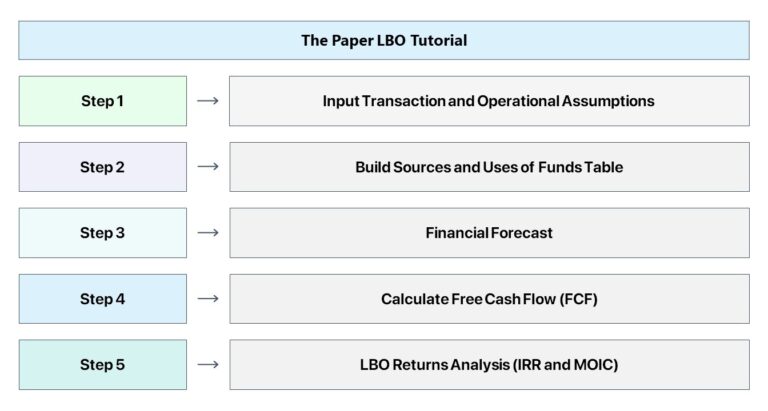
Step 1: Entry Valuation → The first step to building an LBO model is to calculate the implied entry valuation based on the entry multiple and LTM EBITDA of the target company.
Step 2: Sources and Uses → Next, the “Sources and Uses” section will lay out the proposed transaction structure. The “Uses” side will calculate the total amount of capital required to make the acquisition, whereas the “Sources” side will detail how the deal will be funded. Most importantly, the key question being answered is: What is the size of the equity check the financial sponsor must contribute?
Step 3: Financial Projection → Once the Sources & Uses table has been completed, the free cash flows (FCFs) of the company will be projected based on the operational assumptions (e.g. revenue growth rate, margins, interest rates on debt, tax rate). The FCFs generated are central to an LBO as it determines the amount of cash available for debt amortization and the interest expense due each year.
Step 4: Returns Calculation → In the final step, the exit assumptions of the investment are made (i.e. exit multiple, date of exit), and the total proceeds received by the private equity firm are used to calculate the IRR and cash-on-cash return, with a variety of sensitivity tables attached below.
Continue Reading Below
The Wharton Online and Wall Street Prep Private Equity Certificate Program
Level up your career with the world’s most recognized private equity investing program. Enrollment is open for the upcoming cohort.
Q. What is the basic intuition underlying the usage of debt in an LBO?
The typical transaction structure in an LBO is financed using a high percentage of borrowed funds, with a relatively small equity contribution from the private equity sponsor. As the principal of the debt is paid down throughout the holding period, the sponsor will be able to realize greater returns upon exiting the investment.
The logic behind why it is beneficial for sponsors to contribute minimal equity is due to debt has a lower cost of capital than equity. One of the reasons the cost of debt is lower is because debt is higher up on the capital structure – as well as the interest expense associated with the debt being tax-deductible, which creates an advantageous "tax shield". Thus, the increased leverage enables the firm to reach its returns threshold easier.
Simply put, the smaller the equity check the financial sponsor has to write toward the transaction, the higher the returns to the firm.
Private equity firms, therefore, attempt to maximize the amount of leverage while keeping the debt level manageable to avoid bankruptcy risk.
Another side benefit of using higher amounts of debt is that it leaves the firm with more unused capital (i.e. "dry powder") that could be used to make other investments or to acquire add-ons for their portfolio companies.
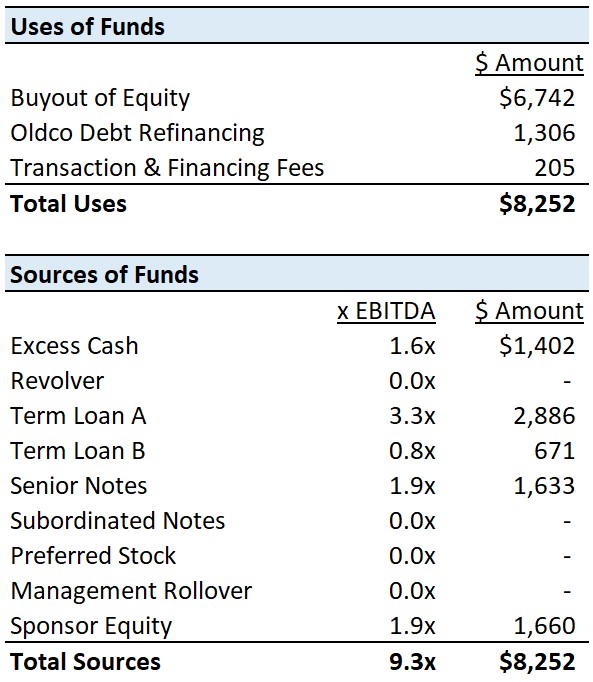
Q. What is the “Sources and Uses of Funds” section of an LBO model?
The “Sources and Uses of Funds” section of an LBO model outlines the amount of capital required to complete the transaction and how the proposed deal will be funded.
Uses Side→ The "Uses" side answers, "What does the firm need to buy and how much will it cost?" The most significant usage of funds in an LBO is the buyout of equity from the targets’ existing shareholders. Other uses include transaction fees paid to M&A advisors, financing fees, and oftentimes the refinancing of existing debt (i.e. replacing the debt).
Sources Side→ On the other hand, the “Sources” side answers: "Where is the funding coming from?" The most common sources of funds are various debt instruments, the equity contribution from the financial sponsor, excess cash on the balance sheet, and management rollover in some cases.
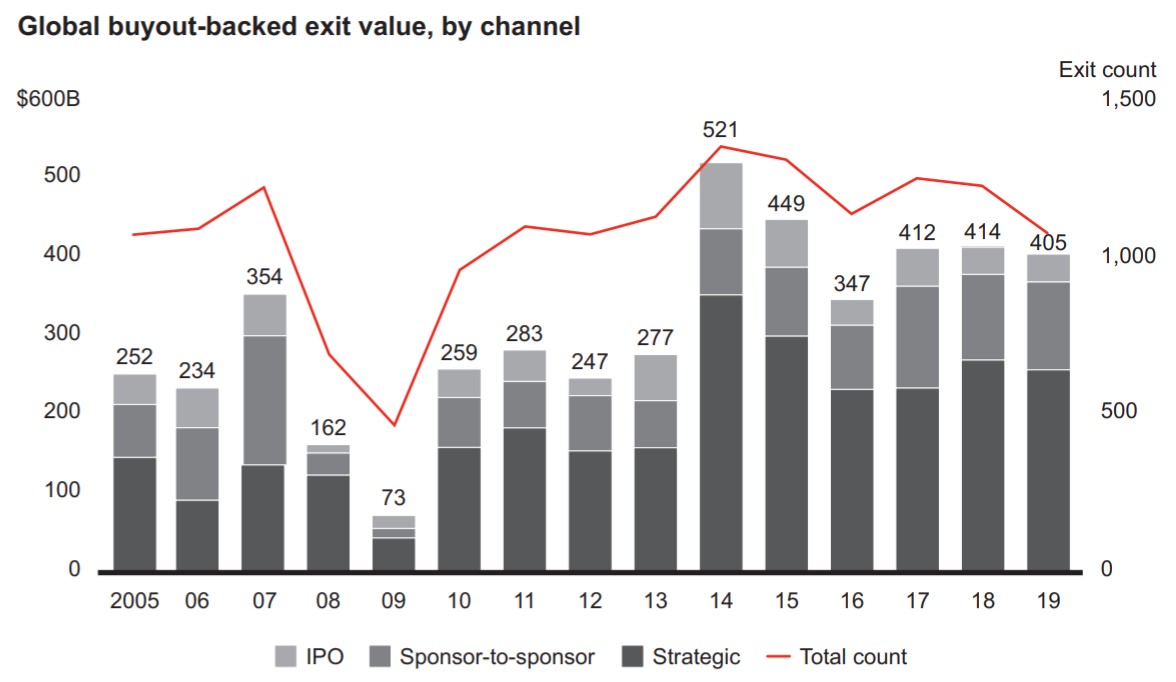
Q. How do private equity firms exit their investment?
The most common ways for a PE firm to monetize its investment are:
Sale to a Strategic Buyer → The sale to a strategic buyer tends to be the most convenient while fetching higher valuations as strategics are willing to pay a premium for the potential synergies.
Secondary Buyout (aka Sponsor-to-Sponsor Deal) → Another option is the sale to another financial buyer – but this is a less-than-ideal exit as financial buyers cannot pay a premium for synergies.
Initial Public Offering (IPO) → The third method for a private equity firm to monetize its profits is for the portfolio company to undergo an IPO and sell its shares in the public market – however, this is an option exclusive to firms of larger size (i.e. mega-funds) or club deals.
Q. What are the primary levers in an LBO that drive returns?
Deleveraging → Through the process of deleveraging, the value of the equity owned by the private equity firm grows over time as more debt principal is paid down using the cash flows generated by the acquired company.
EBITDA Growth → Growth in EBITDA can be achieved by making operational improvements to the business’s margin profile (e.g. cost-cutting, raising prices), implementing new growth strategies to increase revenue, and making accretive add-on acquisitions.
Multiple Expansion → Ideally, a financial sponsor hopes to acquire a company at a low entry multiple (“getting in cheap”) and then exit at a higher multiple. The exit multiple can increase from improved investor sentiment in the relevant industry, better economic conditions, and favorable transaction dynamics (e.g. competitive sale process led by strategic buyers). However, most LBO models conservatively assume the firm will exit at the same EV/EBITDA multiple it was purchased at. The reason is that the deal environment in the future is unpredictable and having to rely on multiple expansion to meet the return threshold is considered to be risky.
Q. What attributes make a business an ideal LBO candidate?
An ideal LBO candidate should have most (or all) of the following characteristics:
Steady, Predictable Cash Flow Generation
Operates in a Mature Industry with Defensible Market Positioning
Business Model with Recurring Revenue Component
Strong, Committed Management Team
Diversified Revenue Streams with Minimal Cyclicality
Low Capex Requirements & Working Capital Needs
Currently Undervalued by Market (i.e. Low-Purchase Multiple)
Q. What types of industries attract the most LBO deal flow?
The industries that tend to attract higher amounts of interest from private equity investors are those that are mature, growing at a moderate rate, and non-cyclical. The companies found in these types of industries are more likely to generate predictable revenue with fewer disruption risks from technological advancements or new entrants due to having high barriers to entry.
The ideal industry should exhibit stable growth in the upcoming years and have positive tailwinds that present growth opportunities. Typically, industries expected to contract or prone to disruption are avoided. Some PE firms do specialize in high-growth sectors (e.g. Vista Equity Partners, Thoma Bravo), but drift more so onto the side of growth equity than traditional buyouts.
Furthermore, if the investment strategy of the firm is based around roll-up acquisitions – the PE firm will look for fragmented industries where the consolidation strategy (i.e. “buy-and-build”) would be more viable since there are more potential add-on targets in the market.
Q. What would the ideal type of products/services being sold be for a potential LBO target?
Mission Critical→ The ideal product/service is essential to the end market being served. In other words, discontinuance should be detrimental to the customers’ business continuity, result in severe monetary consequences, or damage their reputation. For example, the decision for a data center to terminate its contract with its security solutions provider (e.g. video surveillance, access control) could impair the data center’s relationships with its existing customers in the case of a security breach and loss of confidential customer data.
High Switching Costs→ The decision to switch to another provider should come with high costs that make customers reluctant to move to a competitor. Said another way, the switching costs should outweigh the benefits of moving to a lower-cost provider.
Recurring Revenue Component → Products/services that require maintenance and have a recurring revenue component are more valuable given the greater predictability in revenue. In most cases, customers prefer to receive maintenance and other types of related services from the original provider they purchased the product from.
Ultimately, there are various avenues that you can go down when answering this question and it would be best to tailor your response based on the specific types of portfolio companies the firm owns and their investment strategy.
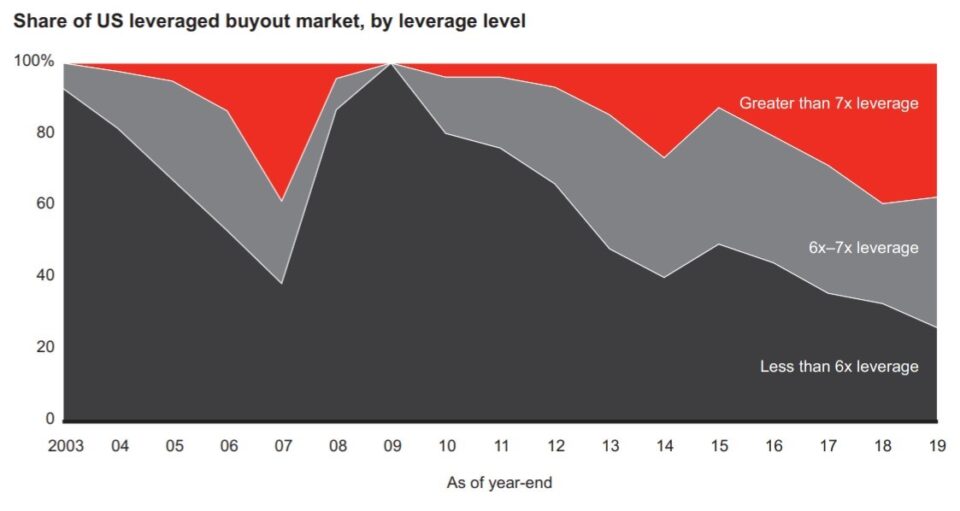
Q. What is the typical capital structure prevalent in LBO transactions?
The capital structure in an LBO tends to be cyclical and fluctuates depending on the financing environment, but there has been a structural shift from Debt to Equity ratios of 80/20 in the 1980s to around 60/40 in more recent years.
The different tranches of debt include leveraged loans (revolver, term loans), senior notes, subordinated notes, high-yield bonds, and mezzanine financing. The vast majority of the debt raised will be senior, secured loans by banks and institutional investors before riskier types of debt are used.
In terms of equity, the contribution from the financial sponsor represents the largest source of LBO equity. In some cases, the existing management team will roll over a portion of their equity to participate in the potential upside alongside the sponsor. Also, because most LBOs retain the existing management team, sponsors will usually reserve anywhere between 3% to 20% of the total equity as an incentive for the management team to meet financial targets.
Q. Which credit ratios would you look at when assessing the financial health of a borrower?
Leverage ratios compare the amount of debt held by a company to a specific cash flow metric, most often EBITDA. The leverage ratio parameters will be highly dependent on the industry and the lending environment; however, the total leverage ratio in an LBO ranges between 4.0x to 6.0x with the senior debt ratio typically around 3.0x
Total Debt / EBITDA
Senior Debt / EBITDA
Net Debt / EBITDA
Interest coverage ratios examine a company’s ability to cover its interest payments using its cash flows.
As a general rule of thumb: the higher the interest coverage ratio, the better (ideally >2.0x)
EBITDA / Interest Expense
(EBITDA – Capex) / Interest Expense
Q. List some of the red flags you would look out for when assessing a potential investment opportunity.
Industry Cyclicality: The ideal candidate for an LBO should generate predictable cash flows. Therefore, highly cyclical revenue and demand fluctuations based on the prevailing economic conditions (or other external factors) make an investment less attractive from a risk standpoint.
Customer Concentration: As a general rule of thumb, no single customer should account for more than ~5-10% of total revenue as the risk of losing that key customer due to unforeseen circumstances or the customer’s refusal to continue doing business with them (i.e. decides not to renew their contract) presents a significant risk.
Customer and Employee Churn: While the circumstances will be specific to the case, high rates of customer and employee churn are generally perceived as a negative sign as high customer churn creates the need for constant new customer acquisitions while low employee retention signals issues in the organizational structure of the target.
Q. When measuring returns, why is it necessary to look at both the internal rate of return (IRR) and cash-on-cash return?
The cash-on-cash multiple cannot be a standalone metric as it does not consider the time value of money, unlike the IRR calculation.
For instance, a 3.0x multiple may be impressive if achieved in five years. But whether it took five years or thirty years to receive those proceeds, the cash-on-cash multiple remains the same.
Over shorter time frames, the cash-on-cash multiple is more important than IRR – however, over longer time frames, it is better to achieve a higher IRR.
On the other hand, IRR is an imperfect standalone measure because it is highly sensitive to timing.
For example, receiving a dividend right after the acquisition immediately increases the IRR and could be misleading for near-term time frames.
Nonetheless, these two metrics are interlinked, and both are widely used by investors to assess returns accurately.
Q. What are some positive levers to increase the IRR on an LBO?
Earlier Receipt of Proceeds → Dividend Recapitalization, Sooner than Anticipated Exit, Opted for Cash Interest (as opposed to PIK Interest), Annual Sponsor Consulting Fees
Increased FCFs Generation → Achieved through Revenue and EBITDA Growth, Improved Margin Profile
Multiple Expansion → Exiting at a Higher Multiple than the Purchase Multiple (i.e. “Buy Low, Sell High”)
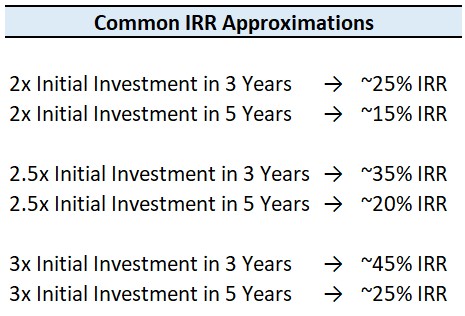
Q. A private equity firm has tripled its initial investment in five years, estimate the IRR.
If the initial investment tripled in five years, the IRR would be 24.6%.
Since it is very unlikely for you to be handed a calculator to solve this calculation, it is highly recommended that you memorize the most common IRR approximations as shown in the table below:
Q. If an LBO target had no existing debt on its closing balance sheet, would this increase the returns to the financial buyer?
Upon the completion of an LBO, the firm essentially wiped out the existing capital structure and recapitalized it using the sources of funds that were raised. When calculating the IRR and cash-on-cash returns, the companies’ debt balance pre-investment does NOT have a direct impact on returns.
Q.If you had to choose two variables to sensitize in an LBO model, which ones would you pick?
The entry and exit multiples would have the most significant impact on the returns in an LBO.
The ideal scenario for a financial sponsor is to purchase the target at a lower multiple and then exit at a higher multiple, as this results in the most profitable returns.
While the revenue growth, profit margins, and other operational improvements will all have an impact on the returns, it is to a much lesser degree than the purchase and exit assumptions.
Q.What is rollover equity and why is it viewed as a positive sign?
In some cases, the existing management team may roll over some or all of its equity into the newly acquired company and may even contribute additional capital alongside the financial sponsor.
Rollover equity is an additional source of funds and it reduces the amount of leverage necessary and the equity contribution from the financial sponsor to complete the deal.
Generally, if a management team is willing to roll over some equity into the new entity, it implies the team is doing so under the belief that the risk they are undertaking is worth the potential upside in it for them. It is overall beneficial for all parties involved in the deal for the management team to have “skin in the game” and altogether have closely aligned incentives.
Q.In the context of an LBO, what does the “tax shield” refer to?
In an LBO, the “tax shield” refers to the reduction in taxable income from the highly levered capital structure.
As interest payments on debt are tax-deductible, the tax savings provides an additional incentive for private equity firms to maximize the amount of leverage they can obtain for their transactions.
Because of the tax benefits attributable to debt financing, private equity firms can be incentivized to not repay the debt before the date of maturity assuming the prepayment is optional (i.e. "cash sweep").
Q.What is PIK interest?
PIK interest (“paid-in-kind”) is a form of non-cash interest, meaning the borrower compensates the lender in the form of additional debt as opposed to cash interest.
PIK interest typically carries a higher interest rate because it has a higher risk to the investor (i.e. delayed payments result in less certainty of being paid).
From the perspective of the borrower, opting for PIK conserves cash in the current period and thus represents a non-cash add-back on the CFS.
However, PIK interest expense is an obligation that accrues towards the debt balance due in the final year and compounds on an annual basis.
Q.How does the treatment of financing fees differ from transaction fees in an LBO model?
Financial Fees → Financing fees are related to raising debt or the issuance of equity and can be capitalized and amortized over the tenor of the debt (~5-7 years).
Transaction Fees → On the other hand, transaction fees refer to the M&A advisory fees paid to investment banks or business brokers, as well as the legal fees paid to lawyers. Transaction fees cannot be amortized and are classified as one-time expenses that are deducted from a company’s retained earnings.
Q.If an acquirer writes up the value of the intangible assets of the target, how is goodwill impacted?
During an LBO, intangible assets such as patents, copyrights, and trademarks are often written up in value.
Goodwill is simply an accounting concept used to “plug” the difference between the purchase price and fair value of the assets in the closing balance sheet – so, a higher write-up means the assets being purchased are actually worth more.
Therefore, a higher write-up of intangible assets means less goodwill will be created on the date of the transaction.
Note: Goodwill cannot be amortized by publicly traded companies under US GAAP – however, private companies can opt to amortize goodwill for tax reporting purposes. This question is in reference to the purchase accounting on the closing date of the transaction.
Q.What is an add-on acquisition and how does it create value?
An add-on acquisition is when a portfolio company of a private equity firm (called the “platform”) acquires a smaller company. The strategic rationale for bolt-on acquisitions is that the add-on will complement the platform companies’ existing product/service offerings – thus, enabling the company to realize synergies, as well as enter new end markets.
One of the reasons that add-ons are a common strategy employed in private equity is because the acquisition target will more often than not be valued at a lower multiple than the acquirer (and thus be an accretive transaction).
For example, if a company valued at 15.0x EBITDA purchases a smaller company for 7.5x EBITDA, the earnings of the add-on target will automatically be priced at 15.0x post-closing in theory. Once the transaction has successfully closed, the cash flows of the newly acquired company will immediately be valued at the multiple of the platform company – instantly creating value for the combined entity.
Another positive consequence provided by the roll-up strategy is that it allows platform companies to better compete with strategic buyers in sale processes.
Q. What is a dividend recapitalization?
A dividend recapitalization is when a private equity firm raises additional debt with the sole purpose of issuing themselves (i.e. the equity shareholders) a dividend.
Recaps are done to monetize profits from an investment before a complete exit and have the benefit of increasing the IRR to the fund due to the earlier receipt of proceeds.
Completing a dividend recap is often considered to be a risky action that should only be undertaken when an LBO is proceeding better than originally anticipated and the acquired company has the financial stability to take on the additional leverage raised.
Q.Why is an LBO analysis often referred to as a “floor valuation”?
An LBO model provides a "floor valuation” for an investment as it is used to determine what the financial sponsor can afford to pay for the target while still realizing the typical 20%+ IRR.
In other words, the question being answered from the perspective of the private equity investor is: "What is the maximum amount that we can pay while still meeting our fund's return hurdle?"
Frequently Asked Questions
What are examples of "investing acumen" questions asked in a private equity interview?
Investing acumen questions typically ask candidates to pitch a stock or company they find interesting, walk through an investment thesis, or discuss a recent deal in the news and share their opinion on whether it made sense. Interviewers use these questions to assess genuine investment judgment and curiosity about markets, rather than just technical modeling ability, since a candidate who can only execute an LBO model but can't articulate why a business is a good investment is a weaker hire for most funds.
What are examples of behavioral or "fit" questions in a private equity interview?
Common fit questions include "walk me through your resume," "why private equity," "why this firm specifically," and questions about a time you disagreed with a team member or made a difficult decision under pressure. These questions are meant to assess whether a candidate's motivations are genuine and well-researched, and whether they'd mesh well with a small, close-knit deal team, since private equity firms are typically much smaller than investment banks and culture fit carries more weight.
What's the difference between on-cycle and off-cycle private equity recruiting?
On-cycle recruiting refers to the compressed, highly structured process where larger private equity funds interview investment banking analysts extremely early, sometimes within months of starting their banking job, for positions that won't start for another year or more. Off-cycle recruiting happens on a rolling, less predictable basis throughout the year, typically for smaller funds, mid-sized firms, or roles that open up due to specific hiring needs rather than a fixed annual class. Off-cycle processes tend to move faster from first interview to offer, but with less advance notice.
How many rounds does a typical private equity interview process have?
Most private equity interview processes involve three to five rounds, typically starting with a recruiter or associate screen, followed by one or two rounds of technical and behavioral interviews with senior team members, and often culminating in a modeling test or case study before a final round with partners. Larger, more competitive funds tend to have more rounds and may add a superday format that compresses multiple interviews into a single day.
Do private equity interviews require deep knowledge of the specific industries a firm invests in?
Yes, candidates are often expected to research and speak intelligently about the specific sectors a firm focuses on, since firm-specific industry questions are a standard category in PE interviews. This might include discussing recent deals the firm has done, trends affecting their target industries, or what makes a company in that space an attractive LBO candidate, and coming in without this research is one of the more common reasons candidates lose points even after performing well on the technical questions.
How is a private equity case study different from a paper LBO test?
A paper LBO is a quick, verbal or handwritten exercise meant to test whether a candidate understands the core mechanics of an LBO within five to ten minutes, using simplified, round numbers. A case study is a much longer, more realistic exercise, often a multi-hour or take-home assignment, where candidates build a full LBO model from a real or realistic set of financials, form an investment thesis, and present their recommendation, testing both technical execution and judgment in a way a paper LBO can't capture.
What's the best way to answer "walk me through your resume" in a private equity interview?
The strongest answers frame a candidate's career as a coherent, forward-moving story that logically leads to private equity, emphasizing deal experience, specific technical skills developed, and moments that shaped their interest in investing rather than simply listing job titles chronologically. Candidates should be ready to speak in detail about any deal or transaction mentioned on their resume, since interviewers frequently drill into specifics to test whether the experience was genuinely substantive.
What is the "why private equity" question really testing for?
This question is testing whether a candidate has a genuine, well-reasoned interest in investing rather than simply chasing the prestige, pay, or perceived next step after investment banking. Strong answers typically connect specific experiences, such as a deal that sparked genuine interest in ownership and value creation, to why private equity's long-term, hands-on investment approach appeals to them more than public markets or continuing in banking.
Should you ask questions at the end of a private equity interview?
Yes, and it's expected. Strong questions to ask include how the firm sources deals, what the investment team looks for in a portfolio company beyond the numbers, or how the culture and team structure differ from the candidate's current role. Avoid questions that could easily be answered by researching the firm beforehand, since asking something already covered on the firm's website can signal a lack of preparation rather than genuine curiosity.
How long does the private equity recruiting process typically take from first interview to offer?
For on-cycle recruiting at larger funds, the entire process can move shockingly fast, sometimes compressed into just a few days once interviews begin, given the competitive rush to lock in top candidates early. Off-cycle processes at smaller or mid-sized funds tend to be slower and more spread out, often taking two to six weeks from the first interview to a final offer, depending on how quickly the firm needs to fill the role.
For question: “What are some positive levers to increase the IRR on an LBO?” Why does using cash interest increases IRR? I would assume that using PIK would increase IRR as you can use the increased FCF for dividend repayments or other levers to increase IRR.
Brad Barlow
May 9, 2024 12:19 pm
Hi, Claudius,
If you use the cash that would have paid interest to pay dividends instead, then it may indeed increase IRR, but there are often restrictions on this, and the cash is required to be used to make optional prepayments on term loans before dividends can be paid. So, with that in mind, paying cash interest on a note might increase IRR over accruing PIK interest at a higher interest rate.
BB
claudius
May 9, 2024 4:49 pm
Thanks Brad. I’m still not sure why this should lead to an earlier receipt of proceeds. In general, yes it increases IRR if you pay less interest on debt. You should always opt for the cheapest debt options. But why should it affect earlier proceeds?
I would even assume that in the short-term, you would increase FCF by using PIK, and thus decrease IRR.
Brad Barlow
May 12, 2024 9:07 pm
Hi, Claudius,
Dividends would lead to earlier receipt of proceeds, but I’m not assuming you can pay them. So not sure what you mean by earlier proceeds. What I am saying is that if you opt for PIK interest at a higher rate rather than negotiating a lower rate and paying cash interest on your notes, rather than making optional prepayments on lower-interest rate term loans, then you will likely increase IRR to equity.








For question: “What are some positive levers to increase the IRR on an LBO?” Why does using cash interest increases IRR? I would assume that using PIK would increase IRR as you can use the increased FCF for dividend repayments or other levers to increase IRR.
Hi, Claudius,
If you use the cash that would have paid interest to pay dividends instead, then it may indeed increase IRR, but there are often restrictions on this, and the cash is required to be used to make optional prepayments on term loans before dividends can be paid. So, with that in mind, paying cash interest on a note might increase IRR over accruing PIK interest at a higher interest rate.
BB
Thanks Brad. I’m still not sure why this should lead to an earlier receipt of proceeds. In general, yes it increases IRR if you pay less interest on debt. You should always opt for the cheapest debt options. But why should it affect earlier proceeds?
I would even assume that in the short-term, you would increase FCF by using PIK, and thus decrease IRR.
Hi, Claudius,
Dividends would lead to earlier receipt of proceeds, but I’m not assuming you can pay them. So not sure what you mean by earlier proceeds. What I am saying is that if you opt for PIK interest at a higher rate rather than negotiating a lower rate and paying cash interest on your notes, rather than making optional prepayments on lower-interest rate term loans, then you will likely increase IRR to equity.
BB