What is the Time Value of Money?
The Time Value of Money is a core principle of valuation that states that money as of the present date carries more value than the same amount received in the future.

The Time Value of Money is a core principle of valuation that states that money as of the present date carries more value than the same amount received in the future.
Under the time value of money (TVM) concept, a dollar received today is worth more than a dollar received at a later date — which is one of the most fundamental concepts in corporate finance.
In short, receiving money today is preferable (i.e. more valuable) than receiving the same amount of money on a later date.
There are two main reasons that underpin the TVM theory:
Since money tends to decline in value over time due to factors such as inflation, the purchasing power of money also decreases.
With that said, cash flows received in the future (and with increased uncertainty) are worth less than the present value (PV) of the cash flows.
If you risk one dollar in an investment, you should reasonably expect gains of more than solely your initial one-dollar contribution as a return.
For each incremental unit of risk you take on, you should expect a proportionally higher return in exchange.
The time value of money (TVM) matter because it serves as the basis of the net present value (NPV) calculation.
Briefly, suppose there are two investment options, as outlined below:
To pick the "right" option rationally, you must consider the time value of money, which is essentially the required rate of return (i.e. cost of capital).
In this example, $11,000 is 10% greater than $10,000 — this serves as the minimum required rate of return if you would be indifferent between these investment options.
For the second option to make sense from a monetary perspective, the returns should exceed that of the 1st option, i.e. if you receive the $10,000 on the present date and receive a return >10%, you should pick the first option, as it is more profitable.
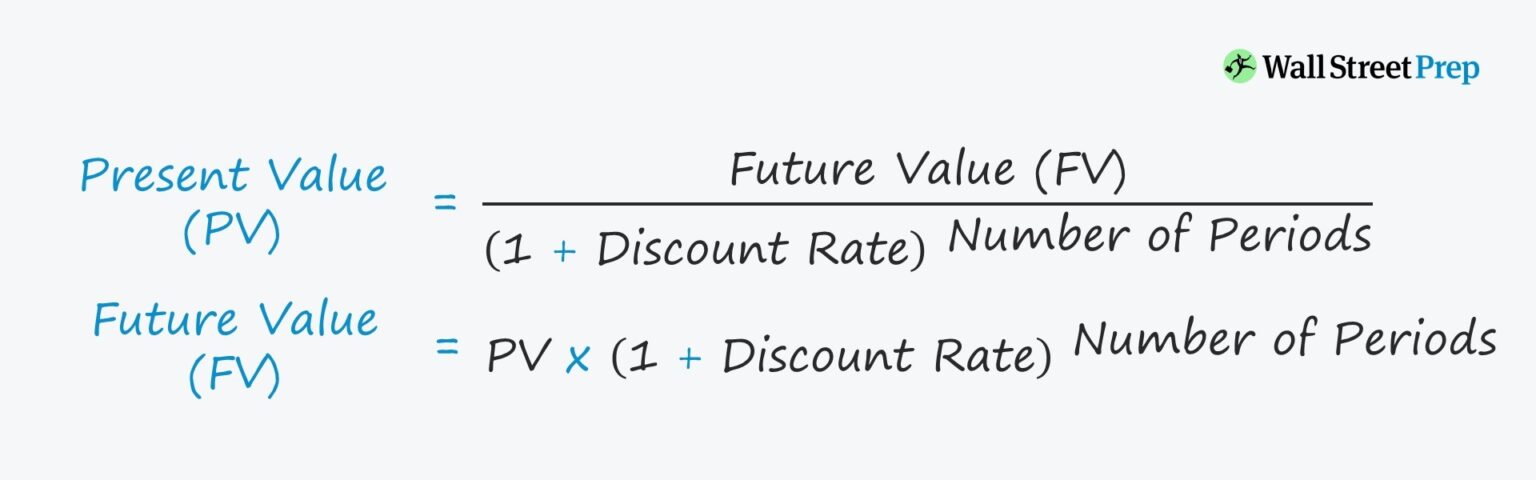
The formula for the time value of money, from the perspective of the current date, is as follows:
Where:
Alternatively, to calculate the future value given the present value, the formula used is:
In both formulas, “i” represents the rate of interest on comparable investments.
For instance, if the present value (PV) of an investment is $10 million, and the amount is invested at a rate of return of 10% for one year, the future value (FV) is equal to:
Moreover, using the same formula as above, we can calculate the future value (FV) assuming quarterly compound interest — i.e. 4.0x times a year:
Thus, the calculation for our example is as follows:
We’ll now move to a modeling exercise, which you can access by filling out the form below.


Suppose you're offered the following two options to pick from:
The determinant of which option is more profitable is the time value of money (TVM).
If we assume a 10% discount rate, which option should you proceed with?
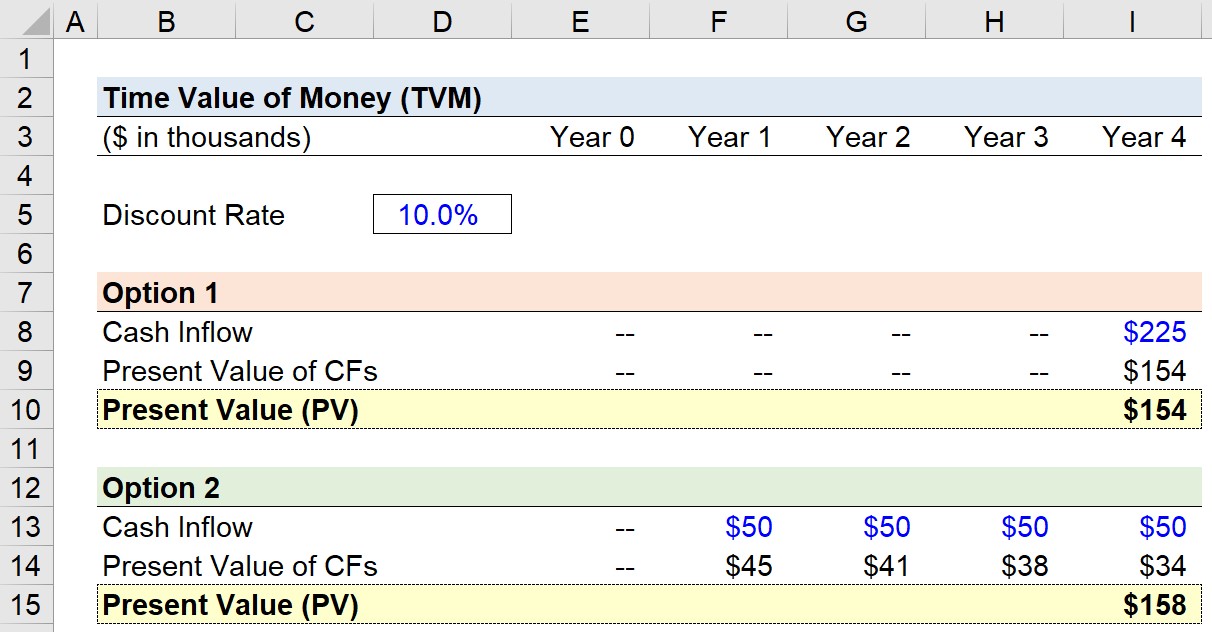
For both option 1 and option 2, we'll list out the cash inflow for each year.
While option 1 consists of a one-time payment of $225,000, option 2 consists of four payments of $50,000.
The formula for discounting each cash flow is the future value (FV) divided by (1 + discount rate), which is then raised to the power of the period number.
Once completed for each year, the sum of the discounted cash flows equals the present value of the option, i.e. how much the future cash flows are worth on the present date.
In our simple example, option 2 is worth more than option 1. But of course, there are far more considerations in reality that can complicate the decision-making process.

Enroll in The Premium Package: Learn Financial Statement Modeling, DCF, M&A, LBO and Comps. The same training program used at top investment banks.


No comments yet.