What is Buyback Yield?
The Buyback Yield is the ratio between the value of a company’s net stock repurchases and its market capitalization as of the beginning of a period, expressed as a percentage.

The Buyback Yield is the ratio between the value of a company’s net stock repurchases and its market capitalization as of the beginning of a period, expressed as a percentage.
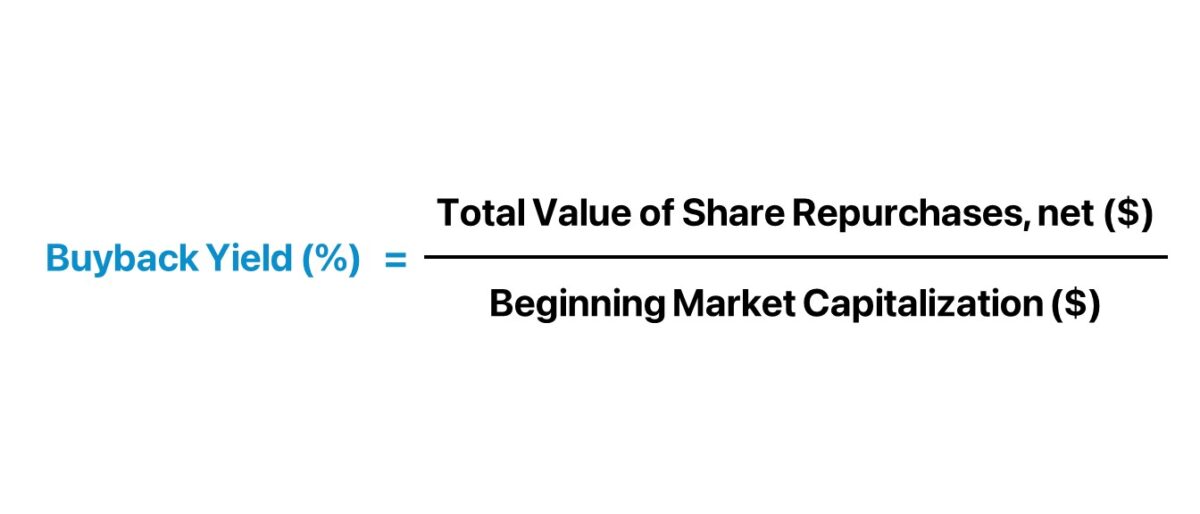
The buyback yield reflects the percentage of a company’s market capitalization (or “market cap”) returned to common shareholders in the form of stock buybacks.
Stock buybacks, often referred to as “share repurchases”, is a method for corporations to return value to its shareholders, i.e. equity investors. The rationale for stock buybacks, similar to the issuance of dividends, is to return value to investors.
In recent times, however, publicly-traded companies are increasingly more likely to utilize stock repurchases in lieu of dividends for various reasons.
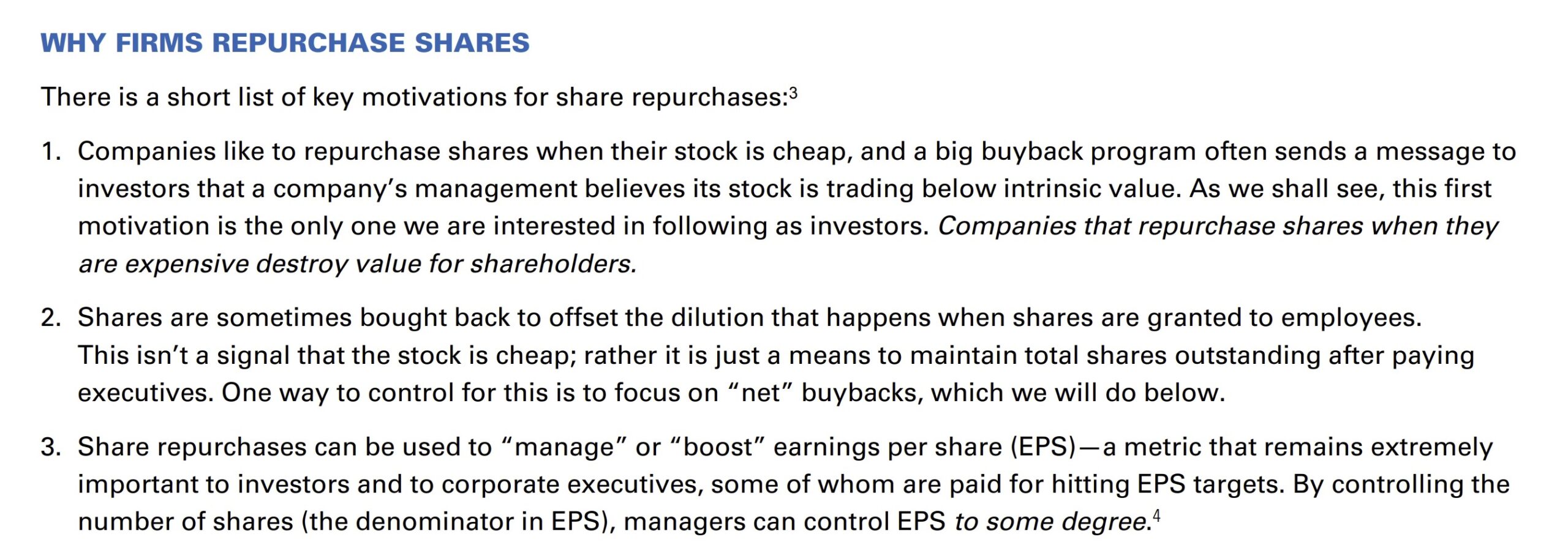
The Power of Share Repurchases (Source: OSAM)
Learn how institutional investors identify high-potential undervalued stocks. Enrollment is open for the upcoming cohort.
Generally speaking, for corporations with aggressive stock buyback programs, maintaining a high buyback ratio is not a sustainable, long-term strategy to drive shareholder returns.
Rather, a high buyout ratio is the function of a corporation with a strong fundamental profile in terms of profitability and growth trajectory, i.e. it is the consequence, not the cause.
For example, a notable public company with one of the most significant share repurchases is Apple (AAPL). From 2012 to the end of fiscal year 2022, Apple spent in excess of $572 billion on stock buybacks.
However, the notion that stock buybacks can create long-term shareholder value is a controversial topic, as many critics perceive share repurchases as near-term oriented tactics to cause an artificial rise in its market value per share.
The market value of a company frequently rises following the buyback, yet the fundamental drivers of valuation – e.g. revenue growth, profit margins, and free cash flow generation (FCF) – remain the same, which is the premise of the argument that stock buybacks do not create real shareholder value.
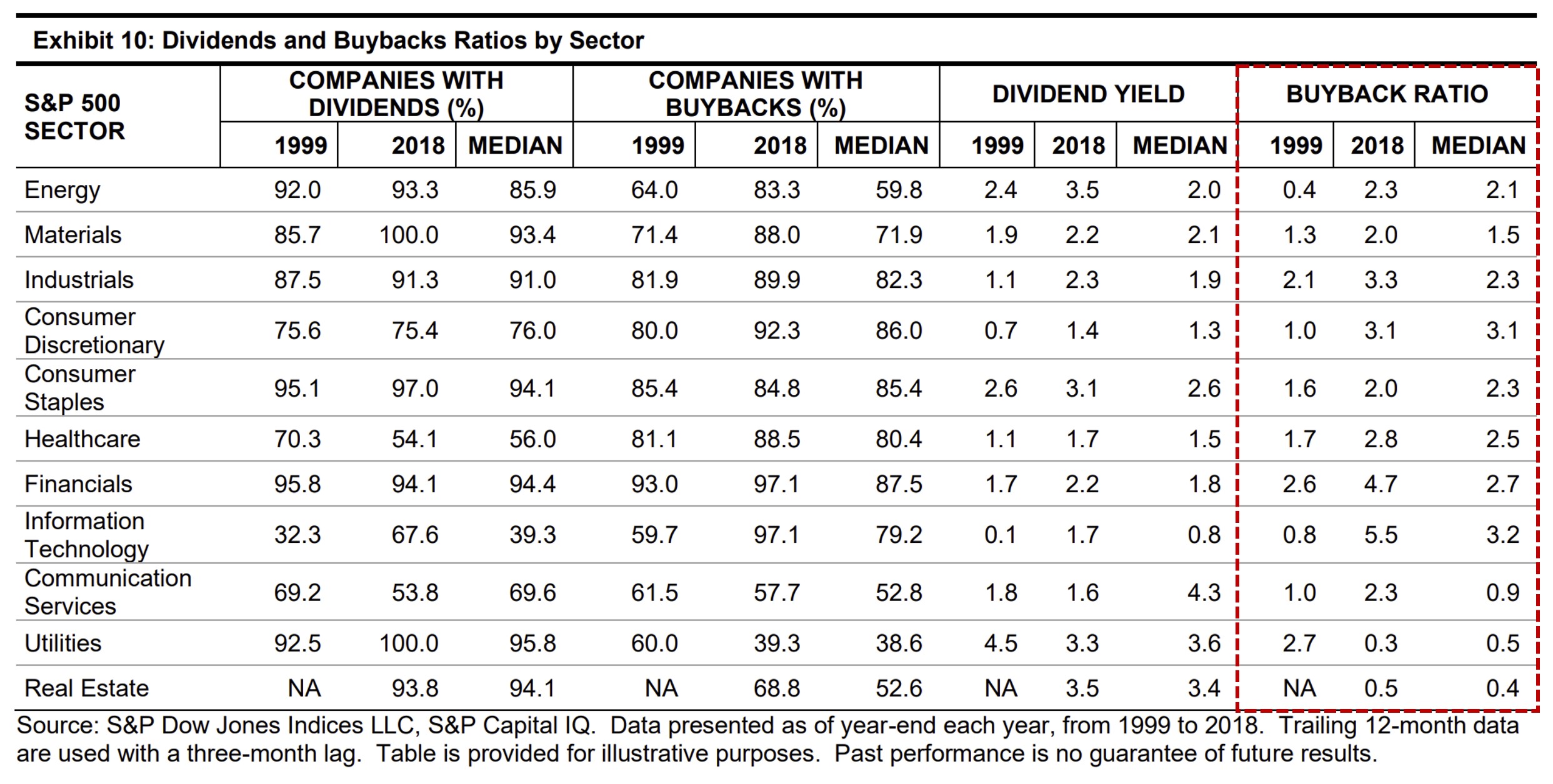
Buyback Ratio by Sector (Source: S&P Capital IQ)
The buyback yield is calculated as the total value of share buybacks in a given period divided by the company’s market capitalization at the beginning of the period, with the most common periodicity used in the ratio being the next twelve months.
The step-by-step process to calculate the buyback yield is as follows.
The formula to calculate the buyback yield on a gross basis is as follows.
But since corporations frequently issue new shares over the course of a given period (e.g. stock based compensation), the following buyback yield formula – expressed on a net basis – should be used instead.
The short-form formula to calculate the net buyback yield is as follows.
The resulting yield is expressed as a percentage, indicating the proportion of a company’s market cap as of the beginning of the year was returned to shareholders via share buybacks.
The total value of share buybacks is determined as the product of the number of shares purchased and the price at which the repurchase occurred.
Therefore, it is necessary to compute the value returned using the granular data found in the public filings of the company that pertain to each share repurchase transaction.
We’ll now move to a modeling exercise, which you can access by filling out the form below.

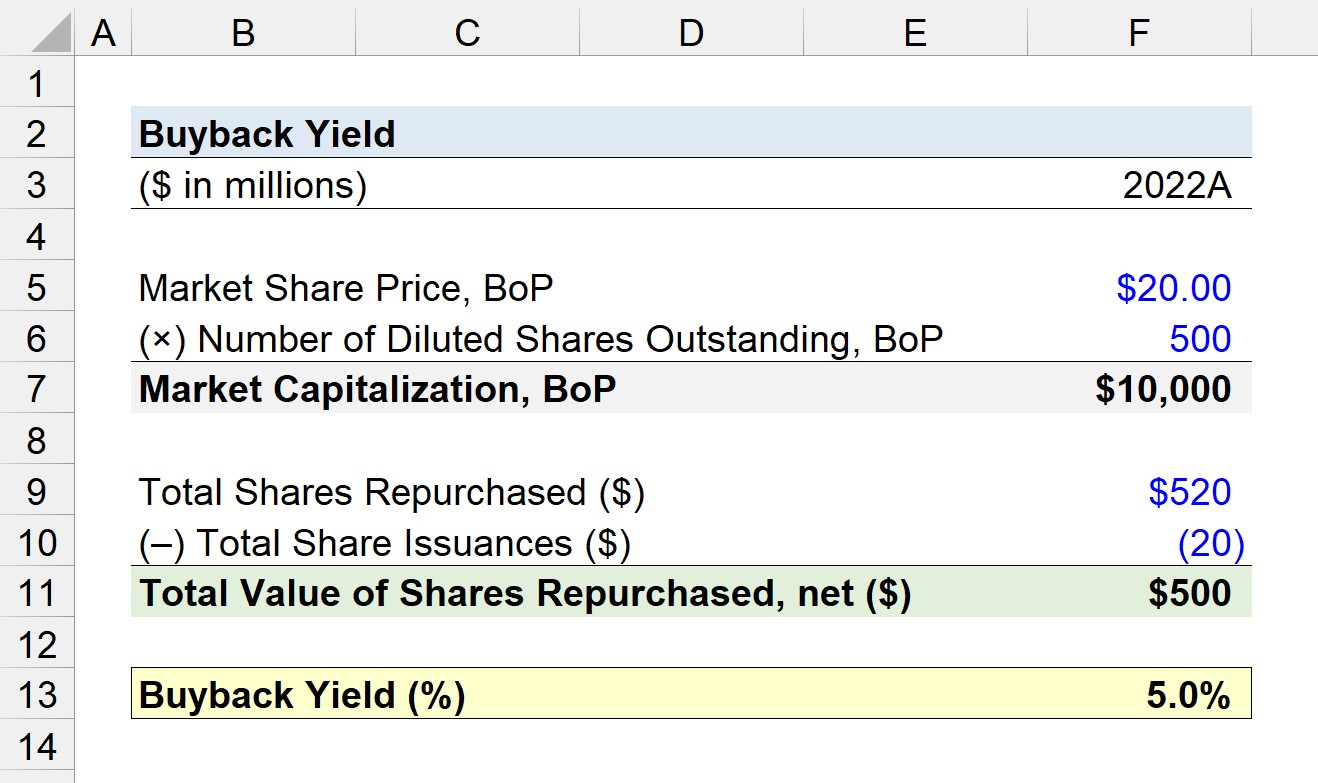
Suppose a publicly traded corporation had a market capitalization of $10 billion as of the beginning of fiscal year 2022.
From the start of 2022 to the end of the fiscal year, the total monetary value of the shares repurchased to date totaled $520 million, whereas the total value of the new stock issuances amounted to $20 million.
Therefore, the net stock issuance for 2022 was $500 million, which we’ll divide by the market capitalization at the beginning of the fiscal year to arrive at a buyback yield of 5.0%.
In conclusion, the 5.0% buyback yield of our hypothetical corporation implies that 5.0% of the company’s market cap at the start of 2022 was returned to shareholders in the form of stock buybacks over the course of the next twelve months.


No comments yet.