What is Accounting Rate of Return?
The Accounting Rate of Return (ARR) is the average net income earned on an investment (e.g. a fixed asset purchase), expressed as a percentage of its average book value.

The Accounting Rate of Return (ARR) is the average net income earned on an investment (e.g. a fixed asset purchase), expressed as a percentage of its average book value.
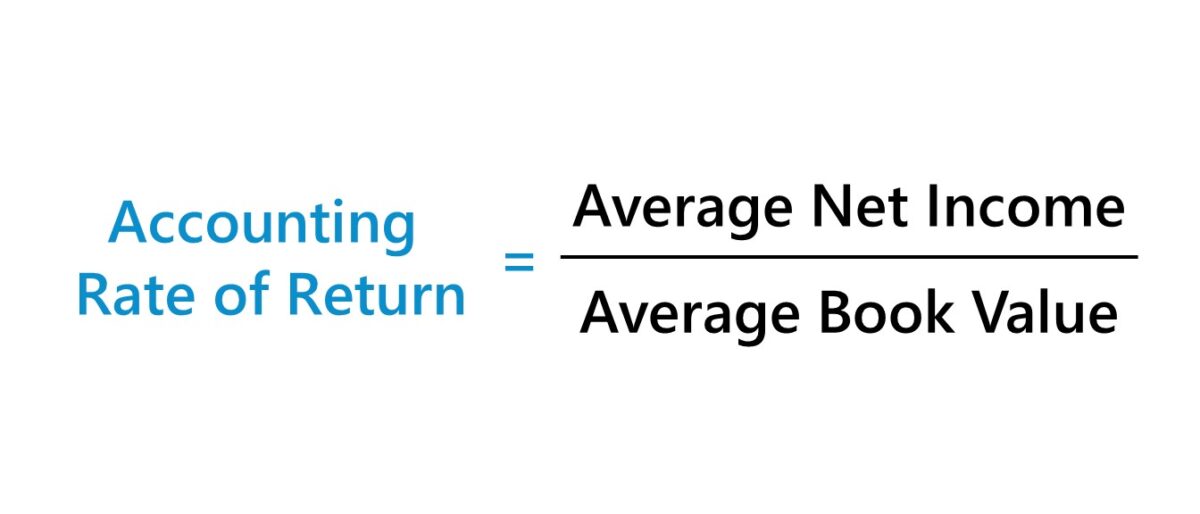
In capital budgeting, the accounting rate of return, otherwise known as the "simple rate of return", is the average net income received on a project as a percentage of the average initial investment.
By comparing the average accounting profits earned on a project to the average initial outlay, a company can determine if the yield on the potential investment is profitable enough to be worth spending capital on.
If the project generates enough profits that either meet or exceed the company's "hurdle rate" – i.e. the minimum required rate of return – the project is more likely to be accepted (and vice versa).
The primary drawback to the accounting rate of return is that the time value of money (TVM) is neglected, much like with the payback period. Hence, the discounted payback period tends to be the more useful variation.
The formula to calculate the accounting rate of return is as follows.
On the income statement, net income (i.e. the "bottom line") is a company's accrual-based accounting profit after all operating costs (e.g. COGS, SG&A and R&D) and non-operating costs (e.g. interest expense, taxes) are deducted.
The standard conventions as established under accrual accounting reporting standards that impact net income, such as non-cash expenses (e.g. depreciation and amortization), are part of the calculation.
The average book value refers to the average between the beginning and ending book value of the investment, such as the acquired fixed asset.
Where:
We’ll now move on to a modeling exercise, which you can access by filling out the form below.


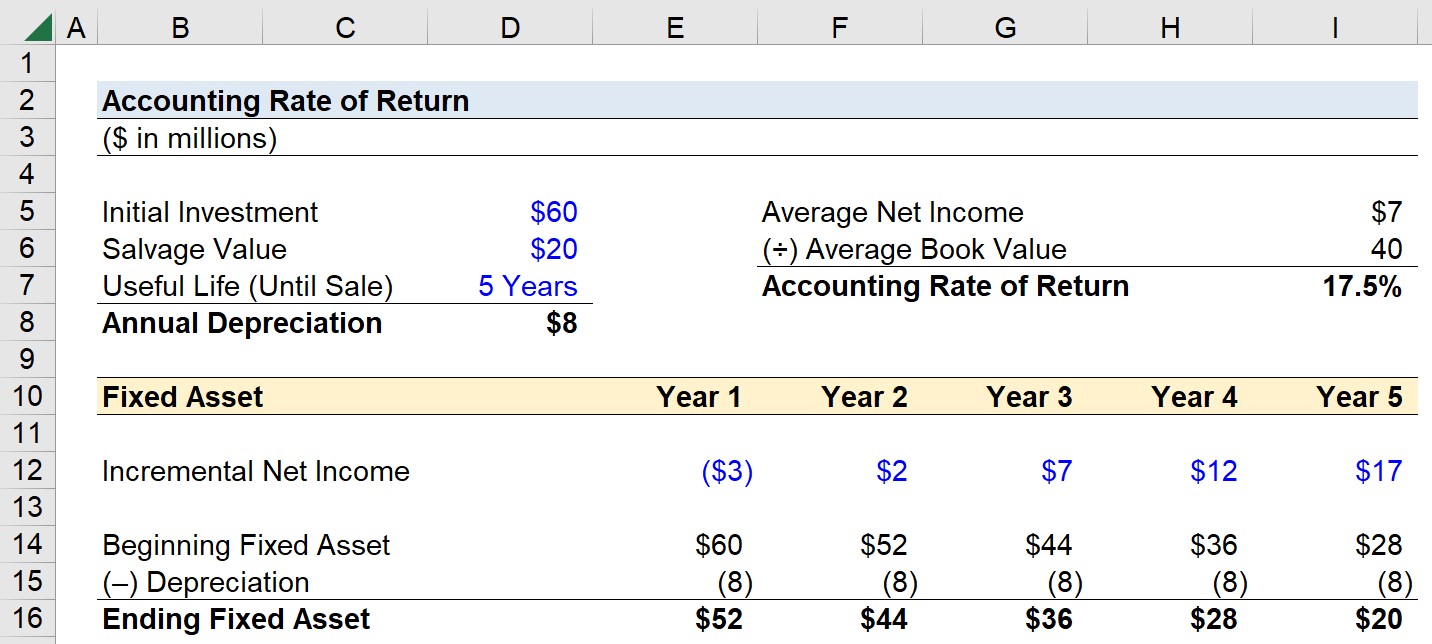
Suppose you're tasked with calculating the accounting rate of return from purchasing a fixed asset using the following assumptions.
Given those figures, we can determine the depreciation is $8 million per year.
The incremental net income generated by the fixed asset – assuming the profits are adjusted for the coinciding depreciation – is as follows.
Next, we'll build a roll-forward schedule for the fixed asset, in which the beginning value is linked to the initial investment, and the depreciation expense is $8 million each period.
The ending fixed asset balance matches our salvage value assumption of $20 million, which is the amount the asset will be sold for at the end of the five-year period.
With the two schedules complete, we'll now take the average of the fixed asset's net income across the five-year time span and divide it by the average book value.
The total profit from the fixed asset investment is $35 million, which we'll divide by five years to arrive at an average net income of $7 million.
The average book value is the sum of the beginning and ending fixed asset book value (i.e. the salvage value) divided by two.
In conclusion, the accounting rate of return on the fixed asset investment is 17.5%.

Enroll in The Premium Package: Learn Financial Statement Modeling, DCF, M&A, LBO and Comps. The same training program used at top investment banks.


No comments yet.