How to Calculate Gordon Growth Model (GGM)?
The Gordon Growth Model (GGM), named after economist Myron J. Gordon, calculates the fair value of a stock by examining the relationship between three variables.
- Dividends Per Share (DPS) ➝ DPS is the value of each declared dividend issued to shareholders for each common share outstanding, and represents how much money shareholders should expect to receive on a per-share basis.
- Dividend Growth Rate (g) ➝ The dividend growth rate is the projected rate of annual growth, which in the case of a single-stage GGM, a constant growth rate is assumed.
- Required Rate of Return (r) ➝ The required rate of return is the “hurdle rate” demanded by equity shareholders to invest in the company’s shares with consideration towards other opportunities with similar risks in the stock market.
Given the fixed dividend issuance growth rate assumption, the Gordon Growth Model is suited for companies with steady dividend growth and no plans for adjustments.
Thus, the GGM is used most frequently for mature companies in established markets with minimal risks that would create the need to cut (or end) their dividend payout program.
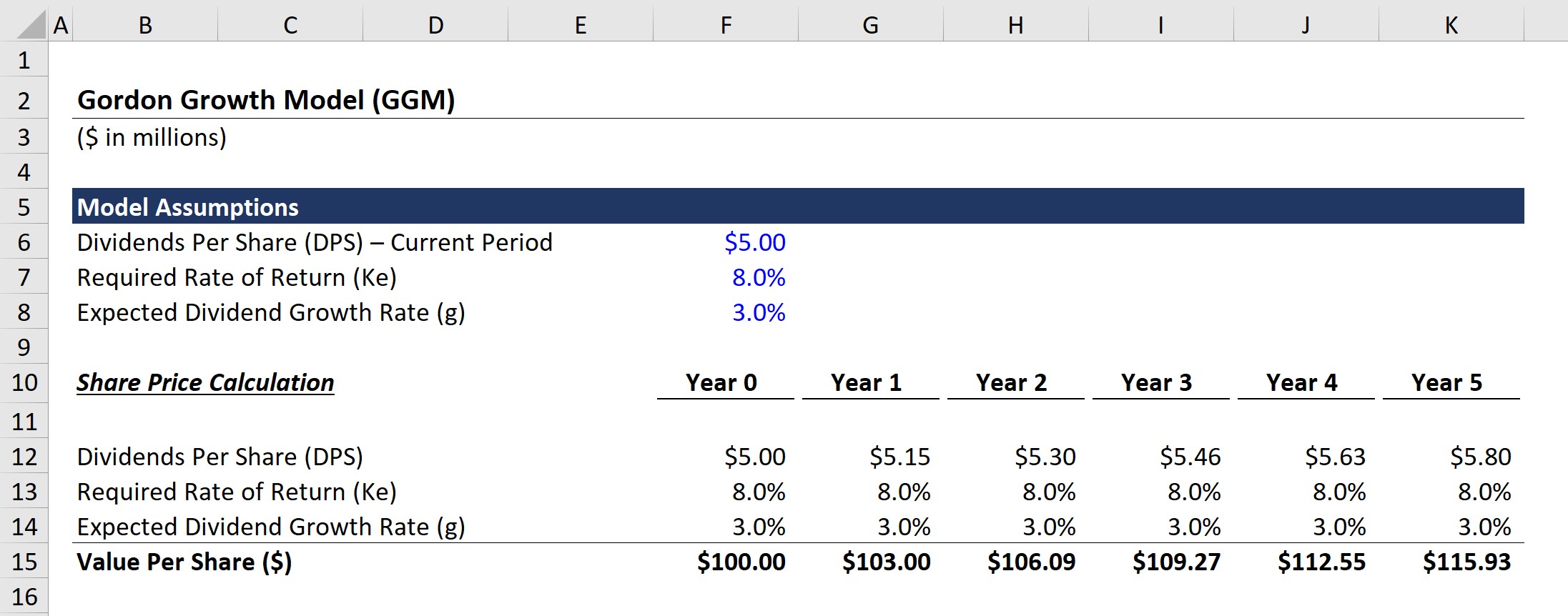
The Gordon Growth Model approximates the intrinsic value of a company’s shares using the dividend per share (DPS), the growth rate of dividends, and the required rate of return.
- Undervalued ➝ If the share price calculated from the GGM is greater than the current market share price, the stock is undervalued and could be a potentially profitable investment.
- Overvalued ➝ If the calculated share price is less than the current market price, the shares are considered overvalued.
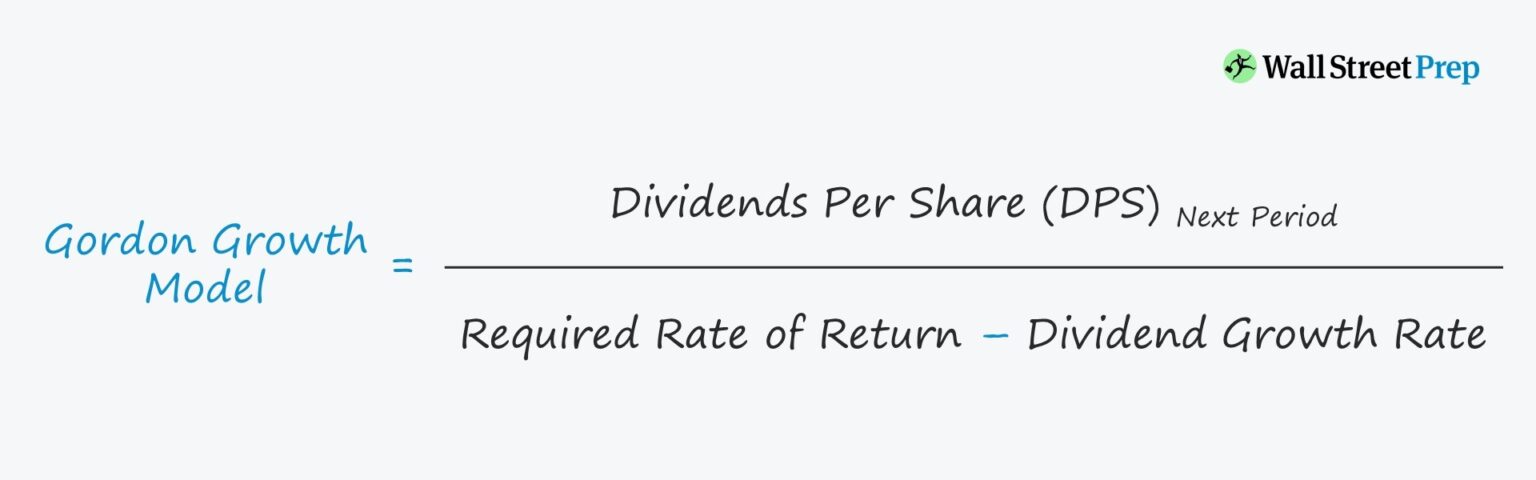
The Gordon Growth Model (GGM) values a company's share price by assuming constant growth in dividend payments.
The formula requires three variables, as mentioned earlier, which are the dividends per share (DPS), the dividend growth rate (g), and the required rate of return (r).
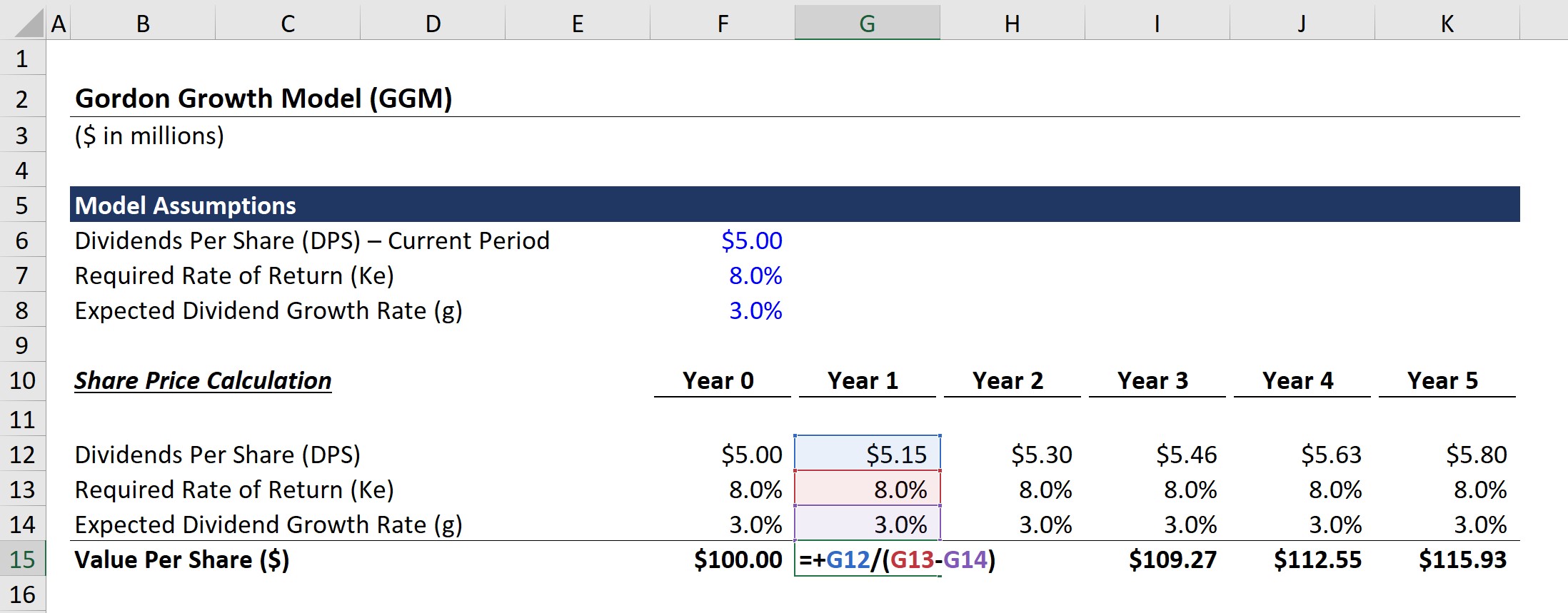
Gordon Growth Model (GGM) = Next Period Dividends Per Share (DPS) ÷ (Required Rate of Return – Dividend Growth Rate)
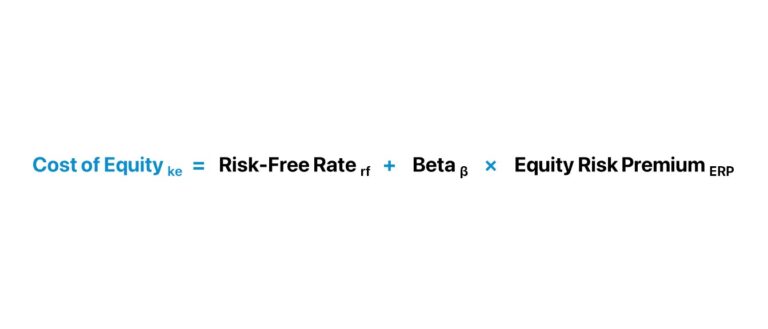
Since the GGM pertains to equity holders, the appropriate required rate of return (i.e., the discount rate) is the cost of equity.
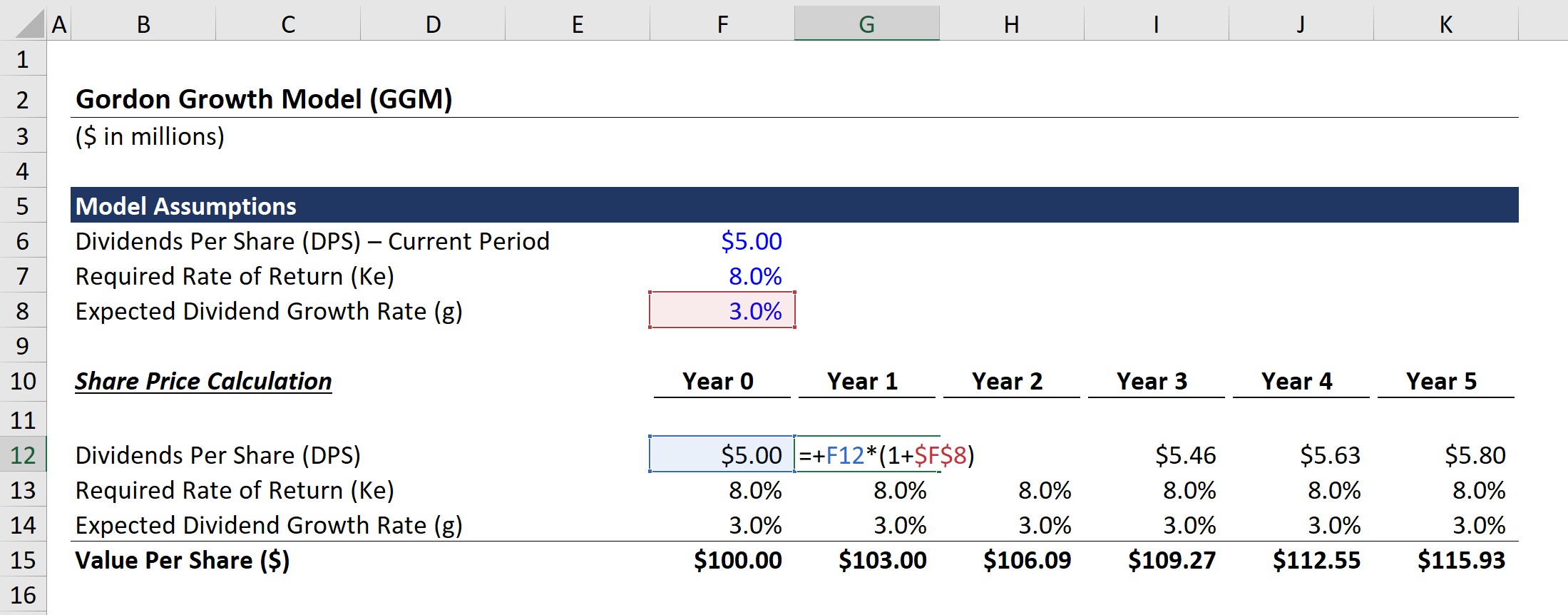
If the expected DPS is not explicitly stated, the numerator can be calculated by multiplying the DPS in the current period by (1 + Dividend Growth Rate %).
For example, if a company’s shares are trading at $100 per share and a minimum required rate of return of 10% (r) with plans to issue a $4.00 dividend per share (DPS) next year, which is expected to increase by 5% annually (g).
- Value Per Share = $4.00 ÷ (10.0% – 5.0%) = $80.00
Given the output, the key takeaway here is that the share price of the company is implied to be overpriced by approximately 25.0% ($100 vs. $85).
DCF Terminal Value Calculation – Growth in Perpetuity Approach
Often referred to as the “Growth in Perpetuity Approach” in DCF analyses, another use-case of the Gordon Growth Model is to calculate the terminal value (TV) of a company at the end of the stage-one cash flow projection period.
To calculate the terminal value, a perpetual growth rate assumption is attached for the forecasted cash flows beyond the initial forecast period.
Terminal Value = [Final Year FCF × (1 + Perpetuity Growth Rate)] ÷ (Discount Rate – Perpetuity Growth Rate)
How to Calculate Cap Rate Using Gordon Growth Model
In the context of real estate investing, the Gordon Growth Model offers an alternative method to calculate the capitalization rate (or “cap rate”) by assuming a consistent annual growth rate in net operating income (NOI).
The Gordon Growth Model (GGM) estimates the value of a property, such as a residential apartment complex or commercial office building, based on its net operating income (NOI), discount rate, and steady growth rate.
The practical utility of the GGM in real estate is contingent on determining an appropriate growth rate, as the equation consists of merely three components:
The cap rate can be expressed as the discount rate subtracted by the perpetual growth rate assumption, i.e., the growth rate at which the cash flow will increase by on a perpetual basis.
Conceptually, the Gordon Growth Model (GGM) states the cap rate is the difference between the property's expected annual rate of return and the expected annual growth in net operating income (NOI).
The formula used to determine the valuation of a real estate property using the Gordon Growth Model is equal to net operating income (NOI) divided by the difference between the discount rate and constant growth rate assumption.
Property Value = Net Operating Income (NOI) ÷ (Discount Rate – Growth Rate)
The constant growth rate must be reasonable, since the implicit assumption is that the NOI of the property will continue to grow at that rate in perpetuity, which refers to a set of cash flows that will continue indefinitely.
The cap rate is the difference between the discount rate and perpetual growth rate.
Cap Rate (%) = Discount Rate – Perpetual Growth Rate
Like earlier, the constant growth rate (g) cannot exceed the discount rate (r).




No comments yet.