The Operating Income metric represents the profitability of a company’s core operating activities over a specified time period.
The operating income of a company, or “EBIT”, is determined by subtracting its direct and indirect operating costs—i.e. cost of goods sold (COGS) and operating expenses (SG&A, R&D)—from its revenue.
Capital Structure Neutral (i.e. Independent of Financing Decision)
Neglects One-Time, Non-Operating Costs (e.g. Gains or Losses on Asset Sales)
Unaffected by Taxes (i.e. Jurisdiction-Dependent)
Since the operating income of a company is capital structure neutral and not impacted by non-operating costs – e.g. interest expense and taxes – the operating profit metric is widely used in corporate valuation.
The calculation of operating income is a three-step process:
Step 1 ➝ Calculate Gross Profit (Subtract COGS from Net Revenue)
Step 2 ➝ Determine Total Operating Expenses (e.g. SG&A, R&D)
Step 3 ➝ Subtract Total Operating Expenses from Gross Profit
Operating Income Formula
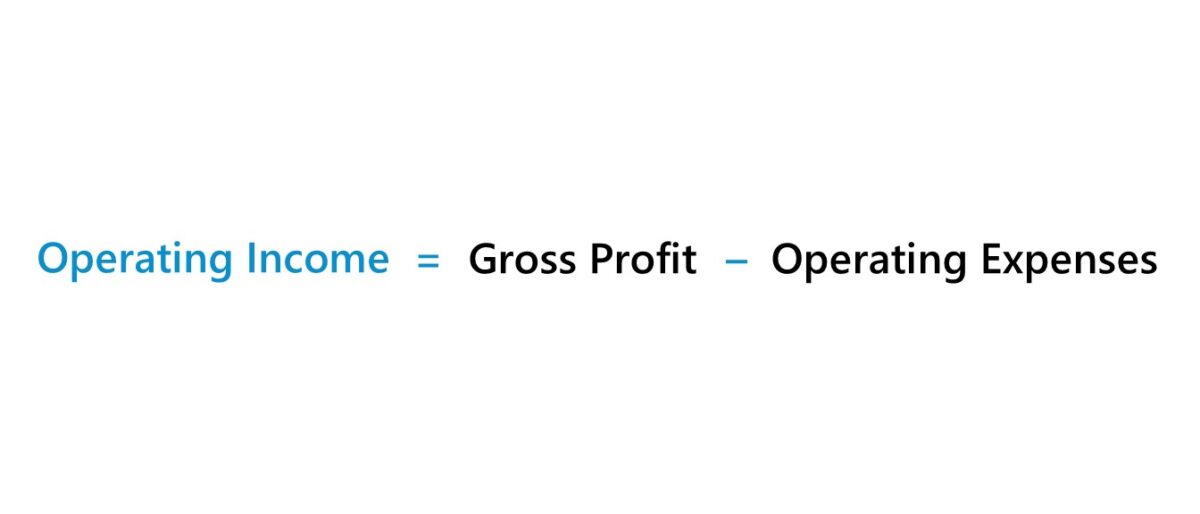
The formula to calculate a company’s operating income is gross profit subtracted by operating expenses.
Operating Income = Gross Profit – Operating Expenses
Each input of the operating profit formula can be found on the income statement.
Net Revenue ➝ The net revenue is the “top line” of the income statement and represents the sales generated by a company from selling its products and services to customers, net of any returns, discounts, and sales allowances.
Cost of Goods Sold (COGS) ➝ The direct costs incurred by a company that are directly tied to its efforts to generate revenue.
Operating Expenses (OpEx) ➝ The indirect costs incurred by a company that are not directly tied to its efforts to generate revenue. Still, the operating expenses are essential to the company’s business model and necessary expenses (e.g. SG&A, R&D).
What is a Good Operating Income?
In order to track a company’s operating profitability across historical periods or for comparisons to its peer group of companies operating in the same (or an adjacent) industry, it is necessary to standardize the operating profit metric.
The operating margin is the ratio between a company’s operating income and its revenue generated in the corresponding period, expressed as a percentage.
Operating Margin (%) = Operating Income ÷ Revenue
The operating margin varies substantially by industry, so a company’s operating margin must only be compared to its industry peers, which share similar business models, cost structures, and risks.
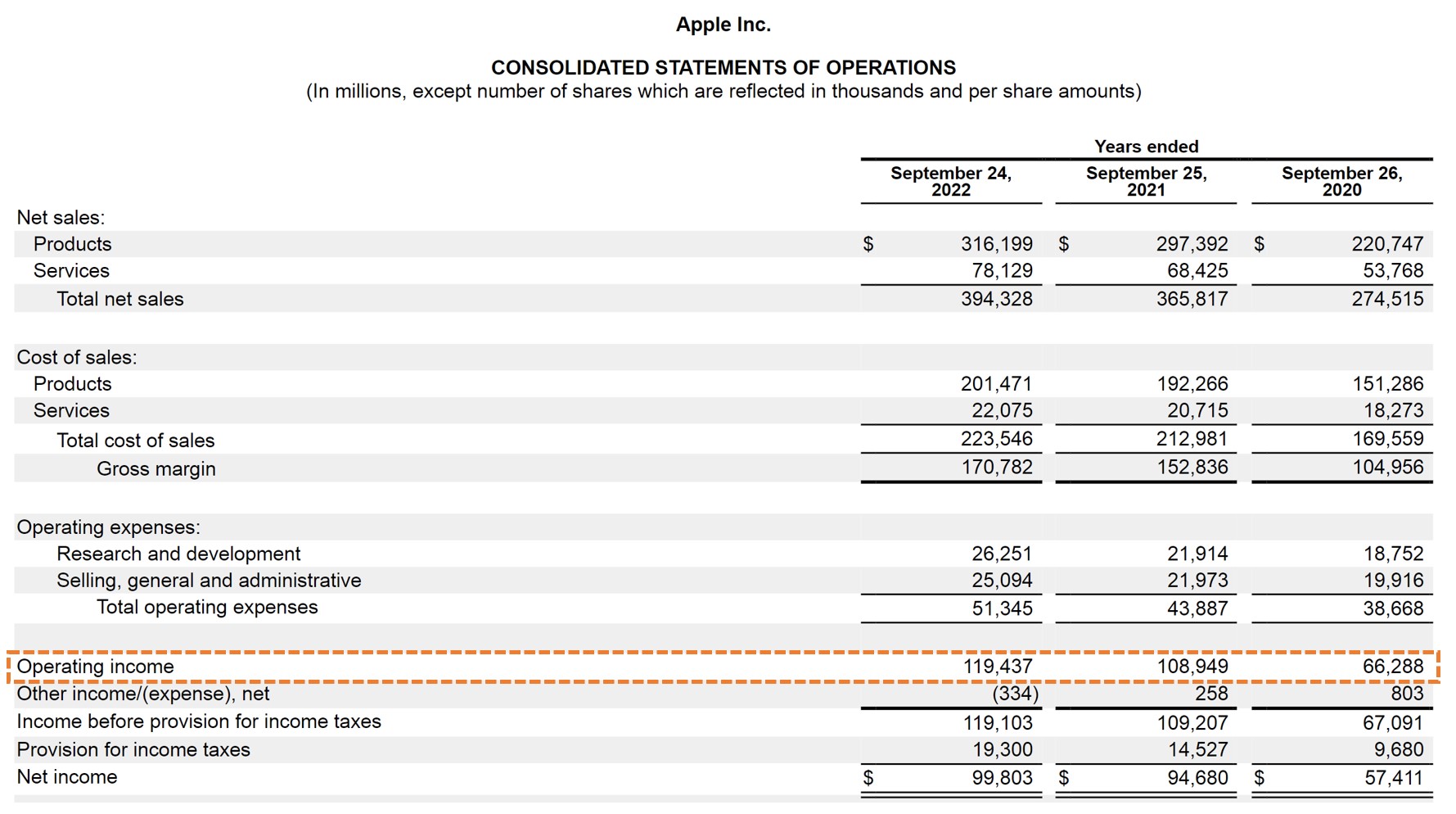
Selling, General and Administrative (SG&A) = $25,094 million
2. Operating Income Calculation Example
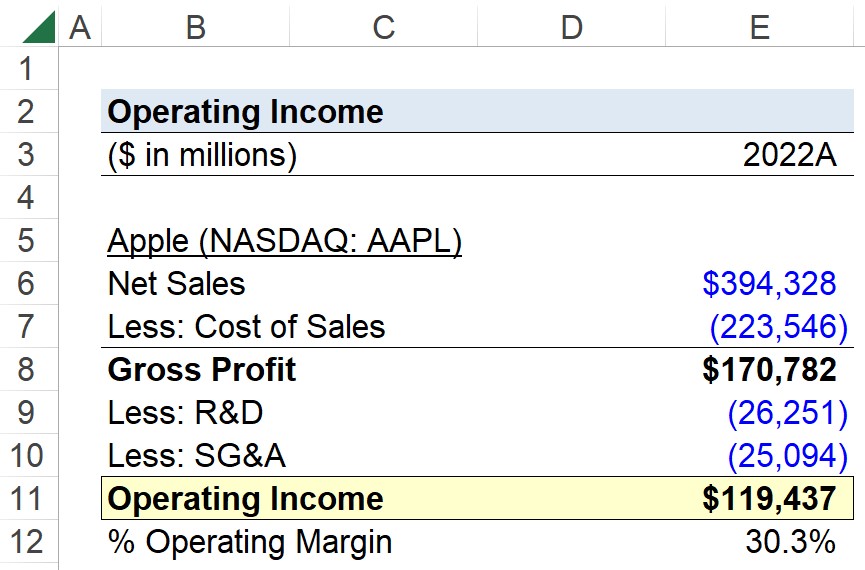
The next step is to calculate Apple’s gross profit by subtracting its cost of sales from its net sales, which comes out to $170,782 million.
Gross Profit = $394,328 million – $223,546 million = $170,782 million
In the final step, we’ll subtract Apple’s total operating expenses – R&D and SG&A – from its gross profit.
Operating Income = $170,782 million – $26,251 million – $25,094 million = $119,437 million
Operating Margin (%) = $119,437 million ÷ $394,328 million = 30.3%
In closing, Apple’s operating income in fiscal year 2022 is approximately $119.4 billion, which can be divided by its revenue to arrive at an operating margin of 30.3%.
Continue Reading Below
Step-by-Step Online Course
Everything You Need To Master Financial Modeling
Enroll in The Premium Package: Learn Financial Statement Modeling, DCF, M&A, LBO and Comps. The same training program used at top investment banks.






No comments yet.