Operating Profit is a profitability metric that measures the remaining income of a company after deducting operating costs, which comprises the cost of goods sold (COGS) and operating expenses (Opex).
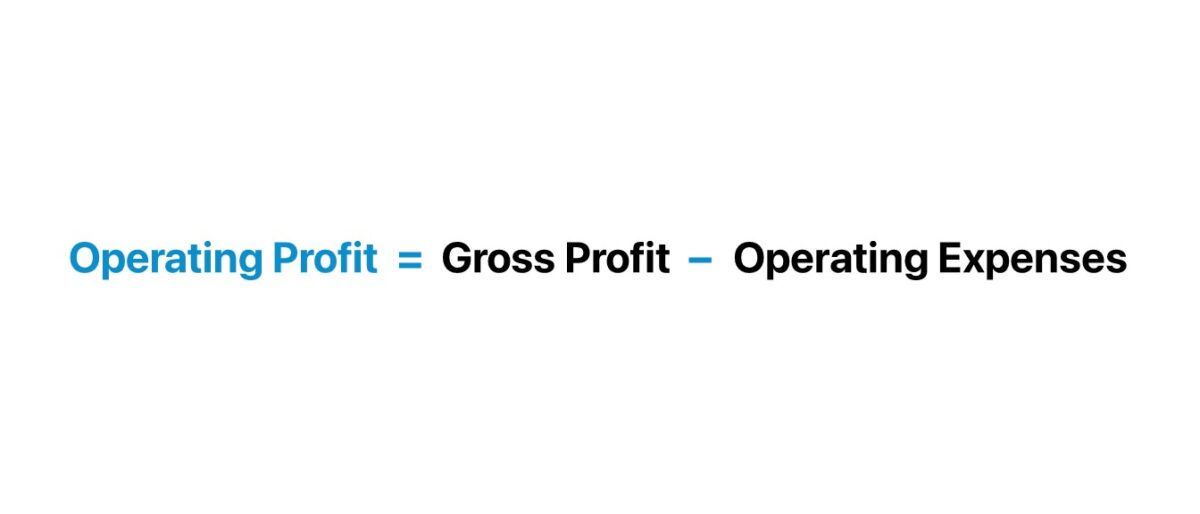
The formula to calculate operating profit subtracts operating costs—which refer to the direct and indirect costs incurred for the day-to-day operations of a business to continue running—from revenue.
Generate Key Takeaways
How to Calculate Operating Profit
The operating profit is a measure of a company’s profitability from its core business activities, excluding the effects of discretionary items such as interest expense and taxes.
COGS and operating expenses (Opex) are each categorized as “operating costs” but COGS are direct costs, while operating expenses are indirect costs.
Therefore, the operating profit metric reflects the profitability of a company’s core operations over a predefined period.
Non-operating items like interest expense are a function of a company’s capital structure (i.e., its funding sources), whereas taxes are jurisdiction-dependent and affected by items like net operating losses (NOLs).
The step-by-step process to calculate operating profit is as follows.
Step 1 ➝ Compute Gross Profit (Subtract Revenue by COGS)
Step 2 ➝ Determine Operating Expenses (OpEx)
Step 3 ➝ Subtract Gross Profit by Operating Expenses
Gross Profit = Revenue – Cost of Goods Sold (COGS)
The operating expenses of a company refer to the indirect costs of a company that are still considered to be a core part of its operations.
Unlike COGS, operating expenses are not directly related to the revenue generation of the company. However, the expenses must be incurred for day-to-day business functions to continue.
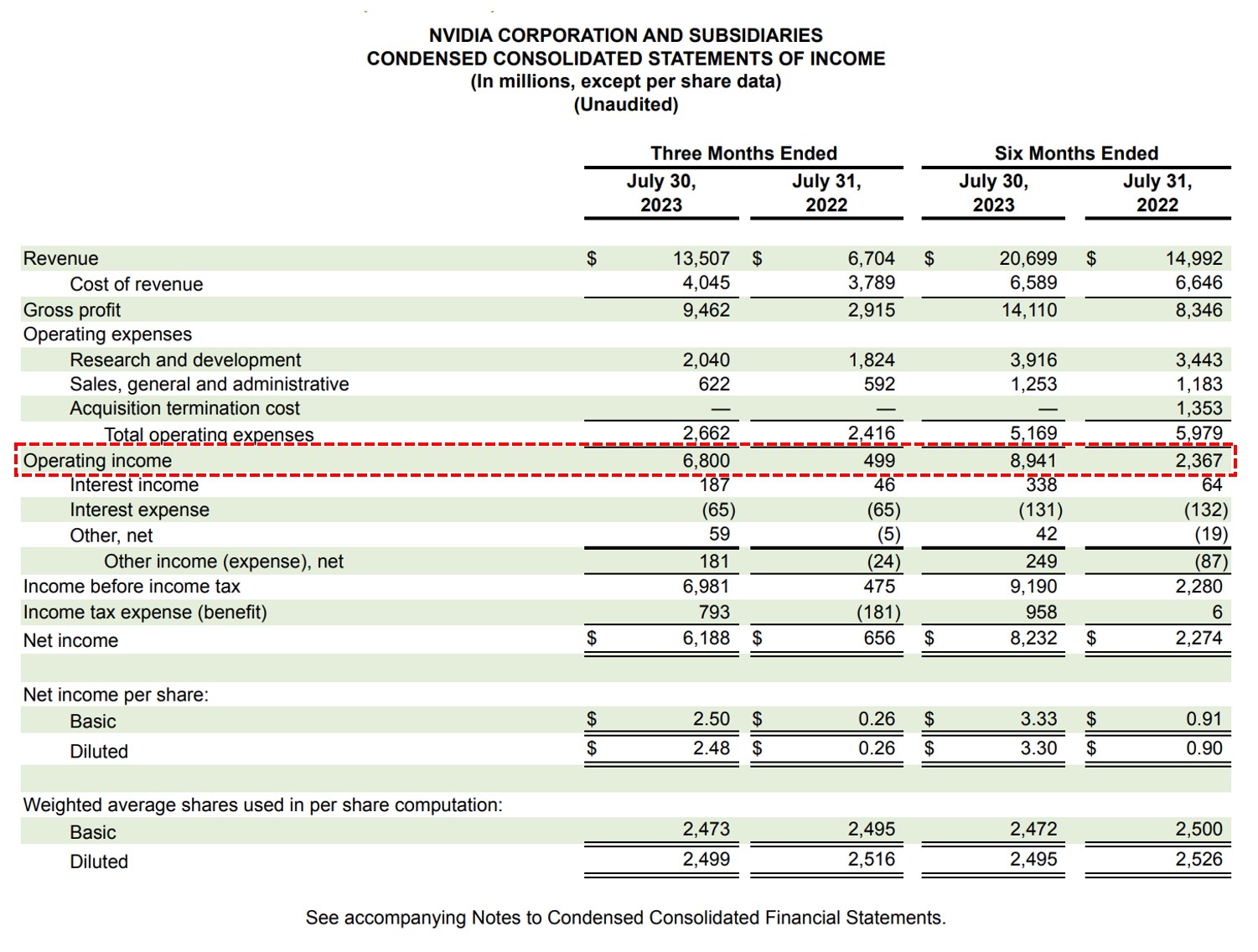
How to Find Operating Profit on Income Statement
On the income statement, the “Operating Profit” line item reflects the cut-off point below which the non-operating items such as interest income and interest expense start to appear.
The operating profit of a company is often recorded as “Operating Income”, “EBIT”, or Income from Operations”, which are all interchangeable terms that are conceptually identical in meaning.
From the “Gross Profit” line item, the common line items that comprise the operating expenses section include the following:
Because the operating profit metric is not impacted by discretionary management decisions, the metric is widely used to analyze the operating performance of companies.
In particular, the operating profit is frequently used to compare the operating profitability of comparable companies. By itself, the operating profit of a company as a standalone metric is not suited for comparability purposes.
Instead, the profit metric must be standardized into a ratio, where the metric is converted into a percentage to facilitate comparisons.
Operating Margin (%) = Operating Profit ÷ Revenue
The operating profit is also frequently used in valuation multiples. In fact, the operating profit metric and EBITDA are two of the most common valuation ratios used in comparable company analysis (CCA).
EV / Operating Profit = Enterprise Value (EV) ÷ Operating Profit
Why? The operating profit metric and EBITDA are each capital structure neutral metrics that measure the core operating performance of the companies.
Operating Profit vs. Net Profit: What is the Difference?
The operating profit and net profit of a company are two common measures of profitability in practice, with key differences:
Operating Profit ➝ The operating profit metric, contrary to net profit, is unaffected by the capitalization of the company. Hence, the operating profit metric is frequently used as part of performing profitability analysis and in comps analysis involving valuation multiples.
Net Profit ➝ The net profit metric, or net income (the “bottom line”), represents the accounting profitability of a company, inclusive of all operating and non-operating costs. Therefore, non-operating items such as interest expense and taxes impact a company’s net income, which can distort the metric as the financial metric does not solely isolate the operating performance of a company.
The formula to compute the net profit starting from operating profit is as follows.
Net Profit = Operating Profit – Interest Expense, net – Other Income / (Expense), net – Income Tax Expense
Operating Profit Calculator
We’ll now move to a modeling exercise, which you can access by filling out the form below.
Excel Template | File Download Form
You’re logged in! Form submission not required. Access your file below.
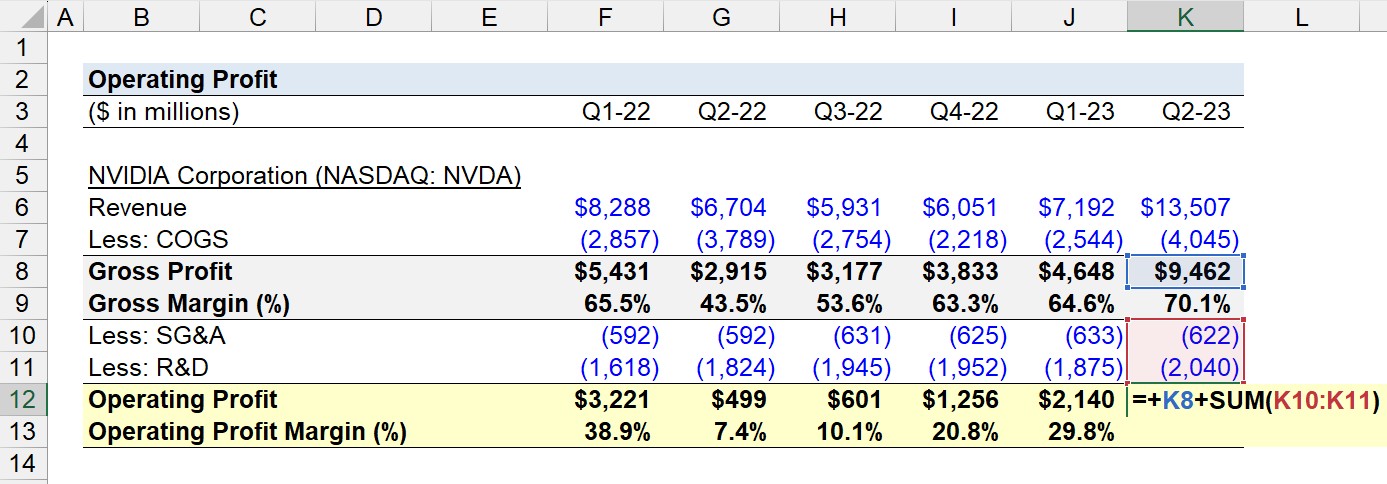
In the next step, the operating profit of NVIDIA can be determined by subtracting its gross profit from its two operating expenses, which are SG&A and R&D.
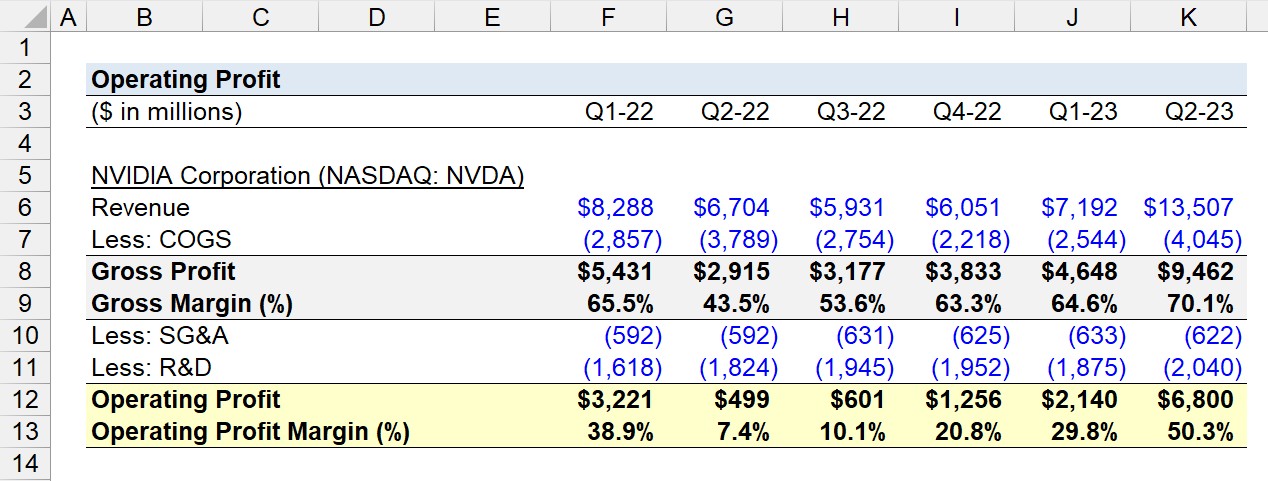
Upon subtracting NVIDIA's reported gross profit from its operating expenses, we arrive at the following operating profits.
Therefore, NVIDIA's operating profit in the trailing six historical quarters has exhibited substantial cyclicality each quarter, an inherent attribute of the semiconductor industry.
But in particular, Q2-23 was notably a robust quarter in operating profitability for NVIDIA, which was driven by the outsized demand for its AI chips in the market.
Continue Reading Below
Step-by-Step Online Course
Everything You Need To Master Financial Modeling
Enroll in The Premium Package: Learn Financial Statement Modeling, DCF, M&A, LBO and Comps. The same training program used at top investment banks.






No comments yet.