What is Interest Income?
Interest Income refers to the earnings generated from a company’s cash balance, typically from interest-bearing bank accounts.

Interest Income refers to the earnings generated from a company’s cash balance, typically from interest-bearing bank accounts.
Companies retain cash and cash equivalents on their balance sheet to ensure they have sufficient liquidity to meet short-term financing and working capital needs.
Cash not reinvested into operations is frequently invested into interest-yielding accounts such as the following:
These sorts of short-term investments typically carry low yields, but can still enable the company to earn a net positive return and offset losses from having "idle" cash.
For most companies – excluding financial institutions such as commercial banks – interest is reported in the non-operating items section of the income statement.
The interest earned is not considered a non-financial company’s core part of operations, i.e. it is not integral to the company's normal course of business.
A company’s interest income is determined by its projected cash balances and an interest rate assumption.
With that said, the forecasted interest income can only be computed once the balance sheet and cash flow statement are complete.
Calculating a company's interest income is a two-step process:
In Excel, the standard method used to forecast either type of interest – interest income and interest expense – creates a "circularity" within a financial model, which we'll discuss how to circumvent later in our modeling tutorial.
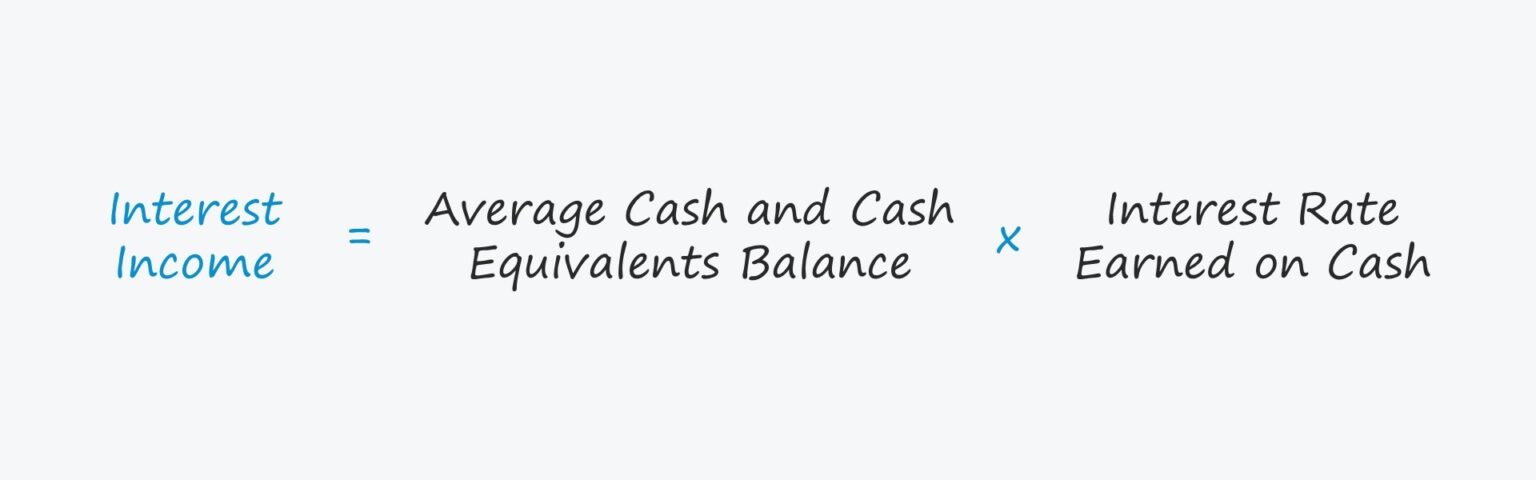
The formula to calculate the interest income is the average cash balance multiplied by the cash rate.
Companies often consolidate interest expense with interest income into a single line item called “Interest Expense, net” on their income statement.
In such cases, it is worth the time to locate the individual amounts broken out separately, so that each item can be referenced and projected in the forecast.
Like its counterpart, interest expense, interest income is modeled when building out the debt schedule of a financial model.
Hence, interest is considered one of the "finishing touches" of a 3-statement model.
On the income statement, interest income and interest expense are often presented together, but there is a clear distinction between the two items:
We’ll now move to a modeling exercise, which you can access by filling out the form below.


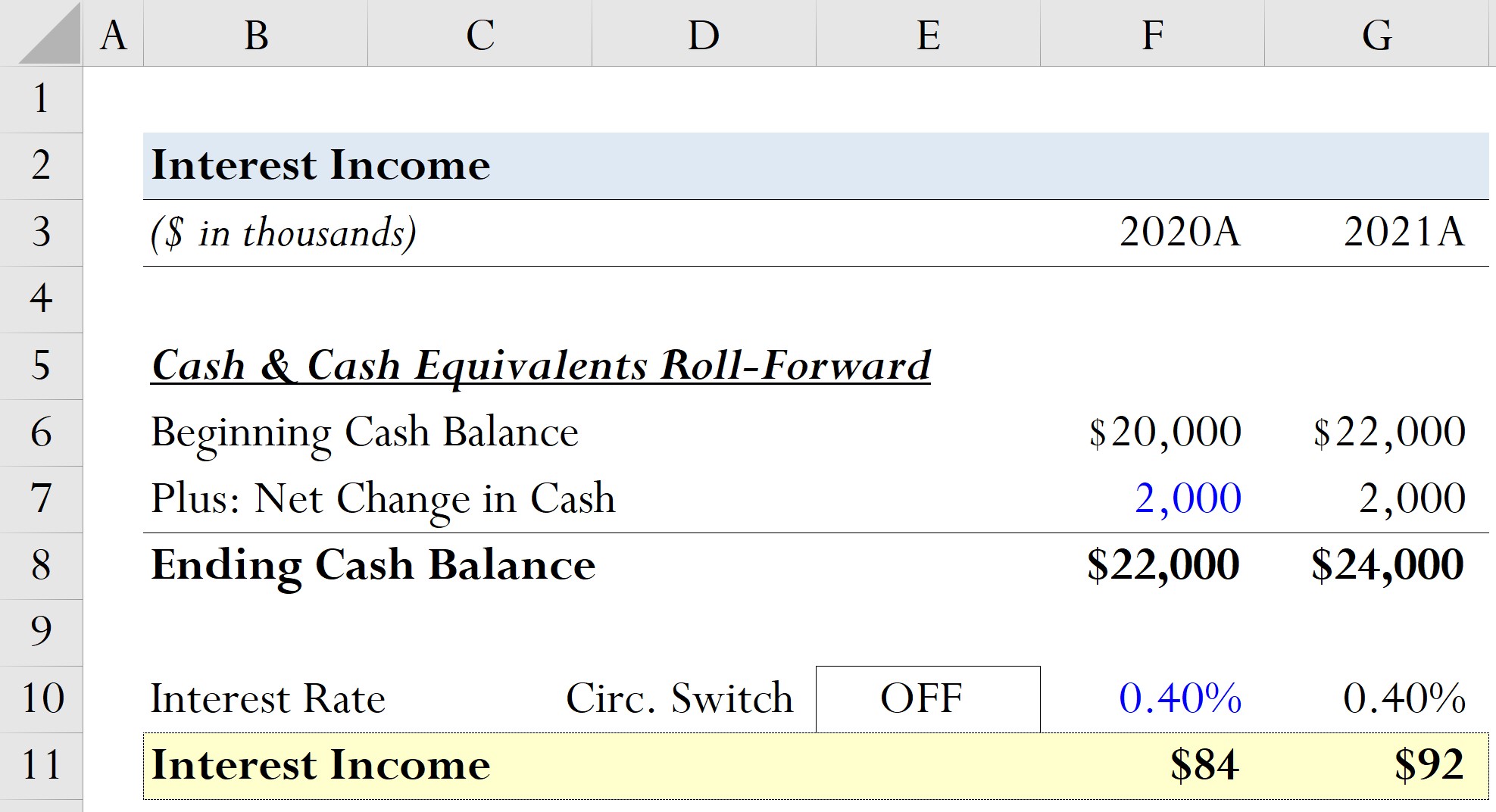
Suppose a company’s beginning cash balance was $20 million in 2020. Further, we’ll assume the net change in cash – i.e. the total movement of cash in the specified period – is an increase of $2 million across both periods.
2020A Cash Balances
2021A Cash Balances
Moreover, the interest rate earned on cash for both periods will be set at 0.40%.
The formula for calculating the interest income in Excel is as follows:
While not necessary for our simple exercise, setting up a circularity switch is crucial in a properly integrated 3-statement model.
The interest income comes out as $84k in 2020, which increases to $92k in 2021 due to the positive rise in the cash balance on a year-over-year (YoY) basis.

Enroll in The Premium Package: Learn Financial Statement Modeling, DCF, M&A, LBO and Comps. The same training program used at top investment banks.


No comments yet.