What are Discontinued Operations?
The Discontinued Operations line item on the income statement represents the parts of a company that were either divested or shut down (i.e. classified as held-for-sale).

The Discontinued Operations line item on the income statement represents the parts of a company that were either divested or shut down (i.e. classified as held-for-sale).
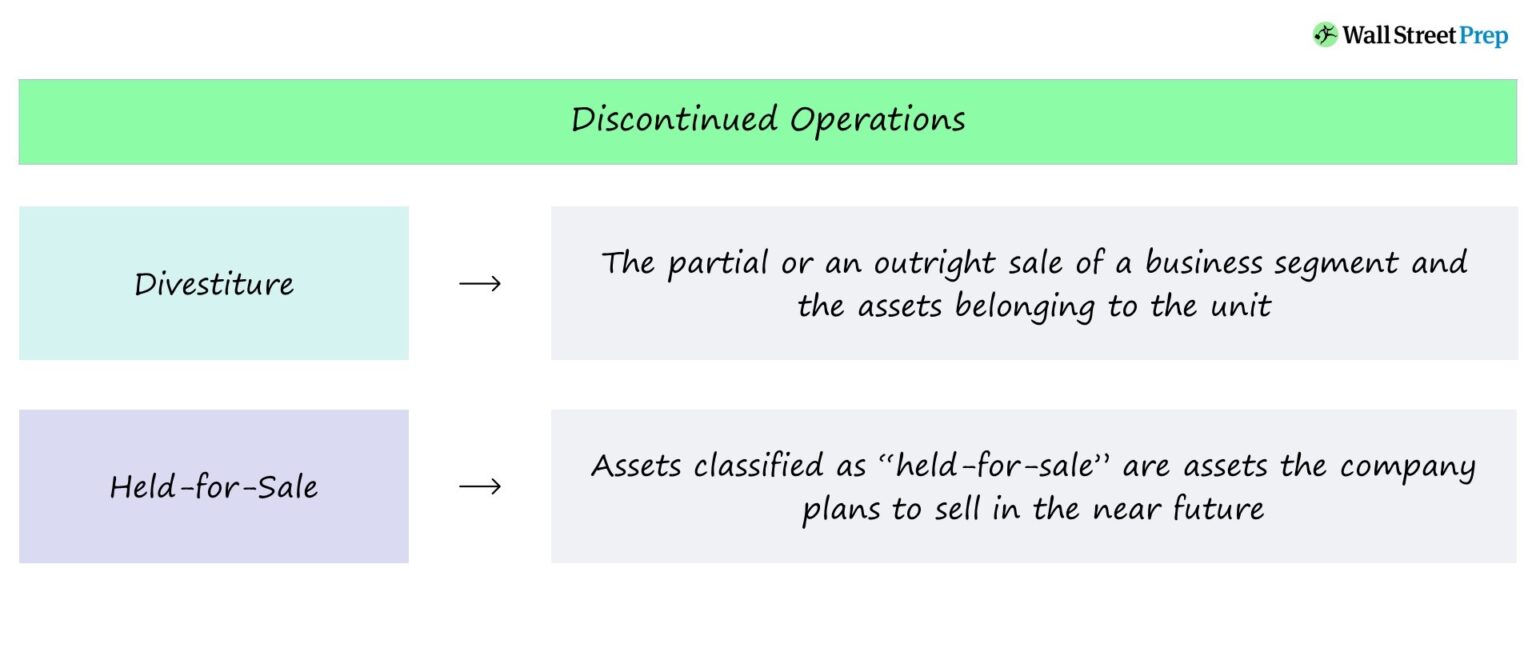
The term "discontinued operations" refers to the business divisions or assets of a company that were formerly part of its operations until being either divested or terminated.
The discontinued operations represent unnecessary segments that a company divests or shuts down to dispose of at a later date.
A business division can be discontinued because of a wide variety of reasons, such as closing a division that cannot turn or consistently sustain a profit or a redundant division following a merger.
If divested, the assets of the discontinued operations are sold off – while in the case of a termination, the assets can be held-for-sale.
Once the operations are disposed of, the income stemming from those operations must be eliminated from the company’s future financial statements (and adjustments are necessary for historical financial reports to facilitate an “apples to apples” comparison).
But in either case, the discontinued operations are reported separately from a company’s core, recurring operations.
The gains or losses from a non-recurring event are recognized separately on the company’s income statement below the performance of its core operations so that investors can easily distinguish between continuing vs. discontinued operations.
The effects of the sale, whether positive or negative, must not impact operating profit (EBIT).
The following are common reasons for a company to divest or terminate a business division.
Under U.S. GAAP reporting standards, a public company can classify an item as “Discontinued Operations” if the following conditions are met:
In the accounting period when operations are ceased, the gain (or loss) can still occur and thus must be recorded and reported.
Since discontinued operations are usually operating at a loss – which is why they’re often discontinued in the first place – the decision to dispose of a segment can often bring about a tax benefit.
We’ll now move to a modeling exercise, which you can access by filling out the form below.


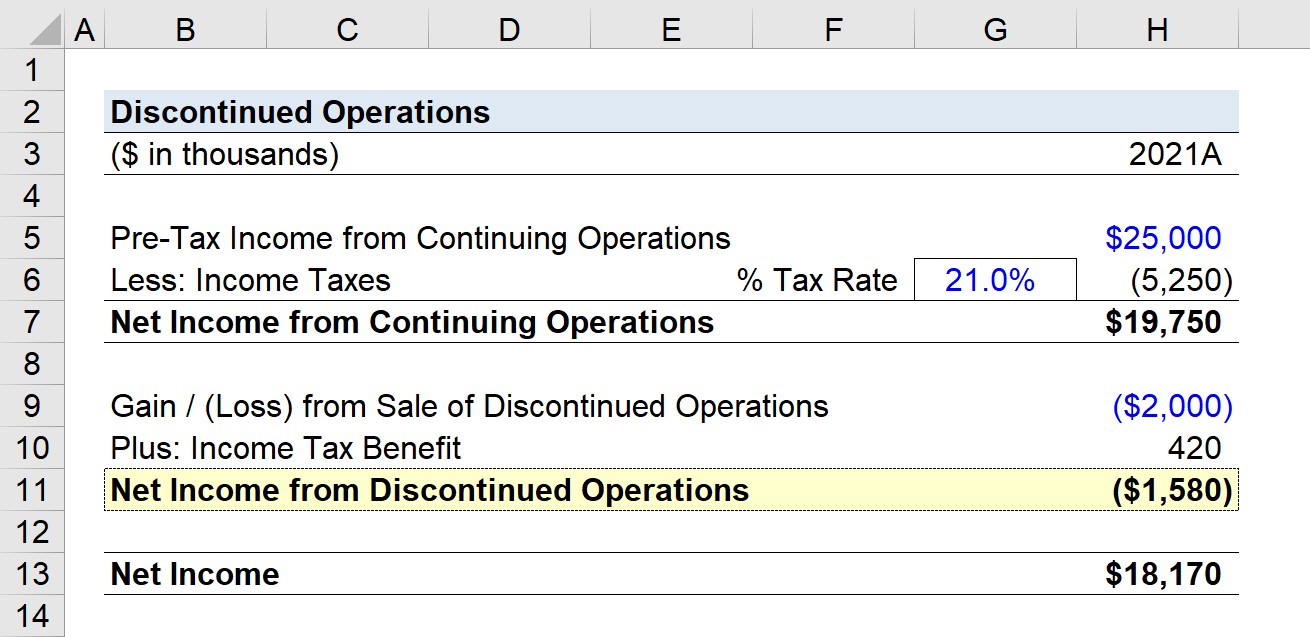
Suppose a company’s continuing operations generated $25 million in pre-tax income for the fiscal year ending 2021.
If the company’s tax rate is 21%, the income tax owed is $5.3 million.
The net income from continuing operations – i.e. the core, recurring operations of our company – comes out to be $19.8 million.
However, let’s say that the company decided to divest an underperforming segment because it was unprofitable and weighing down its margins.
For simplicity, we'll assume there was no income generated from the discontinued segment, which the company was just waiting to dispose of.
If we assume the pre-tax gain / (loss) related to the sale of the divested business division was a loss of $2 million, the tax benefit equals the loss multiplied by the tax rate.
Upon netting the loss from the sale against the income tax benefit, the net income from discontinued operations is a loss of $1.6 million.
In closing, the net income of our hypothetical company after the disposal is $18.2 million.

Enroll in The Premium Package: Learn Financial Statement Modeling, DCF, M&A, LBO and Comps. The same training program used at top investment banks.


No comments yet.