What is Weighted Average Shares Outstanding?
The Weighted Average Shares Outstanding represents a company’s normalized, time-weighted common share count across a specified period of time.

The Weighted Average Shares Outstanding represents a company’s normalized, time-weighted common share count across a specified period of time.
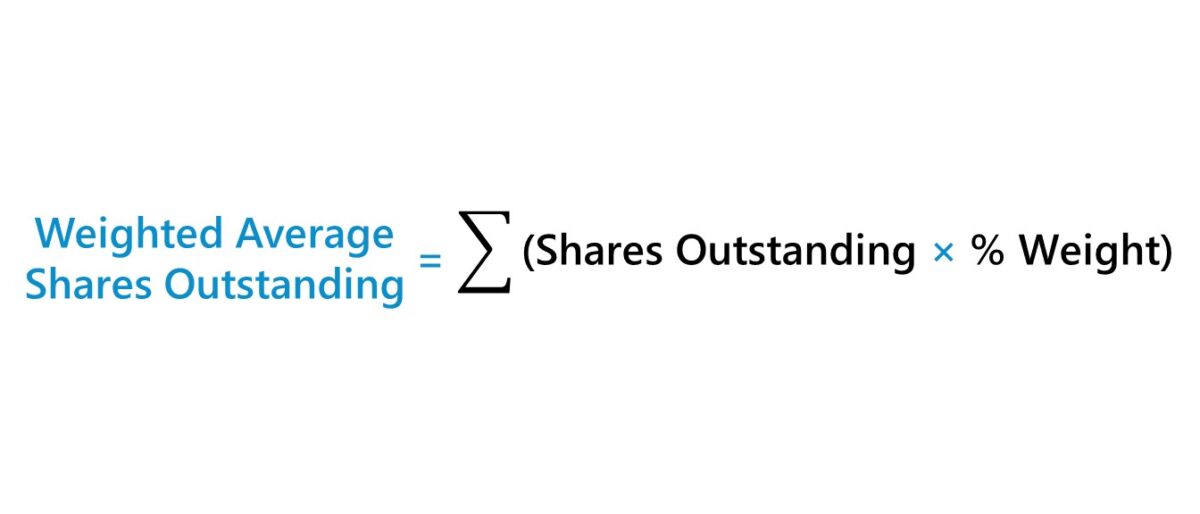
The weighted average shares outstanding represents the number of common shares outstanding, after adjusting for the share count changes that occurred throughout a given period.
Over the course of a reporting period—most often a fiscal year—the total number of common shares in circulation increases and decreases multiple times for most public companies.
The following are common corporate actions that impact the number of shares outstanding:
In order to calculate a company's earnings per share (EPS), a company’s net income is divided by its weighted average shares outstanding.
The numerator in the earning per share (EPS) formula is net income from the income statement, which tracks the financial performance of a company over a period of time.
If the beginning or ending share count were used, there would be a mismatch in the timing between the numerator (which typically spans the full fiscal year) and the denominator. Therefore, the misalignment in timing must be rectified by using the weighted average shares outstanding in the earning per share (EPS) calculation.
The formula to calculate the weighted average shares outstanding is as follows:
The sum of the “% Weight” inputs must equal 100% to ensure the entire period is covered.
We’ll now move on to a modeling exercise, which you can access by filling out the form below.


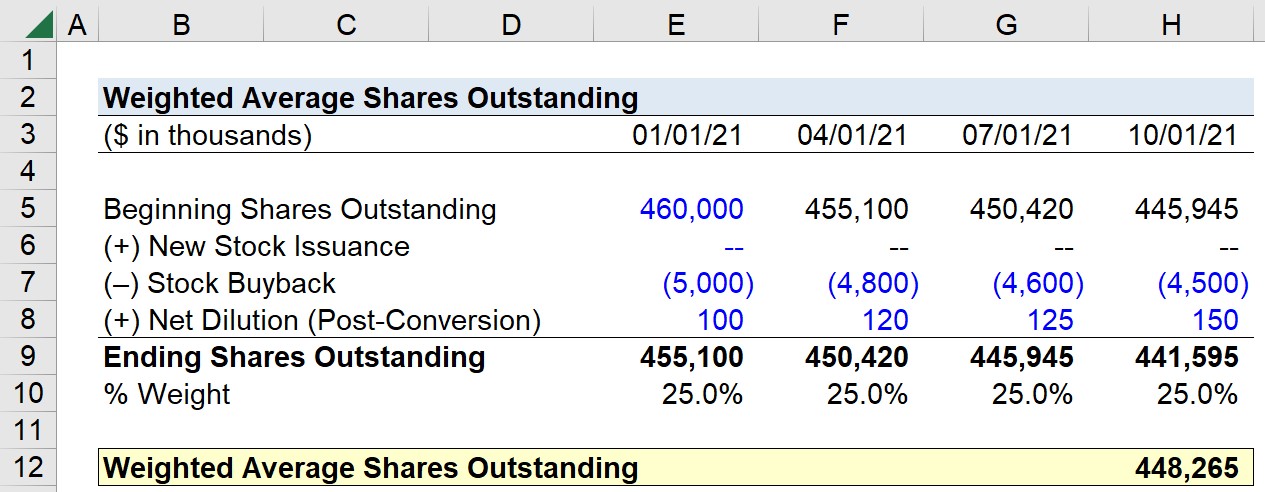
Suppose we’re tasked with calculating the weighted average shares outstanding of a public company for the fiscal year ending 2021.
On the final date of Q-4 2020, 12/31/2020, the company’s total number of common shares outstanding was 460 million.
The day right after (1/01/21)—the first date of the next quarter—the company completes a recurring stock buyback every three months as part of its share repurchase program, in which the number of repurchased shares each quarter was 5 million, 4.8 million, 4.6 million, and 4.5 million, respectively.
Stock Buyback Program
For simplicity, we’ll also assume the conversion of diluted securities occurs on the same dates.
From the start of Q-1 to Q-4, the net dilution from the converted securities was 100,000, 120,000, 125,000, and 150,000, respectively.
Net Dilution (Post-Conversion)
The “Ending Shares Outstanding” represents the common share count on the first date of the quarter.
The “% Weight” for each period is 25%, since each time period represents a quarter of the fiscal year.
Using the SUMPRODUCT function, we’ll calculate the weighted average shares outstanding over fiscal year 2021, which comes out to 448,265.

Enroll in The Premium Package: Learn Financial Statement Modeling, DCF, M&A, LBO and Comps. The same training program used at top investment banks.


No comments yet.