What is Gross Sales?
Gross Sales are defined as a company’s total revenue generated from all transactions that occurred over a specified period before any deductions, such as returns, discounts, and allowances.

Gross Sales are defined as a company’s total revenue generated from all transactions that occurred over a specified period before any deductions, such as returns, discounts, and allowances.
Gross sales, or “gross revenue”, are the all-inclusive monetary value generated by a company from delivering goods and services to customers in a specified period.
Unlike the net sales metric, a company’s gross sales are calculated before the following three adjustments:
These three adjustments to gross sales are deemed contra-accounts — so these adjustments would show up as a credit to the sales account as opposed to a debit since they are designed to offset (and reduce) the sales amount.
Conceptually, the total of all three deductions represents the difference between gross sales and net sales, i.e. if a company has no records of any returns, discounts, or allowances, then its gross sales will be equal to its net sales for the period.
Product returns or discounts incentivize customers to make more purchases and are usually a normal part of a company’s day-to-day operations.
The difference between gross sales and net sales is tracked and compared over time because a lower difference between the two metrics implies that a company’s products or services are of higher quality and meet customer expectations more effectively (and vice versa if the difference is growing, i.e. could be indicative of issues with quality control).
By itself, the gross sales metric could be misleading, which is why net sales are viewed as a more useful indicator of a company’s financial performance.
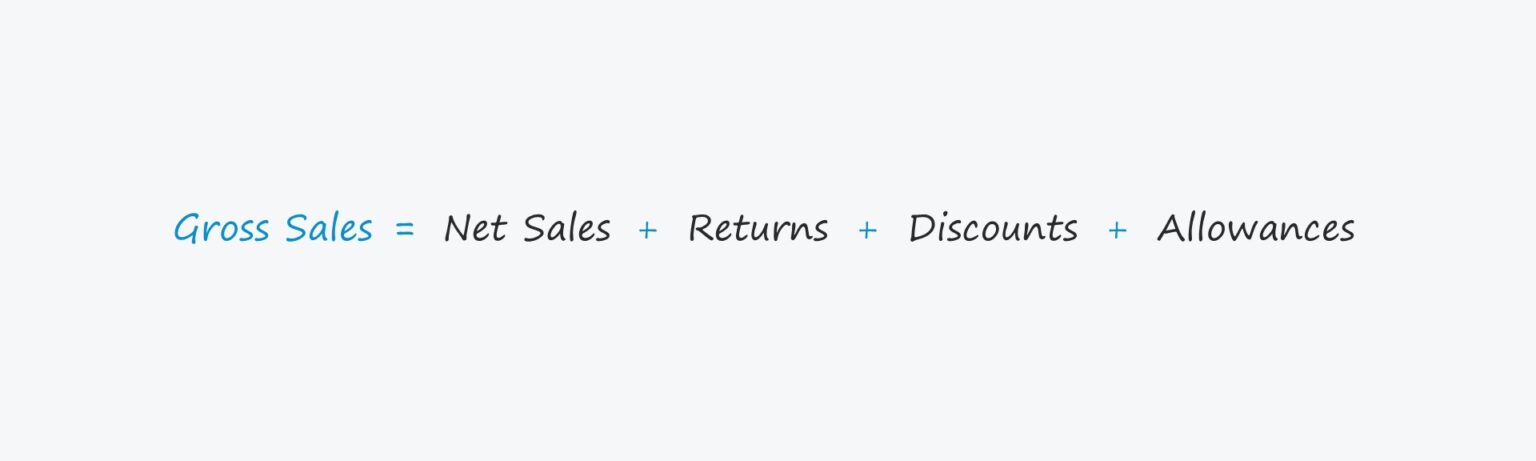
The formula for calculating gross sales is as follows.
The formula above can be rearranged to calculate net sales.
Suppose an eCommerce store had 200k total product orders in the past fiscal year.
Further, we'll assume that the average sale price (ASP) of the company’s product line is $40.00 per item.
The store's gross sales are the product of the ASP and the number of units sold, which amounts to $8 million in gross sales.
In order to calculate the store’s net sales from our gross sales value, we must now deduct the three items as discussed earlier:
For our hypothetical scenario, we’ll assume that a 10% discount was offered to customers that paid early, which was the case in 5% of all completed customer transactions.
The discount adjustment can be calculated as the product of the two inputs.
The discount value comes out to $40,000.
As for returns, we’ll multiply the number of returned transactions by the average selling price (ASP).
If we assume 4% of all transactions were returned, there were 8,000 returns, meaning that the downward adjustment to gross sales is $320k.
Finally, we'll assume that there were no sales allowances during this period.
In closing, the net sales of our company in the period are $7.64 million.

Enroll in The Premium Package: Learn Financial Statement Modeling, DCF, M&A, LBO and Comps. The same training program used at top investment banks.


No comments yet.