What is Adjusted Net Income?
Adjusted Net Income is a non-GAAP measure of a company’s net profitability, from which the effects of non-cash and non-recurring items are removed.

Adjusted Net Income is a non-GAAP measure of a company’s net profitability, from which the effects of non-cash and non-recurring items are removed.
The adjusted net income is a financial metric that reflects the normalized earnings of a company over a stated period.
Since the profit metric excludes the effects of non-recurring items (or “one-time events”), discretionary accounting adjustments, and non-cash expenses (e.g. D&A expense), the adjusted net income presents a more accurate representation of a company’s ongoing financial performance.
While the types of adjustments applied are often industry-specific (or company-specific), the most common examples include:
Each of the adjustments listed stems from non-recurring items (i.e. one-time events or extraordinary events), non-cash items, and non-operating items, which can distort the reported financial results and reported net income under U.S. GAAP accounting standards.
By removing the effects of such items, the adjusted net income metric better represents the net profitability of a company’s core operating activities, which can be informative in terms of understanding its financial health, growth potential, and profitability.
However, the adjusted net income metric does not adhere to the accounting guidelines established under U.S. GAAP. Hence, the metric is not permitted to be recognized on the income statement in company filings (10-Q, 10-K).
Still, the SEC recognizes that non-GAAP metrics, such as “Adjusted Net Income” and “Adjusted EBITDA”, can be informative for investors.
The discretion afforded to companies to present non-GAAP metrics creates room for management teams to mislead investors. Hence, the SEC has to establish a standardized set of rules and guidelines to mitigate that risk to protect the interests of investors by still having companies report GAAP-compliant metrics.
In M&A, the term “Adjusted Net Income" is an estimate of the potential value of a small to mid-sized business (SMB) from the perspective of a potential buyer.
The adjusted net income, or more commonly referred to as “seller’s discretionary earnings (SDE),” measures the pro forma earnings expected to be received by the new owner post-sale.
The distinction here, aside from the context of the analysis, is that the SDE metric will include adjustments for more personal expenses of the prior owner that are not expected to continue post-M&A transaction.
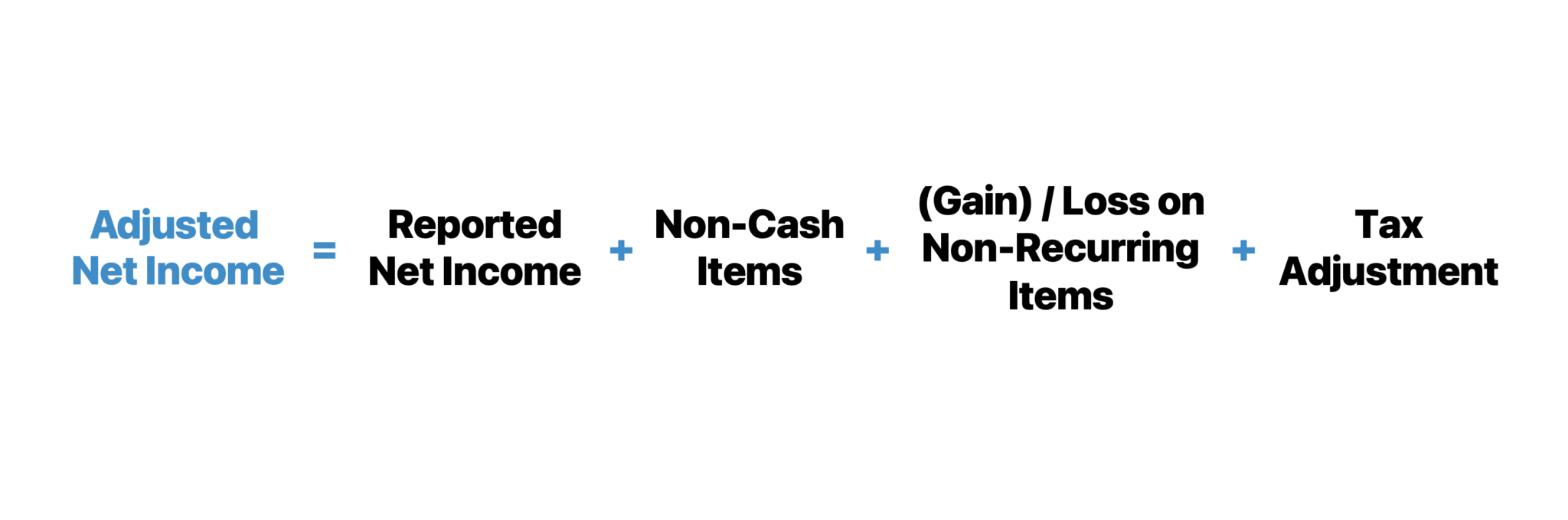
The formula to calculate adjusted net income starts with the reported net income in a specified period, which is then normalized by adding back non-cash and non-recurring items.
Where:
Like most profit metrics, the adjusted net income of a company cannot be compared to its peer group without first standardizing the metric.
The adjusted net margin is calculated by dividing the adjusted net income by the net revenue in the corresponding period.
For the sake of comparability, the resulting figure must then be multiplied by 100 to convert the output from decimal notation to percentage form.
The adjusted net margin illustrates the relationship between the adjusted net income and net revenue, and serves as an indicator of a company’s financial profitability.
Considering the normalized financial performance of a company is tracked by the adjusted net income metric, the implied adjusted net margin is perceived as a forward-looking measure of profitability and long-term sustainability.
If the adjusted net margin is barely profitable, or perhaps even negative, the underlying company is at risk of insolvency (and thus must urgently raise capital).
In particular, publicly-traded corporations tend to apply outsized adjustments to their reported net income prepared under U.S. GAAP if their financial performance (and economic conditions) are anticipated to worsen.
The rationale for the adjustments is to stabilize investor sentiment (or more specifically, the company’s stock price).
However, market participants often perceive a widened discrepancy between the non-GAAP and GAAP-reported net income as an economic indicator signaling that troubling times are on the horizon.
We’ll now move on to a modeling exercise, which you can access by filling out the form below.


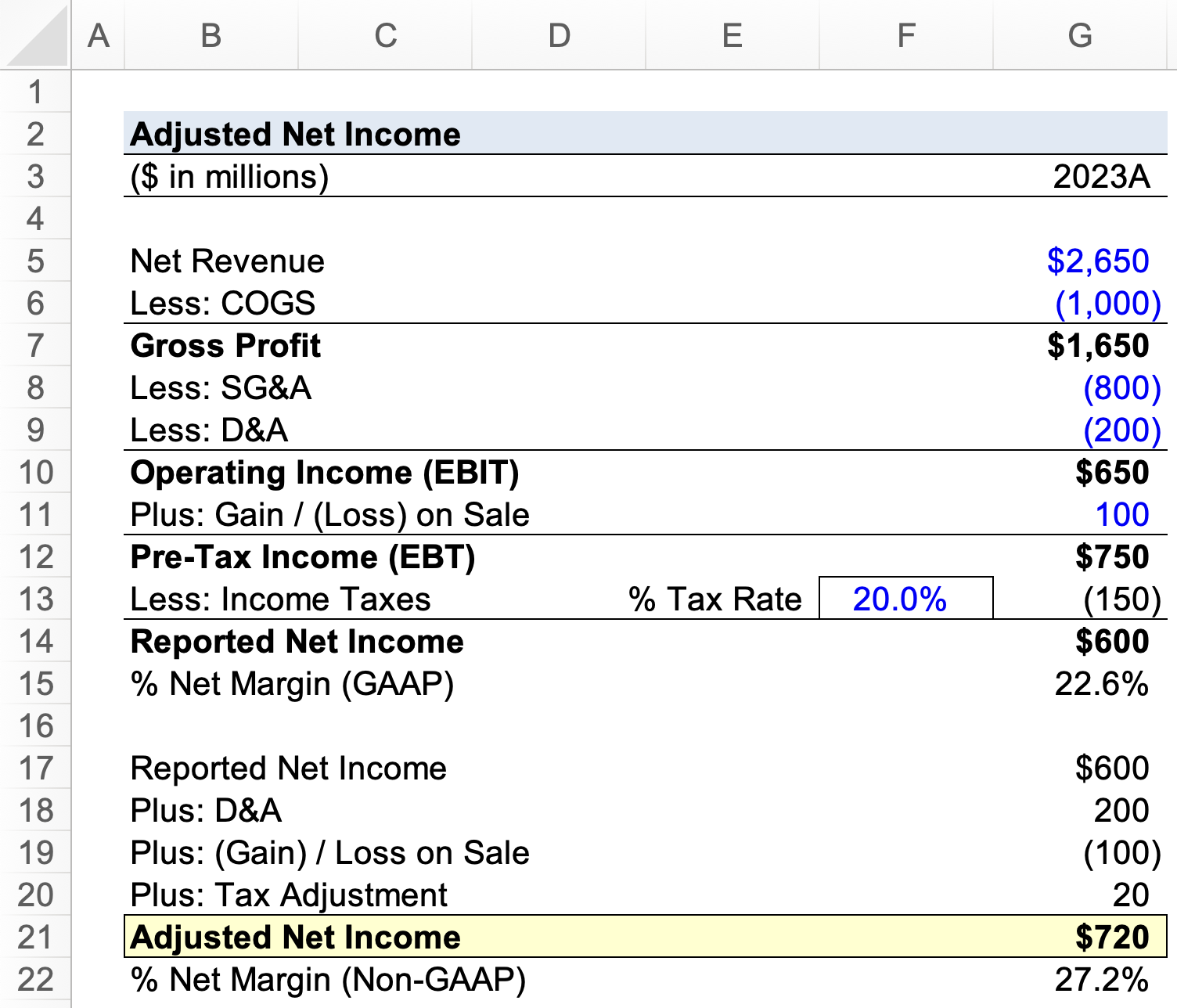
Suppose we're tasked with calculating the adjusted net income of a publicly traded industrials company at the end of fiscal year 2023.
Income Statement Financial Data
Therefore, the company's income statement recognized a non-cash expense (D&A) and non-recurring event (Gain / Loss on Sale).
The process of calculating the inputs for the adjusted net income formula is as follows.
The D&A expense is treated as an add-back, whereas the gain on sale is a deduction for the reasons mentioned earlier.
In closing, the adjusted net income of the industrials company is $720 million, while the non-GAAP net margin equals 27.2%.

Enroll in The Premium Package: Learn Financial Statement Modeling, DCF, M&A, LBO and Comps. The same training program used at top investment banks.


No comments yet.