What is Normalized EBITDA?
Normalized EBITDA measures the operating cash flow generated by a company’s core business activities with discretionary adjustments to remove the effects of non-recurring items and irregular events (i.e. one-time).

Normalized EBITDA measures the operating cash flow generated by a company’s core business activities with discretionary adjustments to remove the effects of non-recurring items and irregular events (i.e. one-time).
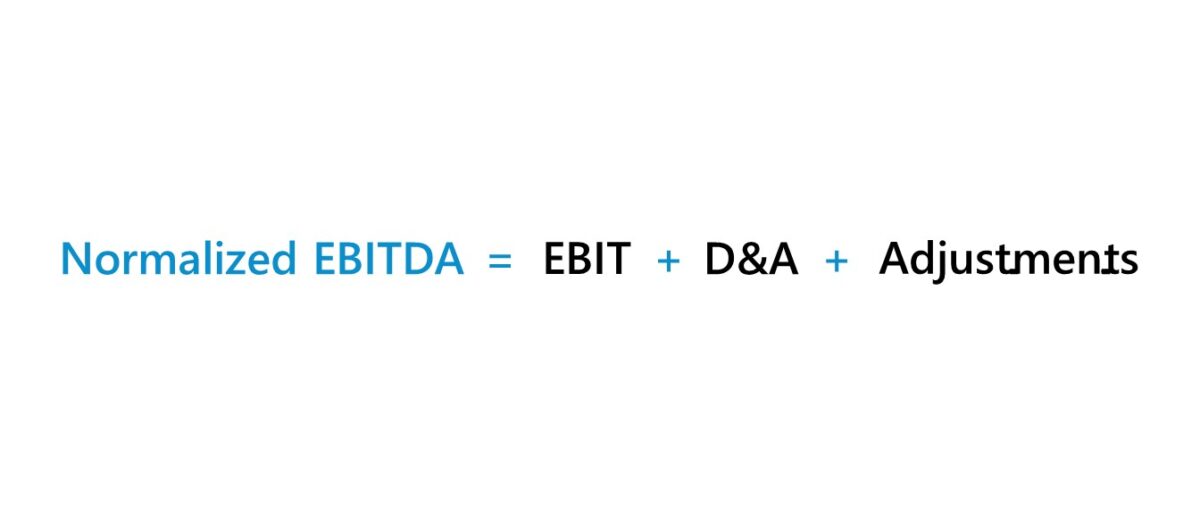
The normalized EBITDA metric, or “adjusted EBITDA”, is a non-GAAP measure of profitability meant to track the core operating performance of a company.
The simplest calculation of EBITDA—i.e. the sum between EBIT and D&A—is an estimate of the operating cash flows produced by a company's day-to-day business functions.
The most notable adjustment is related to non-cash items, depreciation and amortization, which are treated as a non-cash add back on the cash flow statement (CFS).
Neither depreciation nor amortization represent an actual movement of cash. Instead, the recognition of the depreciation and amortization expense on the income statement is related to accounting conventions and the strict guidelines established under U.S. GAAP reporting standards.
EBITDA is one of the most practical metrics, particularly in the context of M&A and valuation, which is attributable to the following characteristics.
In recent times, however, the usage of the EBITDA metric has increasingly come under more criticism, which coincides with the emergence of "Adjusted EBITDA".
Because EBITDA is a non-GAAP profit metric—i.e. there is no dedicated line item on the income statement—companies and their management team have more discretion in terms of what truly constitutes an add-back.
The adjustments applied to EBITDA are necessary to reflect the true operating performance of the company, which typically guides the offer price in M&A and the fair market value (FMV) of a company's shares in the open markets if it is publicly traded.
The vast majority of M&A transactions, if not all, tend to hold lengthy negotiations specifically to discuss EBITDA — or more specifically, the validity of the adjustments made to EBITDA.
The formula to calculate normalized EBITDA is as follows.
The most common examples of adjustments, aside from the add-back of depreciation and amortization, are listed in the next section.
Considering most purchase multiples in M&A are based on trailing EBITDA, adjustments can have a material impact on the implied valuation. Therefore, it is a critical step in the diligence stage to closely examine and question the proposed add-backs to develop a better understanding of the company (and ensure the financial state of the company is not misconstrued).
Similar to operating income (EBIT), EBITDA is frequently used by equity analysts and investors—ranging from the retail market to institutional investors—to compare peer companies that operate in the same industry (or in an adjacent sector).
The normalization of EBITDA alludes to the continued removal of items that are not representative of the company’s core operations and business model, as well as adjusting for non-cash items and accrual accounting conventions.
Thus, a company’s normalized EBITDA should exceed its traditional EBITDA metric in most scenarios, since additional measures were taken to "normalize" its earnings.
If the adjustments seem unreasonable and there is limited transparency in the sale process, the seller (and their sell-side M&A advisor) can lose credibility and trust from the buyer, which serves to widen the gap between the offer price and the sale price.
The practice of companies disclosing non-GAAP earnings to offer more insight into their recent operational performance and financial position has become rather common in recent times to provide enhanced transparency into a company's operating performance, with such non-GAAP measures presented as supplementary material.
The process of calculating EBITDA, however, can become more intricate due to the treatment of items such as stock-based compensation (SBC), with the resulting figure termed “Adjusted EBITDA”.
The add-backs to determine a company’s adjusted EBITDA are discretionary, and some examples of such non-recurring adjustments include the following:
As a real-world example of a GAAP to non-GAAP reconciliation, see the adjustments made by Twitter, Inc. (TWTR) in its most recent reporting period (Q-2, 2022) prior to its take-private transaction.
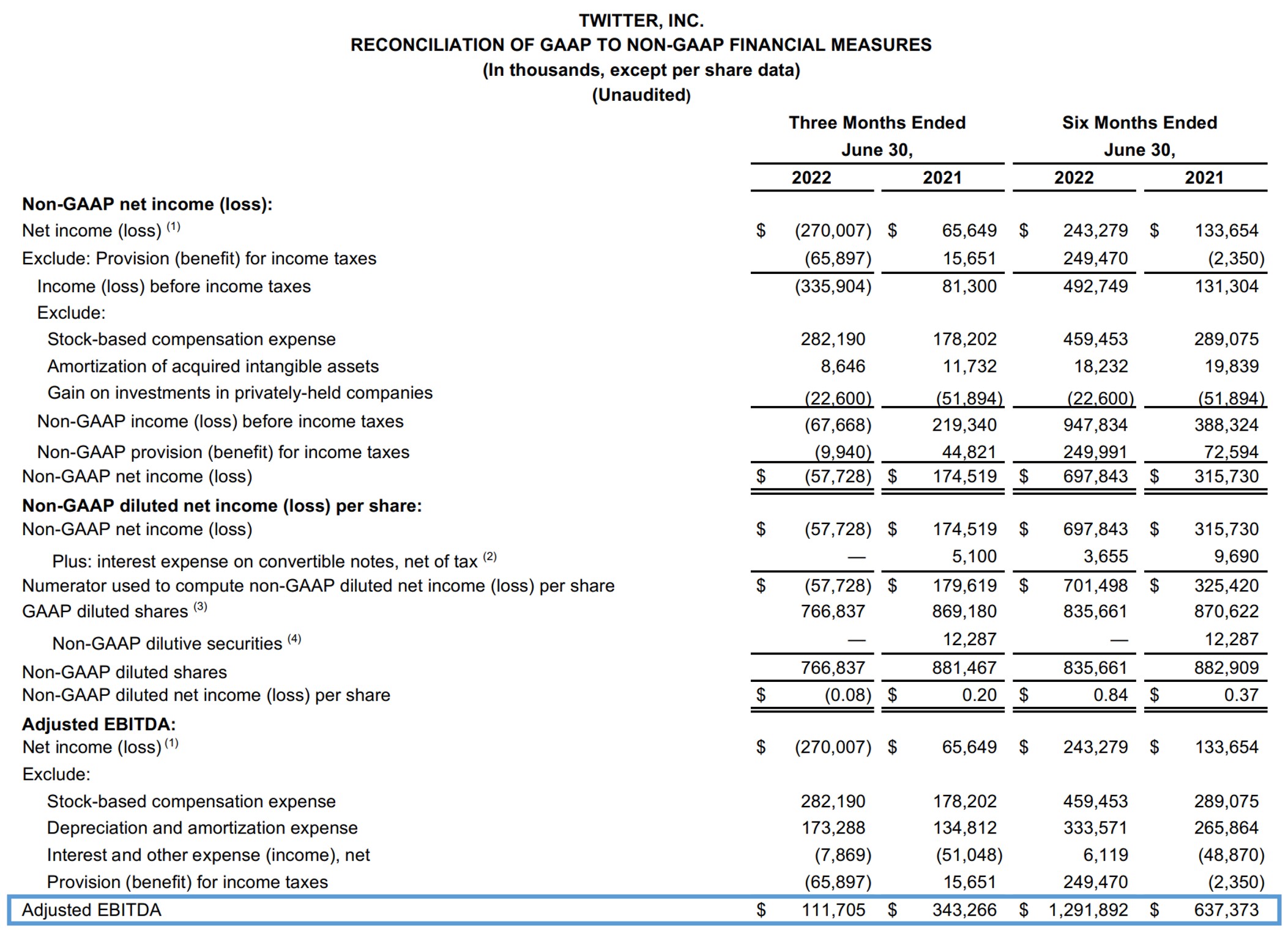
Twitter Announces Second Quarter 2022 Results (Source: TWTR Q2-2022 Press Release)
We’ll now move to a modeling exercise, which you can access by filling out the form below.


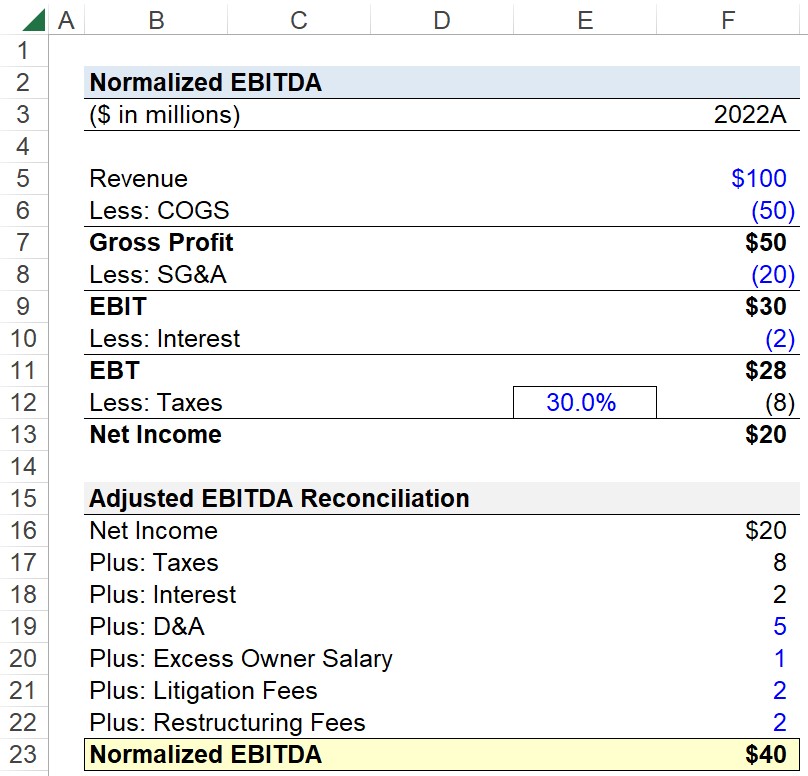
Suppose you’re tasked with calculating the normalized EBITDA of a company in fiscal year ending 2022. The income statement assumptions we’ll use in our exercise are as follows.
| Financial Data | 2022A |
|---|---|
| Revenue | $100 million |
| Less: COGS | (50 million) |
| Gross Profit | $50 million |
| Less: SG&A | (20 million) |
| EBIT | $30 million |
| Less: Interest | (2 million) |
| EBT | $28 million |
| Taxes @ 30.0% | (8 million) |
| Net Income | $20 million |
From there, we'll reconcile net income until we reach our company's normalized EBITDA.
Therefore, our starting point is net income, to which we'll add taxes and interest expense.
Following those two adjustments, we've worked our way back up to the operating income (EBIT) line item.
The next adjustment is to add back D&A since the two items are non-cash charges, wherein the actual outflow of cash occurred in the initial period. Here, we'll assume that the D&A expense in the given period amounts to $5 million.
The final part of our exercise consists of three more adjustments, which are excess owner salary (i.e. new owner will receive less pay), litigation fees, and restructuring fees. The latter two types of fees are added back because neither fee is considered typical in the normal course of business and does not contribute to the company's revenue model.
In closing, the normalized EBITDA of our hypothetical company comes out to $40 million.

Enroll in The Premium Package: Learn Financial Statement Modeling, DCF, M&A, LBO and Comps. The same training program used at top investment banks.


No comments yet.