What is EBIAT?
EBIAT is a company’s after-tax operating income assuming there is no debt in its capital structure, i.e. the effects of interest are removed.

EBIAT is a company’s after-tax operating income assuming there is no debt in its capital structure, i.e. the effects of interest are removed.
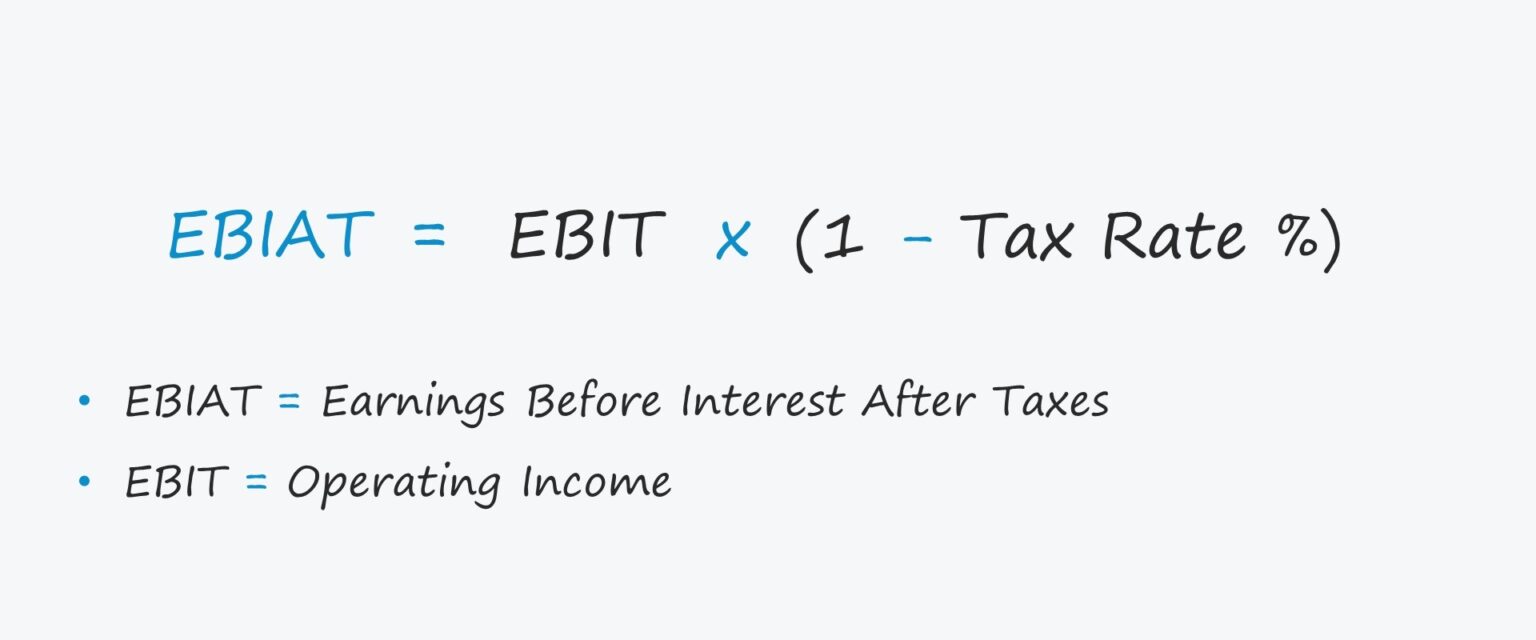
EBIAT, short for "Earnings Before Interest After Taxes", represents a company’s profit if no debt-related tax benefits were received.
Since the impact of financing differences in capital structures is removed, comparisons among different companies is more “apples to apples”.
In practice, the EBIAT metric – also referred to as net operating profit after taxes (NOPAT) – is used to estimate a company’s operating profits once the effects of financing items, namely interest expense, are removed.
If the impact of debt is not removed, the discretionary decisions surrounding the amount of leverage among the peer set could skew the calculations, resulting in misleading findings.
Interest expense is tax-deductible, so the company of taxes paid are reduced by the so-called “interest tax shield”.
Calculating EBIAT is one of the first steps in projecting a company’s future free cash flows (FCFs) in a DCF model because it is an unlevered metric.
The metric should reflect a company’s taxed core operating income (EBIT), after eliminating the impact of non-operating gains / (losses) and debt financing (e.g. “tax shield”), i.e. normalized under the assumption that the company’s capitalization is entirely all-equity with no debt.
EBIAT represents the profits available to all sources of capital, i.e. both debt and equity.
The formula multiplies operating income (EBIT) by (1 – t), in which “t” is the company’s marginal tax rate.
EBIT is a company’s gross profit minus all operating expenses, with includes items such as depreciation, amortization, employee compensation, and overhead costs.
Moreover, while the marginal tax rate is used here, the effective tax rate (i.e. the actual tax rate paid based on historical periods), could also be used.
An alternative formula starts with net income, as shown below.
Suppose we have two companies that share the following financials:
Down to the operating income (EBIT) line, the two companies are identical.
But the similarities end there because of a non-operating line item, interest expense.
Here, we’ll assume the two companies carry different amounts of debt on their balance sheet.
The interest tax shield subsequently reduces Company B’s pre-tax income.
The $50 million difference is caused by the interest expense, and the taxes of the two companies vary because of the tax deductibility of interest.
Given a 20% tax rate assumption, the companies pay the following taxes:
In conclusion, the taxes paid by Company A are double that of Company B, and the net incomes of the two companies are shown below.

Enroll in The Premium Package: Learn Financial Statement Modeling, DCF, M&A, LBO and Comps. The same training program used at top investment banks.


No comments yet.