What is PVGO?
PVGO, or “present value of growth opportunities”, estimates the portion of a company’s share price attributable to expectations of future earnings growth.

PVGO, or “present value of growth opportunities”, estimates the portion of a company’s share price attributable to expectations of future earnings growth.
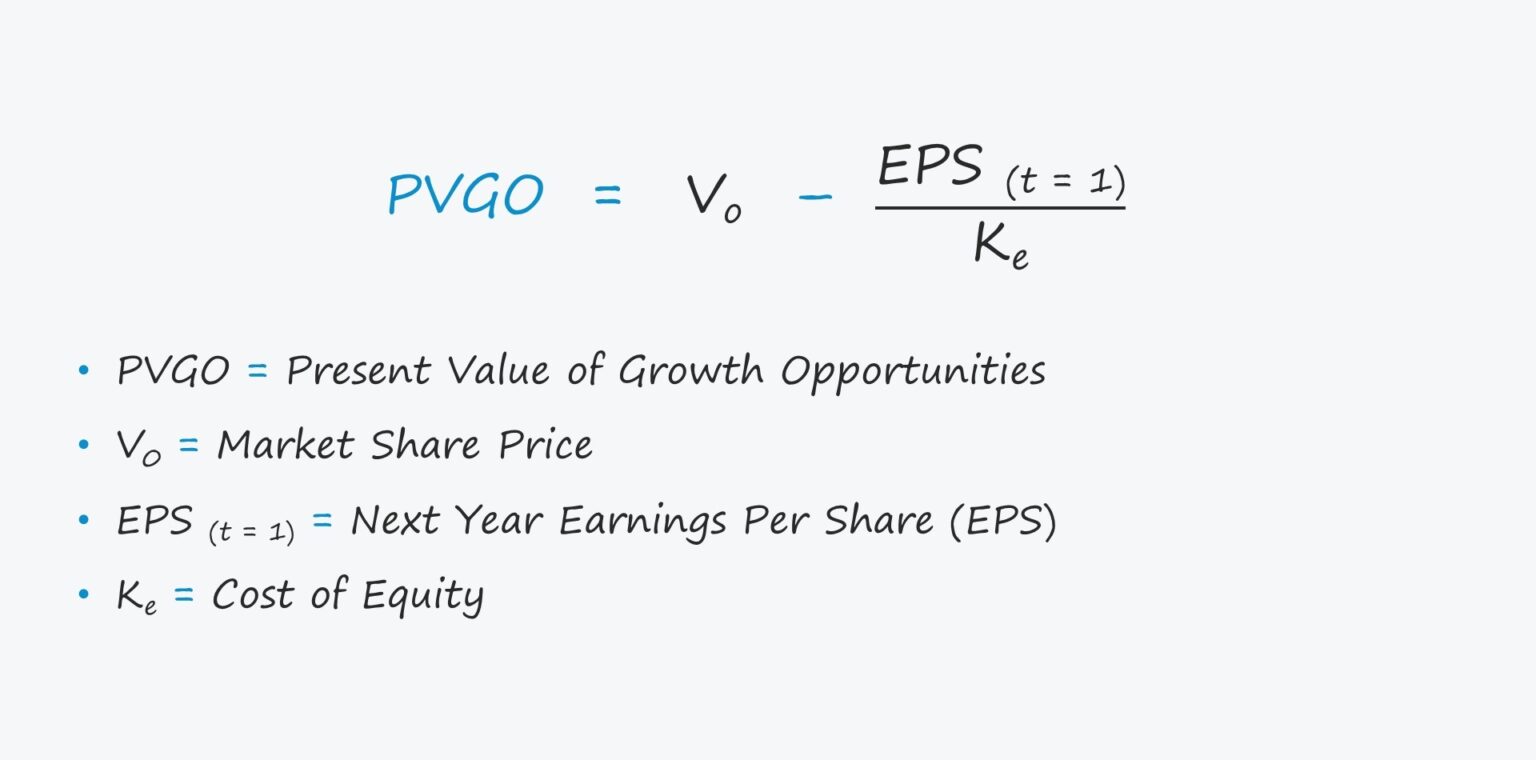
PVGO, shorthand for the “present value of growth opportunities,” represents the value of a company's future growth.
The PVGO metric measures the potential value-creation from a company reinvesting earnings back into itself, i.e. from accepting projects to drive future growth.
There are two components to a company’s current share price:
The earnings with no growth can be valued as a perpetuity, where the expected earnings per share (EPS) next year is divided by the cost of equity (Ke).
The latter part, the future earnings growth, is what PVGO attempts to measure, i.e. the value of growth.
The formula shown below of the market share price states that a company’s valuation is equal to the sum of the present value (PV) of its no-growth earnings and the present value of growth opportunities.
Where:
After rearranging the formula, the formula is as follows.
Therefore, PVGO is conceptually the difference between a company’s value minus the present value (PV) of its earnings, assuming zero growth.
In theory, the objective of all corporates should be to maximize shareholder wealth.
That being said, shareholder wealth is created when companies consistently reinvest earnings into positive net present value (NPV) projects.
If there are no projects worth pursuing from a returns standpoint, these zero-growth companies should distribute their earnings to shareholders in the form of dividends.
The PVGO can be a useful guide in the critical decision-making process of picking between reinvesting earnings or paying out dividends.
The metric is often expressed as a percentage of the current market share price (Vo).
One limitation to PVGO is the assumption that the current share price reflects the Company's fair value, which can be quite a risky assertion considering how volatile (and irrational) the market can be.
Thus, it is recommended to either ensure the share price is normalized to reflect historical performance or use the one-year average share price.
We’ll now move to a modeling exercise, which you can access by filling out the form below.


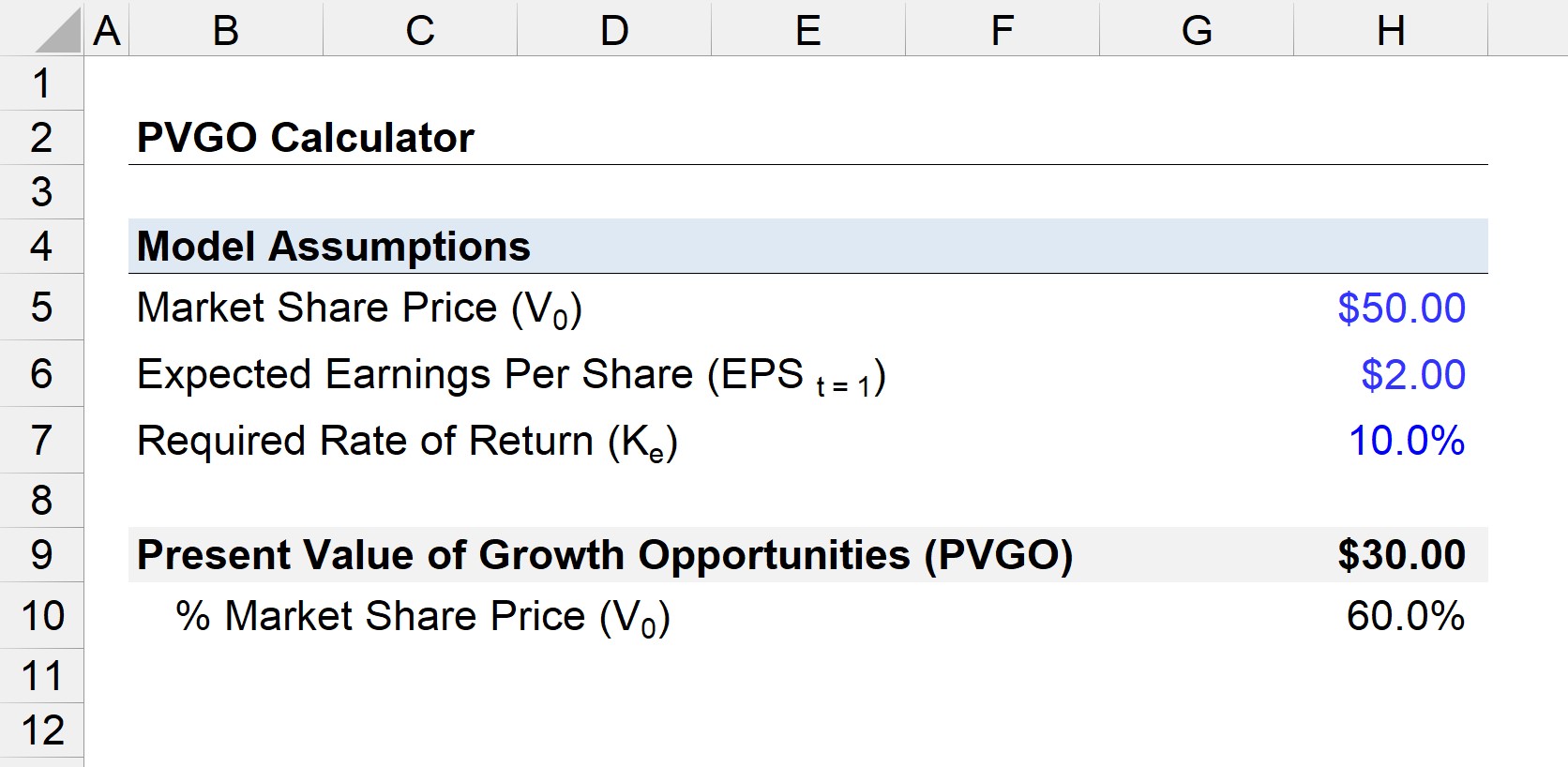
Suppose a company is currently trading at a share price of $50.00, with the market anticipating its earnings per share (EPS) next year to be $2.00.
If we assume a required rate of return of 10%, what proportion of the company’s market price is attributable to its future growth?
After entering the provided assumption into our share price formula from earlier, we are left with the following:
By dividing the EPS expected next year by the required rate of return (i.e. the cost of equity), we arrive at the zero-growth valuation of $20.
We can now solve for PVGO by rearranging the formula and then subtracting the zero-growth valuation price component ($2.00 / 10% = $20.00) from the total valuation.
Upon dividing the $30 PVGO by the $50 share price, we can conclude that the market assigns 60% of the market price to future growth — which implies that significant growth expectations are priced into our illustrative company’s current share price.

Enroll in The Premium Package: Learn Financial Statement Modeling, DCF, M&A, LBO and Comps. The same training program used at top investment banks.


No comments yet.