What is Recapitalization?
Recapitalization is a catch-all term referring to measures taken by companies to adjust the debt-to-equity (D/E) mixture within their capital structures.

Recapitalization is a catch-all term referring to measures taken by companies to adjust the debt-to-equity (D/E) mixture within their capital structures.
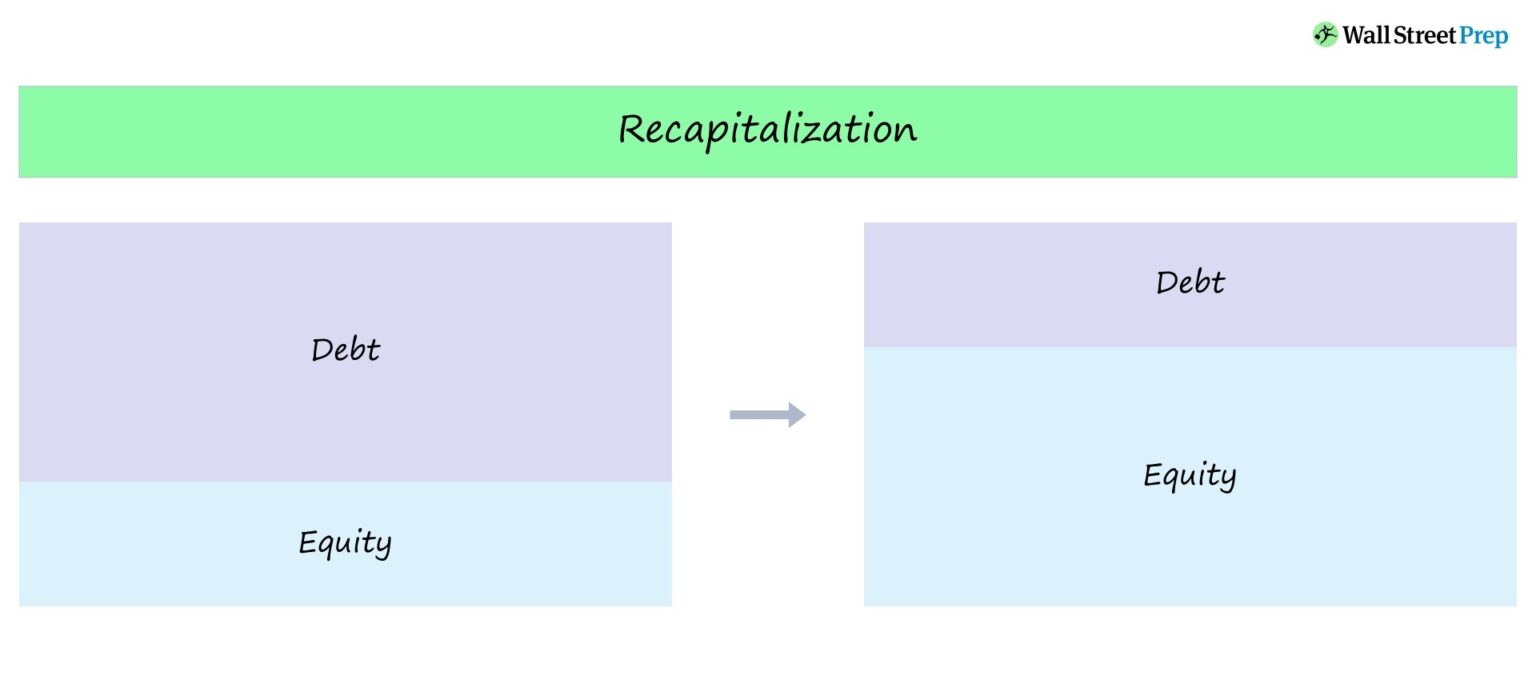
Recapitalization occurs when a company adjusts its capital structure, often with the goal of shifting its D/E ratio closer to its optimal capital structure.
Such measures are taken by companies to reach their "optimal capital structure" – either to:
The term frequently appears in restructuring, in which a company is forced (rather than choosing to do so voluntarily) to undergo a recapitalization to stabilize its capital structure.
For example, a company’s capital structure could be deemed unsustainable, causing debt restructuring to become necessary. In such a scenario, the recapitalization’s objective is to reduce the company's proportion of debt on its balance sheet (and lower its default risk).
If the purpose of a recapitalization is to lower the amount of leverage in the total capital structure – i.e. due to the absence of an adequate amount of equity – then the company has two choices:
For distressed companies, an equity recapitalization is typically difficult to complete due to the lack of interest in the capital markets.
The claims held by equity holders (i.e. common and preferred equity) are placed at the bottom of the capital structure, so shareholders represent the lowest tiers in terms of liquidation priority.
A more common strategy for distressed companies is called a “debt-for-equity swap”, in which claims held by certain debt holders are exchanged into equity as part of the restructuring process.
If a company's capital structure does not contain enough debt, it could be missing out on the benefits of debt, namely the interest "tax shield".
Assuming the company has sufficient debt capacity remaining, management could determine that the best course of action for maximizing shareholder value is to repurchase shares (or issue dividends) using the proceeds from additional debt.
For a debt recapitalization (or "leveraged recap"), the company aims to:
Following the debt recapitalization, the share price of the company could see an “artificial” increase, which is contingent on how the market perceives the buyback.
Another variation of a recapitalization is called a dividend recapitalization (or dividend "recap"), which is one option for private equity firms to increase fund returns from a leveraged buyout (LBO).
A dividend recapitalization occurs when additional debt is raised with the specific purpose of issuing the private equity firm – i.e. the financial sponsor – a one-time dividend with the newly-raised cash proceeds.
Most dividend recaps are completed after the post-LBO portfolio company has already paid down a portion of the initial debt raised to fund the transaction, creating more debt capacity.
The purpose of dividend recaps is for the sponsor to partially monetize an investment without undergoing an outright sale via an exit to a strategic or an initial public offering (IPO), which also helps increase fund returns.
In particular, upon completion of a dividend recap, the fund’s IRR can be positively impacted by the earlier monetization and distribution of funds.
After a dividend recap, the private equity firm remains in control of the company's equity while increasing fund returns and de-risking its investment.




No comments yet.