What are Convertible Bonds?
Convertible Bonds are fixed-income issuances structured with a conversion option to exchange them for a certain number of shares (i.e. equity) in the underlying company.

Convertible Bonds are fixed-income issuances structured with a conversion option to exchange them for a certain number of shares (i.e. equity) in the underlying company.
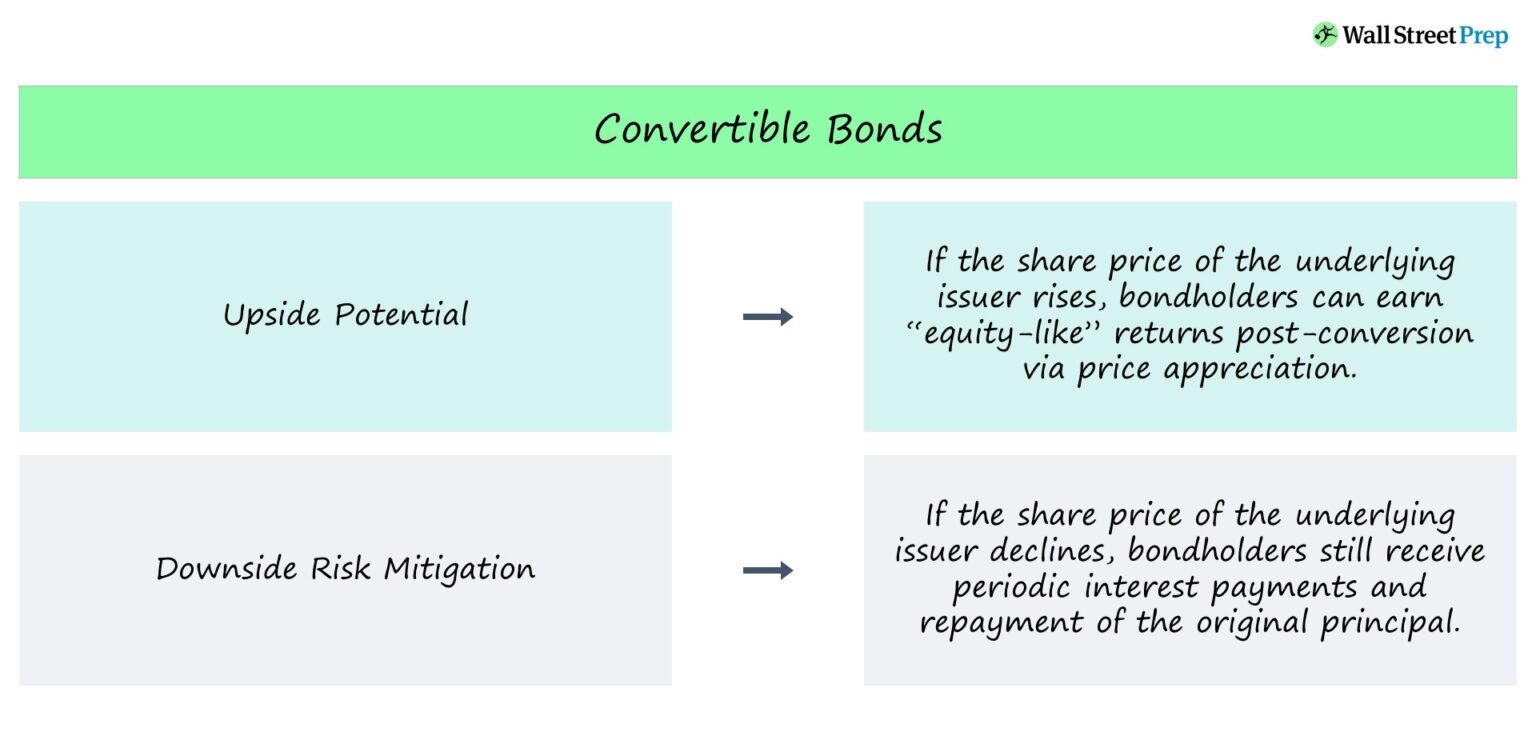
Convertible bonds, or "convertibles," are hybrid financing instruments that blend the traditional features of debt and equity.
Convertible bonds provide the bondholder with the option to convert the bonds into equity if certain conditions are met.
The differentiating factor of convertible bonds is their “equity-kicker”, where the bonds can be exchanged for a pre-determined number of equity shares.
Until converted, the issuer is obligated to pay interest periodically to the bondholder, who can redeem the bonds for a set time frame to receive either:
The appeal of convertible bonds for bondholders is the added optionality of equity participation for equity-like returns along with bond-like protection, creating a more balanced risk/reward profile.
The decision to convert the bonds into equity is up to the bondholder, with the main consideration being the share price of the underlying company.
Like options, bondholders usually opt to convert the bonds into common shares only if doing so results in a higher return than the yield on the bonds.
Convertibles are issued with the key terms clearly stated within the loan agreement, as well as the details regarding the conversion option.
The conversion ratio determines the number of shares received in exchange for one bond and is established on the date of issuance.
For instance, a "3:1" ratio means the bondholder is entitled to receive three shares per bond post-conversion.
The conversion price is the price per share at which a convertible bond can be converted into common shares.
The issuer offering convertible bonds typically expects their share price to appreciate in value.
For example, if a company seeks to raise $10 million and the current share price is $25, then 400,000 new shares must be issued to reach its capital raising target.
With convertible debt, the conversion could be deferred until its share price has increased.
If we assume the company's shares have doubled and are currently trading at $50 per share, the number of shares issued is cut in half.
As a result of the higher share price, the number of shares issued to reach the target declines to 200,000, partially reducing the net dilutive impact.
Convertible bonds are a form of "deferred" equity financing, reducing the net impact of dilution if the share price appreciates later.
Convertible bonds can be a preferable method of raising capital because the issuance is contingent on meeting two conditions:
In effect, the contractual provisions function as a hedge against dilution.
The bondholder receives downside protection – i.e. protection of the original principal and source of income via interest, barring default – as well as the potential for equity-like returns if converted.
However, most convertible bonds contain a call provision that allows the issuer to redeem the bonds earlier, which caps the capital gain potential.
The exchange feature attached to convertibles could enable a bondholder to earn outsized returns, yet the returns stem from share price appreciation post-conversion rather than interest.
Why? The option to convert comes at the expense of a lower coupon, i.e. interest rate.
Relative to other fixed-income securities, convertibles are often more volatile, as the equity option component is a derivative of the underlying company's share price.
Conversion can still cause a company’s earnings per share (EPS) and share price to decline, despite the reduced dilution compared to traditional equity issuances.
The treasury stock method (TSM) is the recommended approach to calculating diluted EPS and the total number of diluted shares outstanding, in order to take into account the potential dilutive effects of convertible bonds and other dilutive securities.
The final downside to convertible bonds is that these securities, particularly those designated as subordinated convertible bonds, are lower in the capital structure than the other debt tranches.
Wall Street Prep’s globally recognized certification program prepares trainees with the skills they need to succeed as a Fixed Income Trader on either the Buy Side or Sell Side.


No comments yet.