What is Capital Gain?
A Capital Gain occurs when the value of an investment – typically in equity (stocks) or debt instruments – rises above the initial purchase price post-sale.

A Capital Gain occurs when the value of an investment – typically in equity (stocks) or debt instruments – rises above the initial purchase price post-sale.

If an investment is sold at a price that exceeds the original price paid on the date of initial investment, then there is a capital gain.
The most common examples of assets that are regularly purchased and sold are:
Conversely, if the investment is sold to a buyer at a price lower than the initial price, there is no capital gain, but rather a capital loss – which brings about certain implications to taxes.
Capital gains can be taxed, unlike capital losses, which cannot be taxed.
Moreover, capital gains are factored into a specific individual/company’s taxable income (EBT) and are charged at the prevailing tax rates in the appropriate jurisdiction.
The formula to calculate the capital gain on an investment is as follows.
Learn how institutional investors identify high-potential undervalued stocks. Enrollment is open for the upcoming cohort.
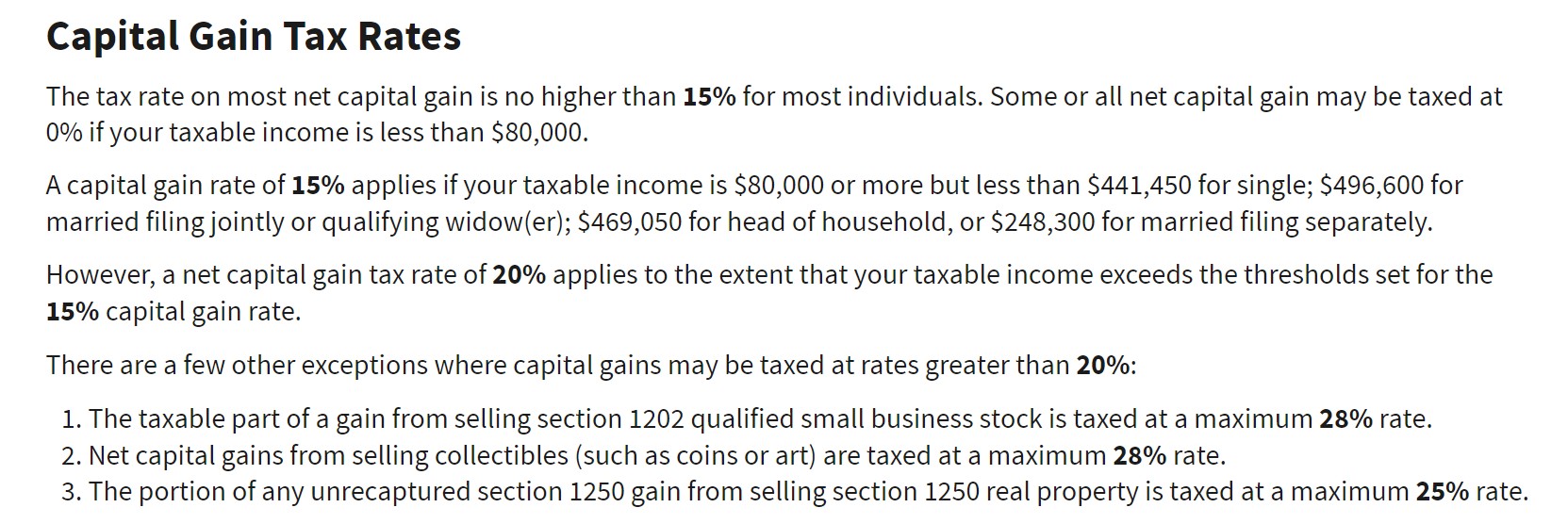
Topic No. 409 Capital Gains and Losses (Source: IRS)
If an investment is sold, meaning that there is now a new owner of the investment, the capital gain is considered to be “realized.”
Further, if you realize a capital gain post-sale, the proceeds are deemed taxable income.
By contrast, if the value of an investment is higher than entry, but the holders of the asset have not yet sold it, the capital gain is “unrealized.”
Realized capital gains occur on the date of exit, as this triggers a taxable event, whereas unrealized capital gains are simply “paper” gains/losses.
The importance of the statement above stems from the fact that the investor is not taxed until the investment is exited, and a profit is obtained. Unrealized gains, also referred to as “paper gains,” are NOT taxable.
Furthermore, capital gains can be categorized as either:
The importance of the distinction is tied to taxes, as income taxes are directly impacted by the duration of the holding period.
In particular, investors with short holding periods – e.g. day-traders – must take into consideration the higher tax rate for near-term trading.
Long-term capital gains, compared to short-term capital gains, are taxed at a lower rate.
The rationale for long-term capital gains to be taxed lower is to reduce the volatility in the market and provide an incentive for longer holding periods (i.e. promote market stability).
Hence, value investors purchase securities with the intent to hold onto the investment for a long duration before exiting.
| Tax Rate | Single, Unmarried | Married, Filing Jointly | Married, Filing Separately | Head of Household |
|---|---|---|---|---|
| 10.0% | $0 to $10,275 | $0 to $20,550 | $0 to $10,275 | $0 to $14,650 |
| 12.0% | $10,275 to $41,775 | $20,550 to $83,550 | $10,275 to $41,775 | $14,650 to $55,900 |
| 22.0% | $41,775 to $89,075 | $83,550 to $178,150 | $41,775 to $89,075 | $55,900 to $89,050 |
| 24.0% | $89,075 to $170,050 | $178,150 to $340,100 | $89,075 to $170,050 | $89,050 to $170,050 |
| 32.0% | $170,050 to $215,950 | $340,100 to $431,900 | $170,050 to $215,950 | $170,050 to $215,950 |
| 35.0% | $215,950 to $539,900 | $431,900 to $647,850 | $215,950 to $539,900 | $215,950 to $539,900 |
| 37.0% | $539,900+ | $647,850+ | $539,900+ | $539,900+ |
| Tax Rate | Single, Unmarried | Married, Filing Jointly | Married, Filing Separately | Head of Household |
|---|---|---|---|---|
| 0.0% | $0 to $41,675 | $0 to $83,350 | $0 to $41,675 | $0 to $55,800 |
| 15.0% | $41,675 to $459,750 | $83,350 to $517,200 | $41,675 to $258,600 | $55,800 to $488,500 |
| 20.0% | $459,750+ | $517,200+ | $258,600+ | $488,500+ |
To reiterate from earlier, a capital gain is triggered when you sell an investment for a net profit.
For our example scenario, let’s assume that a corporation (i.e. not an individual tax payer) based in the U.S. has $10 million in taxable income for the year.
In addition, the company has exited an investment with a total capital gain of $2 million – which is taxed at 21% (i.e. the corporate tax rate).
Given a tax rate of 21%, the tax liability is equal to $2.5 million, inclusive of the capital gains tax of $420k.


No comments yet.