What are the Top Hedge Funds?
The Top Hedge Funds are compiled in the following list, where the rankings are based on their assets under management (AUM).

The Top Hedge Funds are compiled in the following list, where the rankings are based on their assets under management (AUM).
To access our comprehensive database of 400 hedge funds and investment firms in the public equities market, fill out the form below to download the Excel spreadsheet.


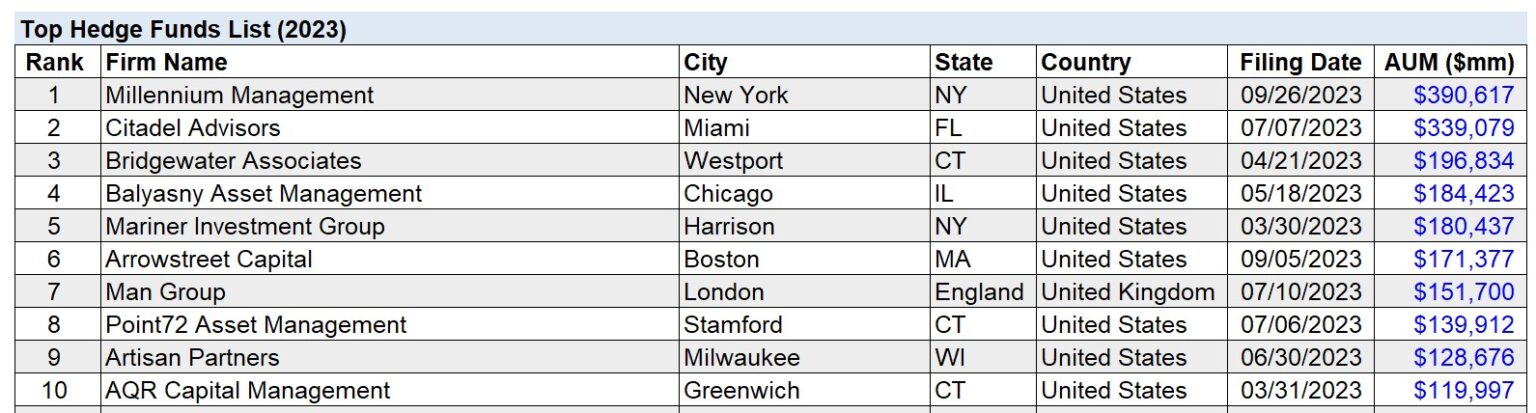
The following table lists the largest hedge funds in 2023 ranked by assets under management (AUM).
| Rank | Firm Name | City | State | Country | ADV Filing Date | AUM ($mm) |
|---|---|---|---|---|---|---|
| 1 | Millennium Management | New York | NY | United States | 09/26/2023 | $390,617 |
| 2 | Citadel Advisors | Miami | FL | United States | 07/07/2023 | $339,079 |
| 3 | Bridgewater Associates | Westport | CT | United States | 04/21/2023 | $196,834 |
| 4 | Balyasny Asset Management | Chicago | IL | United States | 05/18/2023 | $184,423 |
| 5 | Mariner Investment Group | Harrison | NY | United States | 03/30/2023 | $180,437 |
| 6 | Arrowstreet Capital | Boston | MA | United States | 09/05/2023 | $171,377 |
| 7 | Brookfield Asset Management | New York | NY | United States | 07/03/2023 | $159,981 |
| 8 | Man Group | London | England | United Kingdom | 07/10/2023 | $151,700 |
| 9 | Point72 Asset Management | Stamford | CT | United States | 07/06/2023 | $139,912 |
| 10 | Artisan Partners | Milwaukee | WI | United States | 06/30/2023 | $128,676 |
| 11 | AQR Capital Management | Greenwich | CT | United States | 03/31/2023 | $119,997 |
| 12 | Clearbridge Investments | New York | NY | United States | 08/23/2023 | $111,196 |
| 13 | D. E. Shaw & Co. | New York | NY | United States | 07/10/2023 | $109,282 |
| 14 | Renaissance Technologies | New York | NY | United States | 07/12/2023 | $106,027 |
| 15 | Garda Capital Partners | Wayzata | MN | United States | 08/07/2023 | $105,664 |
| 16 | Wilshire Advisors | Santa Monica | CA | United States | 03/21/2023 | $95,287 |
| 17 | Harris Associates | Chicago | IL | United States | 07/18/2023 | $94,139 |
| 18 | Elliott Investment Management | West Palm Beach | FL | United States | 03/29/2023 | $93,207 |
| 19 | Exoduspoint Capital Management | New York | NY | United States | 04/10/2023 | $90,256 |
| 20 | Cambridge Associates | Boston | MA | United States | 03/30/2023 | $78,909 |
| 21 | Alphadyne Asset Management | New York | NY | United States | 08/29/2023 | $76,677 |
| 22 | Fortress Investment Group | New York | NY | United States | 05/16/2023 | $73,630 |
| 23 | Squarepoint Capital | New York | NY | United States | 08/10/2023 | $72,711 |
| 24 | Bracebridge Capital | Boston | MA | United States | 07/05/2023 | $71,843 |
| 25 | Starwood Capital Group | Miami Beach | FL | United States | 03/31/2023 | $71,330 |
| 26 | Two Sigma Investments | New York | NY | United States | 08/24/2023 | $70,803 |
| 27 | Element Capital Management | New York | NY | United States | 07/14/2023 | $68,583 |
| 28 | Two Sigma Advisers | New York | NY | United States | 03/30/2023 | $67,471 |
| 29 | Blackstone Alternative Asset Management (BAAM) | New York | NY | United States | 08/24/2023 | $66,937 |
| 30 | Oak Hill Advisors | New York | NY | United States | 07/12/2023 | $63,165 |
| 31 | Sanders Capital | West Palm Beach | FL | United States | 08/27/2023 | $61,660 |
| 32 | Tiger Global Management | New York | NY | United States | 05/09/2023 | $58,515 |
| 33 | Pinebridge Investments | New York | NY | United States | 03/29/2023 | $58,042 |
| 34 | Schonfeld Strategic Advisors | New York | NY | United States | 07/13/2023 | $56,944 |
| 35 | TCW Asset Management | Los Angeles | CA | United States | 05/12/2023 | $54,237 |
| 36 | Viking Global Investors | Greenwich | CT | United States | 06/26/2023 | $52,147 |
| 37 | AHL Partners | London | England | United Kingdom | 08/17/2023 | $52,080 |
| 38 | Lighthouse Investment Partners | Palm Beach Gardens | FL | United States | 08/28/2023 | $51,918 |
| 39 | Ares Capital Management | Los Angeles | CA | United States | 08/25/2023 | $51,191 |
| 40 | Haidar Capital Management | Pearl River | NY | United States | 08/22/2023 | $49,839 |
| 41 | Coatue Management | New York | NY | United States | 03/30/2023 | $47,876 |
| 42 | Sculptor Capital | New York | NY | United States | 05/26/2023 | $45,974 |
| 43 | Select Equity Group | New York | NY | United States | 06/30/2023 | $45,142 |
| 44 | Jupiter Asset Management | London | England | United Kingdom | 06/05/2023 | $44,662 |
| 45 | Adage Capital Management | Boston | MA | United States | 08/08/2023 | $44,628 |
| 46 | Verition Fund Management | Greenwich | CT | United States | 07/03/2023 | $43,630 |
| 47 | Capstone Investment Advisors | New York | NY | United States | 07/19/2023 | $43,429 |
| 48 | Crescent Capital Group | Los Angeles | CA | United States | 05/18/2023 | $42,746 |
| 49 | Tudor Investment Corporation | Stamford | CT | United States | 04/21/2023 | $42,611 |
| 50 | Farallon Capital Management | San Francisco | CA | United States | 07/20/2023 | $41,249 |
| 51 | Davidson Kempner Capital Management | New York | NY | United States | 08/08/2023 | $40,819 |
| 52 | Moore Capital Management | New York | NY | United States | 05/03/2023 | $40,197 |
| 53 | Hudson Advisors | New York | NY | United States | 08/28/2023 | $33,325 |
| 54 | Lone Star Funds | Dallas | TX | United States | 08/22/2023 | $33,190 |
| 55 | Grosvenor Capital Management | Chicago | IL | United States | 08/23/2023 | $33,172 |
| 56 | Sands Capital Management | Arlington | VA | United States | 07/07/2023 | $32,206 |
| 57 | Octagon Credit Investors | New York | NY | United States | 04/20/2023 | $31,365 |
| 58 | Ruffer Investment Company | London | England | United Kingdom | 06/28/2023 | $31,345 |
| 59 | GC Advisors (Golub Capital) | Chicago | IL | United States | 06/21/2023 | $30,175 |
| 60 | HBK Capital Management | Dallas | TX | United States | 03/31/2023 | $28,457 |
| 61 | D1 Capital Partners | New York | NY | United States | 03/31/2023 | $27,551 |
| 62 | The Baupost Group | Boston | MA | United States | 08/31/2023 | $27,385 |
| 63 | Voloridge Investment Management | Jupiter | FL | United States | 06/14/2023 | $27,140 |
| 64 | Hudson Bay Capital Management | Greenwich | CT | United States | 06/21/2023 | $27,110 |
| 65 | Fulcrum Asset Management | London | England | United Kingdom | 03/30/2023 | $27,043 |
| 66 | Holocene Advisors | New York | NY | United States | 06/15/2023 | $26,486 |
| 67 | King Street Capital Management | New York | NY | United States | 08/29/2023 | $26,126 |
| 68 | Anchorage Capital Group | New York | NY | United States | 06/15/2023 | $25,970 |
| 69 | Rockefeller Capital Management | New York | NY | United States | 07/26/2023 | $25,816 |
| 70 | Brigade Capital Management | New York | NY | United States | 07/12/2023 | $25,603 |
| 71 | Magnetar Financial | Evanston | IL | United States | 08/21/2023 | $24,733 |
| 72 | Parallax Volatility Advisers | San Francisco | CA | United States | 03/20/2023 | $24,601 |
| 73 | First Pacific Advisors | Los Angeles | CA | United States | 03/30/2023 | $24,343 |
| 74 | Eagle Capital Management | New York | NY | United States | 05/30/2023 | $23,926 |
| 75 | Makena Capital Management | Menlo Park | CA | United States | 05/23/2023 | $23,696 |
| 76 | Baker Bros | New York | NY | United States | 03/31/2023 | $23,155 |
| 77 | Silver Point Capital | Greenwich | CT | United States | 05/01/2023 | $22,450 |
| 78 | Caxton Associates | New York | NY | United States | 03/31/2023 | $22,258 |
| 79 | Edgepoint Investment Group | Toronto | Ontario | Canada | 06/28/2023 | $21,906 |
| 80 | TFG Asset Management | New York | NY | United States | 06/30/2023 | $21,763 |
| 81 | Dragoneer Investment Group | San Francisco | CA | United States | 08/11/2023 | $21,729 |
| 82 | ArrowMark Partners | Denver | CO | United States | 03/30/2023 | $21,395 |
| 83 | Crestline Management | Fort Worth | TX | United States | 06/06/2023 | $20,825 |
| 84 | Hall Capital Partners | San Francisco | CA | United States | 04/24/2023 | $20,520 |
| 85 | AB CarVal Investors | Minneapolis | MN | United States | 03/29/2023 | $19,366 |
| 86 | Tenaron Capital Management | New York | NY | United States | 06/30/2023 | $18,974 |
| 87 | Marshall Wace | New York | NY | United States | 03/31/2023 | $18,865 |
| 88 | Sali Fund Services | Austin | TX | United States | 08/21/2023 | $18,775 |
| 89 | Orbimed Advisors | New York | NY | United States | 03/31/2023 | $18,278 |
| 90 | Alpha Wave Global | New York | NY | United States | 03/31/2023 | $18,195 |
| 91 | Third Point Management | New York | NY | United States | 08/11/2023 | $17,965 |
| 92 | Strategic Value Partners | Greenwich | CT | United States | 08/17/2023 | $17,609 |
| 93 | Lone Pine Capital | Greenwich | CT | United States | 03/29/2023 | $17,076 |
| 94 | Fred Alger Management | New York | NY | United States | 03/29/2023 | $16,989 |
| 95 | 3G Capital Partners | New York | NY | United States | 08/31/2023 | $16,960 |
| 96 | Thompson Siegel & Walmsley | Richmond | VA | United States | 05/15/2023 | $16,810 |
| 97 | Woodline Partners | San Francisco | CA | United States | 08/03/2023 | $16,755 |
| 98 | Axiom Investors | Greenwich | CT | United States | 08/09/2023 | $16,573 |
| 99 | The Colony Group | Boston | MA | United States | 03/31/2023 | $16,363 |
| 100 | Pershing Square Capital Management | New York | NY | United States | 03/31/2023 | $16,000 |
Learn how institutional investors identify high-potential undervalued stocks. Enrollment is open for the upcoming cohort.

Analyzing hedge funds by assets under management (AUM) offers a useful snapshot, but it often falls short when predicting future performance or assessing risk exposure. Artificial intelligence revolutionizes this analysis by combining performance metrics, historical market trends, and advanced risk modeling techniques. By utilizing AI-driven analytics, investors gain a more comprehensive understanding of performance drivers, which helps identify high-quality investment opportunities that go beyond current rankings. The AI for Business & Finance Certificate Program — developed by Wall Street Prep in collaboration with Columbia Business School Executive Education — teaches professionals how to incorporate hedge fund analysis and decision-making tools into investment workflows.
In the following section, we'll describe the top ten largest hedge funds, the origins of each firm, and a brief description of their respective investment strategies.
Founded in 1989 by Israel Englander, Millennium Management is a New York-based hedge fund that uses a global multi-strategy approach to investing.
Millennium's investment strategies are broad in scope, where capital is allocated toward equity and debt securities, as well as currencies and more speculative derivative instruments.
In particular, there are four primary strategies in the Millennium business model:
Founded by Ken Griffin in 1990, Citadel Advisors is a leading investment firm widely recognized as one of the most successful hedge funds in terms of returns (i.e. net gains) and profitability since inception.
Citadel invests in a wide range of asset classes and geographies, with a singular focus on achieving industry-leading returns.
Citadel specializes in five distinct strategies.
Bridgewater Associates was founded in 1975 by Ray Dalio, one of the most widely recognized hedge fund managers, not only for his consistent track record of strong returns and perspective of investing but also for corporate management and workplace culture to optimize performance.
Bridgewater, now headquartered in Connecticut, rose to prominence amid periods of market turmoil, where the fund’s portfolio risk mitigation strategies allowed it to navigate periods of significant market volatility.
Dalio describes the strategy of Bridgewater as a “global macro fund”, in which the core objective of constructing a portfolio is to generate uncorrelated returns.
Bridgewater is considered a pioneer of risk-parity investing and portfolio construction, where an investment portfolio can perform well across different economic conditions.
Balyasny Asset Management (BAM) was founded in 2021 by a trio of co-founders – Dmitry Balyasny, Scott Schroeder, and Taylor O’Malley – in the state of Chicago.
Originally, Balyasny Asset Management (BAM) focused on fundamental investing in equities and long/short investing to hedge portfolio risk.
However, Balyasny later transitioned into a multi-strategy hedge fund, as its assets under management (AUM) expanded and returns started to trail its competitors.
After a period of underperformance, BAM’s strategies started to include early-stage investing, commodities, and macro. In particular, macro strategies have become a more critical part of the portfolio construction of Balyasny.
William Michaelcheck founded Mariner Investment Group in in 1992, after serving as the co-head of the fixed-income department at Bear Stearns.
Since then, Mariner has become one of the top alternative investment firms offering highly specialized strategies to invest across both the public and private markets.
Led by Michaelcheck, Mariner maintained its strong commitment to risk management as an integral part of the firm’s investment strategies.
Mariner’s investment platform consists of three distinct categories:
Founded in 1999 by Bruce Clarke, Peter Rathjens, and John Campbell, Arrowstreet Capital is a Boston-based hedge fund that offers discretionary global equity investment strategies to institutional clients.
The investment strategies used by the firm include long-only, long-only, alpha extension and long/short techniques, while also utilizing various speculative instruments, such as swaps and futures.
The firm’s research process is oriented around the use of proprietary, quantitative models to identify investment opportunities, as well as to evaluate predictive factors as a form of mitigating risk and reducing capital losses.
The Man Group is an asset manager with a history of more than 230 years, including 25 years in investment management.
The firm focuses on long-term, risk-adjusted returns by utilizing long-only and long-short strategies, among other investment styles (and often in other asset classes).
The core principle of the Man Group and its capabilities are connected to access to cutting-edge technology and computing, especially around machine learning (ML).
Of the funds belonging to Man Group, the common theme is quantitative equity investing and systematic investing. In addition, various firms have been acquired that specialize in other strategies, such as long-only strategies, the private markets, and direct lending via the acquisition of Varagon.
Founded in 2014 by Steven A. Cohen, Point72 Asset Management is the successor of S.A.C. Capital Advisors.
Headquartered in Connecticut, Point72 is a global investment firm that invests across multiple asset classes and employs various strategies worldwide.
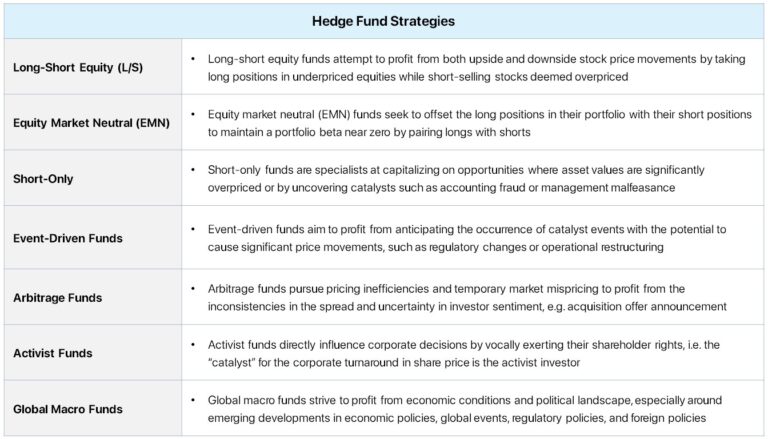
The strategies deployed by Point72 include discretionary long-short equity (L/S), systematic trading, and macro investing strategies.
In recent times, Point72 has also expanded into the private markets via Point72 Ventures, while Cohen became the majority owner of the New York Mets.
Established in 1994, Artisan Partners uses a diverse range of investment strategies across multiple asset classes and securities to generate profitable returns.
Headquartered in Wisconsin, the investment professionals of Artisan Partners manage a range of actively managed strategies and focus on process-driven results (i.e. “autonomous”).
Each team is given discretion in constructing their portfolio. However, the investment process is consistent and disciplined to remain true to the firm’s origins.
Each strategy is targeted around a pre-determined investment theme, where opportunities exist to generate excess returns beyond the set benchmarks.
AQR Capital was founded in 1998 by Cliff Asness, David Kabiller, John Liew, and Robert Krail.
Since its founding days, AQR has gathered a reputation for being at the forefront of investment innovation, as the firm blends technology, data, and behavioral finance to generate sustainable, long-term value.
There are three core principles that AQR was established:



No comments yet.