What is Unsystematic Risk?
Unsystematic Risk, or “idiosyncratic risk”, refers to the risk inherent to a particular company or industry, rather than from the broader economy and financial markets.

Unsystematic Risk, or “idiosyncratic risk”, refers to the risk inherent to a particular company or industry, rather than from the broader economy and financial markets.
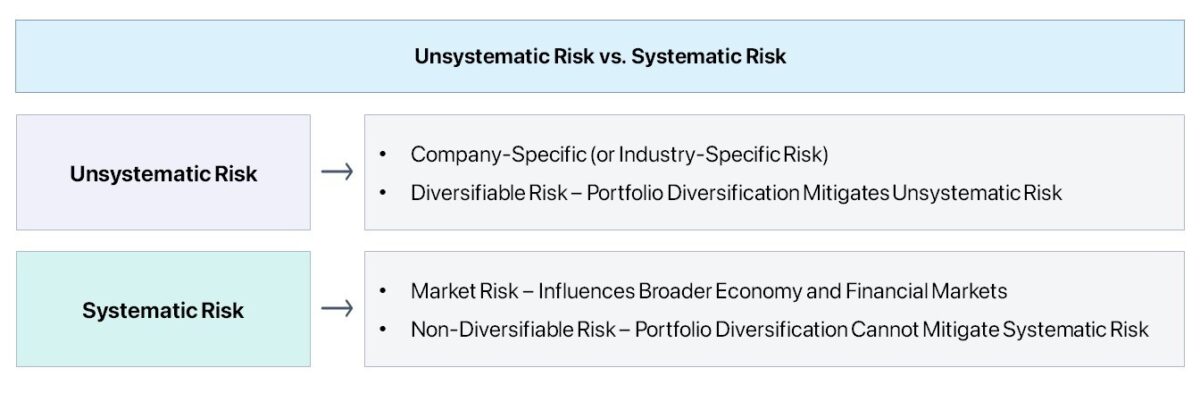
In corporate finance, unsystematic risk is defined as the risk that pertains specifically to individual securities or a particular industry.
Often used interchangeably with the term “idiosyncratic risk”, unsystematic risk can be mitigated via portfolio diversification.
Unsystematic risk arises from company or industry-specific factors with a disproportional impact on a specific security (or securities with commonalities).
The effects of unsystematic risk are constrained to certain securities or a specific industry. Thus, unsystematic risk can thereby be mitigated through portfolio diversification, i.e. less exposure to fluctuations of one particular investment.
So, what are the different sources of unsystematic risk?
Therefore, unsystematic risk is inherent to the ownership of a particular financial security, irrespective of the prevailing market conditions.
Unlike systematic risk, which affects the broader market or an entire asset class (e.g. equity, credit, bond, commodities), unsystematic risk is specific to a particular financial asset or industry.
Learn how institutional investors identify high-potential undervalued stocks. Enrollment is open for the upcoming cohort.
Broadly put, risk is an inevitable part of investing, regardless of the hedging and risk mitigation strategies utilized.
The concept of risk can be broadly segmented into two distinct categories: unsystematic and systematic risk.
Unsystematic risk is specific to a company (or industry), whereas systematic risk has much broader implications that affect the economy and financial markets as a whole.
The notable characteristic of unsystematic risk is the fact that the risk can be mitigated through portfolio diversification, i.e. the strategic inclusion of uncorrelated assets in a portfolio.
Because of the far-reaching scope of systematic risk – wherein the entire economy and financial markets are placed in a position of vulnerability – portfolio diversification is incapable of mitigating it.
Portfolio diversification is by far the most effective method to reduce unsystematic risk, as investing in various securities and asset classes spreads the company and industry-specific risk.
By maintaining a diversified portfolio with holdings across different, uncorrelated securities or asset classes, an investor can reduce the impact of idiosyncratic risk on the returns of the overall portfolio.
Company and industry-specific risks are mitigated by “spreading” the risk across a wide range of investments in different securities, asset classes or geographies.
However, the degree of the impact is not evenly distributed across all industries, as some will be able to recover and return to normalcy far more quickly than others, while others could suffer irreparable monetary losses, resulting in financial distress and requiring restructuring (i.e. filing for bankruptcy protection).
Since unsystematic risk impacts the returns on a specific security (or sector), the risk causes the variability in returns that are not attributable to general economic conditions and market forces (e.g. the interest rate environment).
However, while diversification in theory can substantially reduce the volatility in a portfolio’s returns, it is still not an absolute certain guarantee against potential losses.
One recent example of unsystematic risk is the downfall of BYJU'S, a leading privately-held online learning EdTech platform and formerly one of India’s highest valued startups.
Earlier in 2023, BYJU's had raised more funding at a valuation cap of $22 billion. Since the pandemic, the management team of Byju undertook an aggressive approach to achieve growth at all costs by engaging in M&A.
BYJU's acquired dozens of companies in their niche, such as the following:
The outcome of the aggressive roll-up strategy and reliance on debt financing?
At present date, BYJU's is facing a liquidity crisis and missed an interest payment, so it is amid negotiations with creditors as part of out-of-court restructuring.
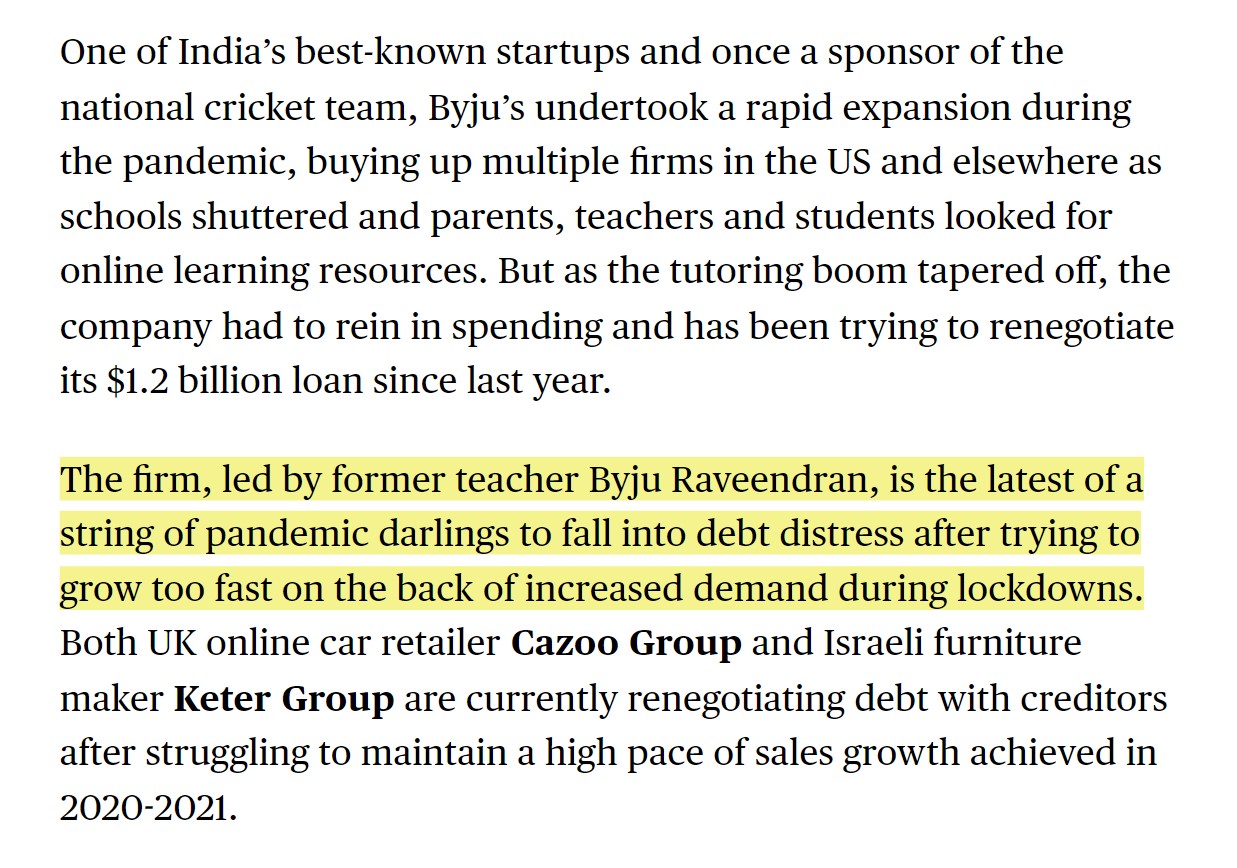
Byju Liquidity Crisis and Financial Distress (Source: Bloomberg)
BlackRock, a minority investor in BYJU's, wrote down the startup’s valuation by nearly two-thirds to $8.4 billion.
To further escalate the concerns regarding its financial health, Deloitte, the auditors of BYJU's, stepped down after management continued to delay their obligations to provide their financial statements with minimal communication.
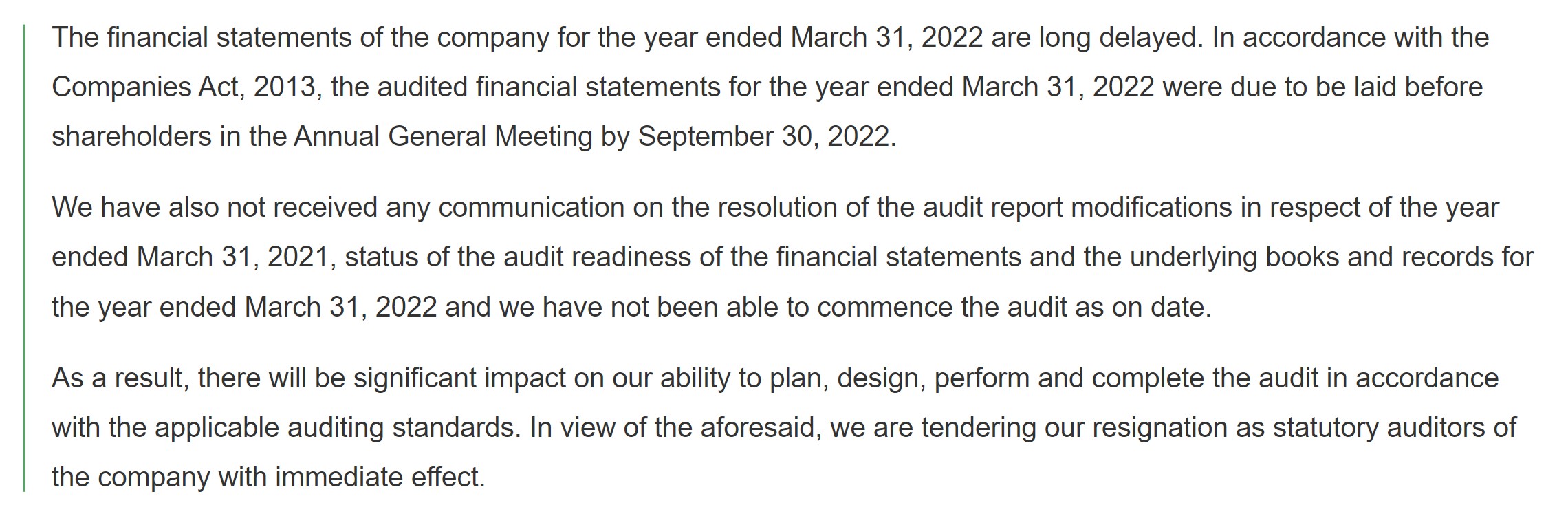
Deloitte Auditor Statement (Source: TechCrunch)
In general, the inability for a company to meet their deadlines to submit financial reports on time is a significant red flag that points towards potential accounting fraud.
Soon after, several board members also left the startup and former partners have disassociated with the startup, which are all negative signs that more legal troubles lie on the horizon.
The reason that the recent financial troubles BYJU's is an example of unsystematic risk is because the sources of the problems were primarily internal in nature, such as the seemingly overambitious roll-up strategy, reliance on too much debt financing, and management's inability to meet financial report filing deadlines.


No comments yet.