What is Event-Driven Investing?
Event-Driven Investing is a strategy wherein investors capitalize on pricing inefficiencies caused by corporate events such as mergers, acquisitions, spin-offs, and bankruptcies.

Event-Driven Investing is a strategy wherein investors capitalize on pricing inefficiencies caused by corporate events such as mergers, acquisitions, spin-offs, and bankruptcies.
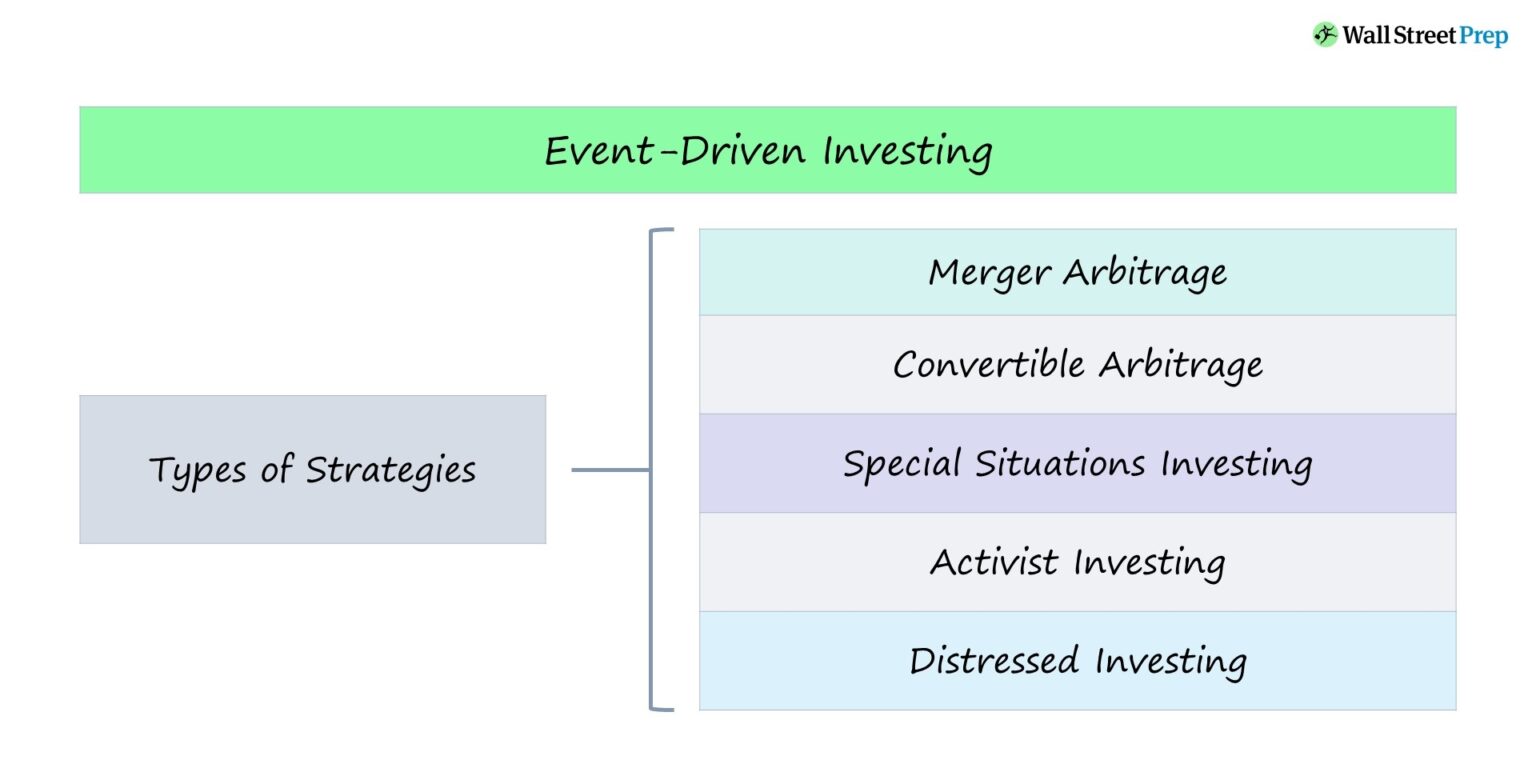
The event-driven strategy is oriented around investments that seek to exploit and profit from corporate events that can create pricing inefficiencies.
Such events include operational turnarounds, M&A activities (e.g. divestitures, spin-offs), and distressed scenarios.
Corporate events can often cause securities to be mispriced and exhibit substantial volatility, especially as the market digests the newly announced news over time.
In particular, event-driven funds tend to thrive in situations of greater complexity, especially around M&A and niche sectors.
| Merger Arbitrage |
|
| Convertible Arbitrage |
|
| Special Situations |
|
| Activist Investing |
|
| Distressed Investing |
|
Learn how institutional investors identify high-potential undervalued stocks. Enrollment is open for the upcoming cohort.
Certain event-driven strategies such as merger arbitrage and distressed investing can perform well independent of economic conditions.
As an illustrative example, suppose that a company just announced its interest in acquiring another company, which we’ll refer to as the “target.”
Typically, the target's share price will rise, although the amount will depend on how the market perceives the announcement at the end of the day.
The market attempts to price in various factors, such as the chance of closure, the anticipated synergies, and control premium, which creates a period of uncertainty in the market, i.e. the uncertainty among investors is reflected in the volatility of the share prices.
The market price tends to remain slightly discounted to the announced offer price, which reflects the remaining uncertainty on the close of the acquisition.
An event-driven investor could analyze the potential acquisition to determine how to maximize profits from the opportunity, with consideration towards factors such as the following:
If the transaction appears near-certain to close, the event-driven investor could purchase shares in the target to profit from the post-acquisition stock price appreciation and take a corresponding short position in the acquirer’s shares – which is the "traditional" merger arbitrage strategy.
But more efficient market pricing and increased competition among institutional investors have contributed to more complex strategies being employed.
For instance, hedge funds nowadays integrate options, utilize secular shorts, trade derivatives around the acquirer, and willfully target highly-complex scenarios with more contingencies (e.g. competing bids, hostile takeovers / anti-takeover).


No comments yet.