How Does the Margin of Safety Work in Value Investing?
The avoidance of losses is one of the core principles of value investing.
Furthermore, a common strategy to limit losses is to invest in securities with a sufficient margin of safety, which is necessary because valuation is an art rather than science, unforeseeable events occur, and the market can misprice securities.
From a risk standpoint, the margin of safety serves as a buffer built into their investment decision-making to protect them against overpaying for an asset — i.e. if the share price were to decline substantially post-purchase.
Instead of shorting stocks or purchasing put options as a hedge against their portfolio, a large proportion of value investors view the MOS concept and long holding periods as the most effective approach to mitigating investment risk.
Coupled with a longer holding period, the investor can better withstand any volatility in market pricing.
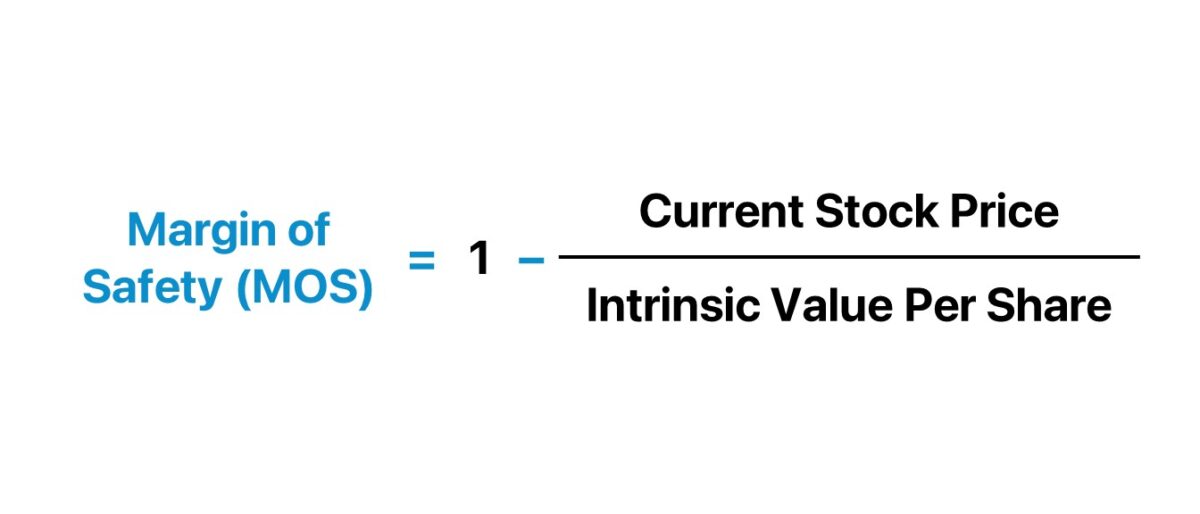
Generally, the majority of value investors will NOT invest in a security unless the MOS is calculated to be around ~20-30%.
If the hurdle is set at 20%, the investor will only purchase a security if the current share price is 20% below the intrinsic value based on their valuation.
If not, there is no “room for error” in the valuation of the shares, meaning that the share price would be lower than the intrinsic value following a minor decline in value.
How to Calculate Margin of Safety in Break-Even Analysis
While the margin of safety is associated with value investing – largely attributable to the book by Seth Klarman – the term is also used in accounting to measure how much extra revenue is generated over the minimum amount needed to break even.
From a different viewpoint, the margin of safety (MOS) is the total amount of revenue that could be lost by a company before it begins to lose money.
The formula for calculating the MOS requires knowing the forecasted revenue and the break-even revenue for the company, which is the point at which revenue adequately covers all expenses.
Margin of Safety (MOS) = (Projected Revenue – Break-Even Point) ÷ Projected Revenue
Note that the denominator can also be swapped with the average selling price per unit if the desired result is the margin of safety in terms of the number of units sold.
Similar to the MOS in value investing, the larger the margin of safety here, the greater the “buffer” between the break-even point and the projected revenue.
Accounting Margin of Safety Calculation Example
For example, if a company expects revenue of $50 million but only needs $46 million to break even, we’d subtract the two to arrive at a margin of safety of $4 million.
If we divide the $4 million safety margin by the projected revenue, the margin of safety is calculated as 0.08, or 8%.
- Projected Revenue = $50 million
- Break-Even Revenue = $46 million
- Margin of Safety (MOS) = ($50 million – $46 million) ÷ $50 million = 8.0%



No comments yet.