What is Jensen’s Measure?
Jensen’s Measure quantifies the excess returns obtained by a portfolio of investments above the returns implied by the capital asset pricing model (CAPM).

Jensen’s Measure quantifies the excess returns obtained by a portfolio of investments above the returns implied by the capital asset pricing model (CAPM).
In the context of portfolio management, alpha (α) is defined as the incremental returns from a portfolio of investments, typically consisting of equities, above a certain benchmark return.
Under Jensen’s Measure, the chosen benchmark return is the capital asset pricing model (CAPM), rather than the S&P 500 market index.
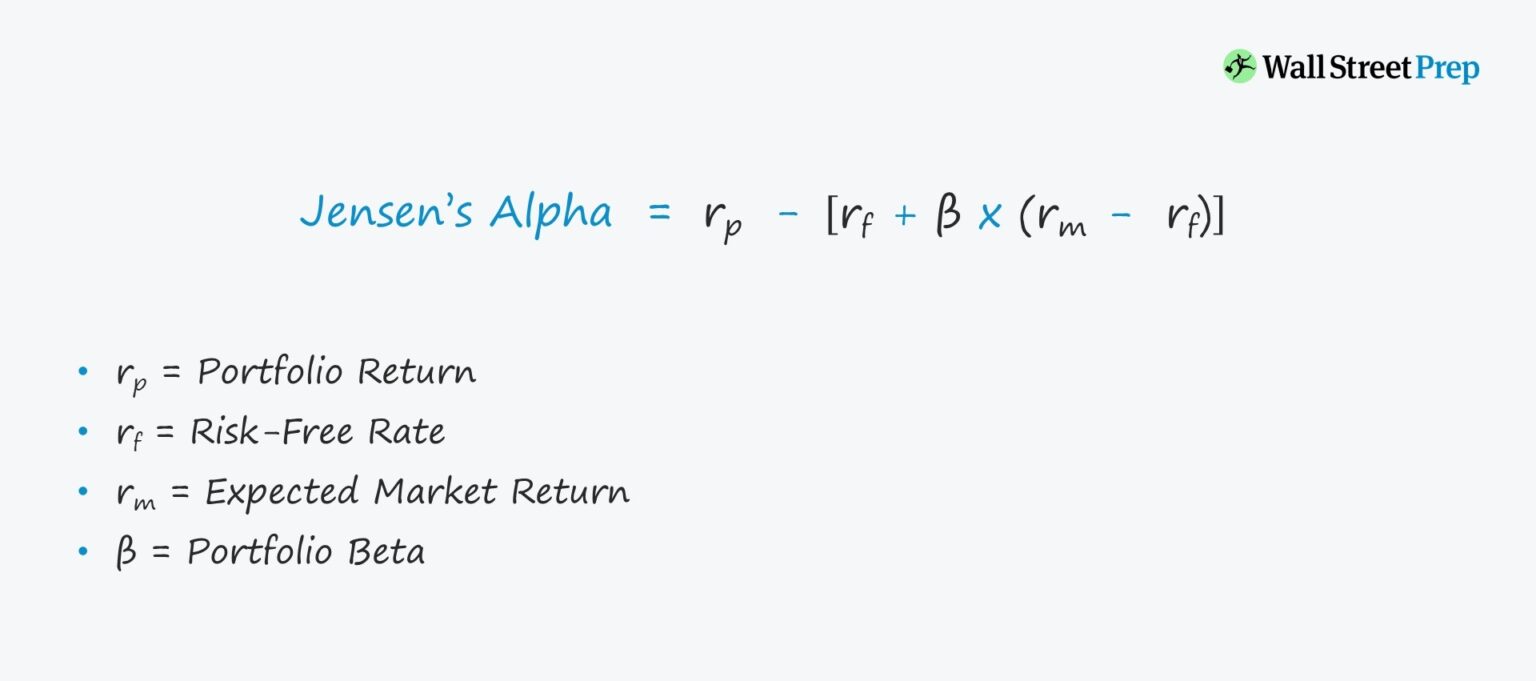
The formula for alpha under Jensen’s Measure is shown below:
Jensen's Alpha Formula
Jensen's Alpha = rp – [rf + β * (rm – rf)]
- rp = Portfolio Return
- rf = Risk-Free Rate
- rm = Expected Market Return
- β = Portfolio Beta
The value of alpha – the excess returns – can range from being positive, negative, or zero.
The CAPM model calculates risk-adjusted returns – i.e. the formula adjusts for the risk-free rate to account for risk.
Therefore, if a given security is fairly priced, the expected returns should be the same as the returns estimated by CAPM (i.e. alpha = 0).
However, if the security were to earn more than the risk-adjusted returns, the alpha will be positive.
By contrast, negative alpha suggests the security (or portfolio) fell short in achieving its required return.
For return-oriented portfolio managers, a higher alpha is nearly always the desired outcome.
Learn how institutional investors identify high-potential undervalued stocks. Enrollment is open for the upcoming cohort.
Now, to move to an example calculation of Jensen’s alpha, let’s use the following assumptions:
The first step is to calculate the portfolio return, which can be calculated using the formula below.
Portfolio Return Formula
- Portfolio Return = (Ending Portfolio Value / Beginning Portfolio Value) – 1
If we divide $1.2 million by $1 million and subtract one, we arrive at 20% for the portfolio return.
Next, the portfolio beta was stated as 1.2 while the risk-free rate is 2%, so we have all the necessary inputs.
In closing, the estimated alpha for our example scenario is equal to 8.4%.


No comments yet.