What is Long-Short Equity?
Long-Short Equity (L/S) is an investing strategy comprised of taking long positions on publicly-traded equities anticipated to rise in share price, paired with short-selling to mitigate downside risk.

Long-Short Equity (L/S) is an investing strategy comprised of taking long positions on publicly-traded equities anticipated to rise in share price, paired with short-selling to mitigate downside risk.
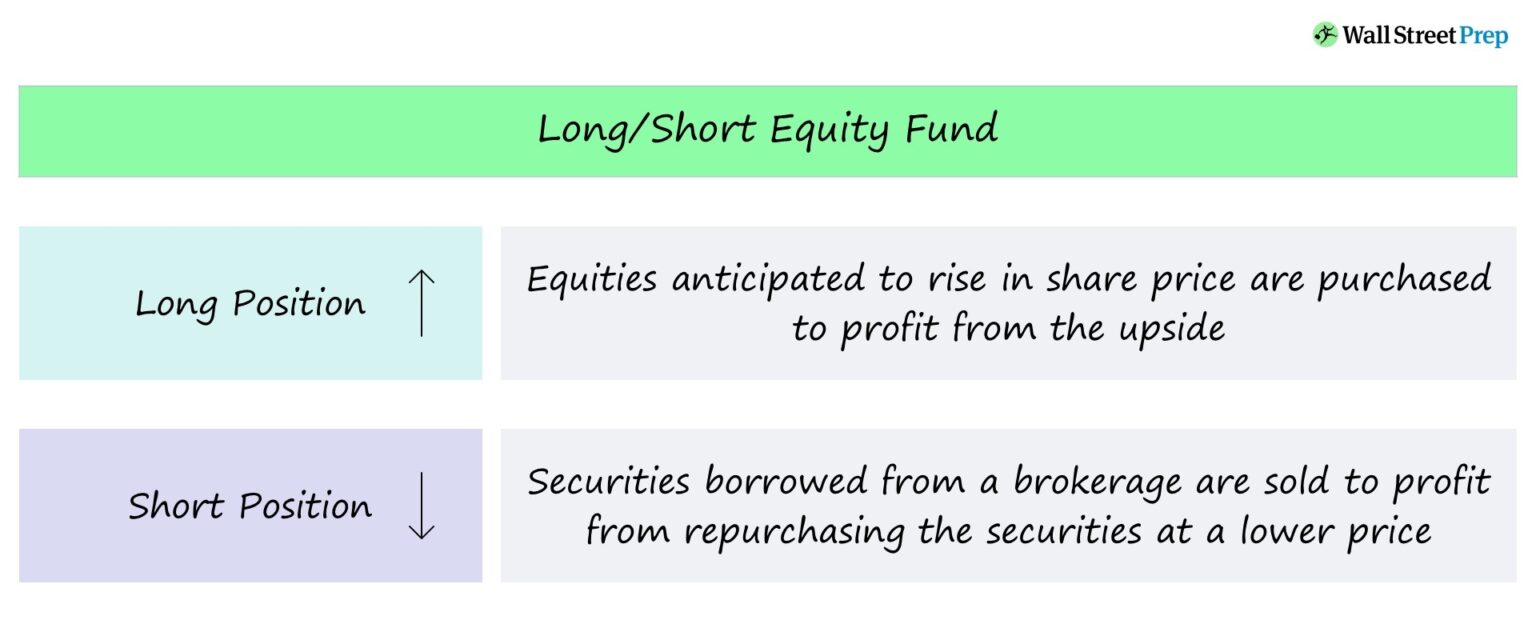
The long-short equity strategy refers to portfolios with a mixture of long and short positions to capitalize and profit from both rises and declines in market prices.
Long-short equity funds are designed to profit from the upside potential of certain securities, while mitigating the downside risk.
For "long" positions, the investor profits from the share price of certain equities rising and outperforming the broader market.
On the other hand, the "short" position profit from declines in the share price of stocks expected to underperform the market. Before an agreed-upon date, the short-seller must return the borrowed shares to the lender.
For the short-sell to be profitable, the share must have been repurchased in the open market for lower than the price sold.
By diversifying a portfolio by mixing both long and short positions, the firm constructs a portfolio with less correlation (i.e. lower risk) to the market and specific industries/companies.
The original premise of long-short investing remains unchanged – i.e. equity-like returns with less volatility than the equities market with a focus on capital preservation – but more strategies have emerged in the increasingly competitive pursuit of generating positive alpha.
Since long-short investing relies less on being correct on a single directional bet, firms can opportunistically profit from both rising and falling share prices.
Ideally, the long-short fund can earn outsized excess returns by picking the right long and short positions; however, this is easier said than done.
The far more likely scenario is that the fund is right on certain investments while wrong on others.
The long-short portfolio should theoretically enable the investor to minimize the potential for incurring substantial losses (or at least reduce the losses), although funds can still be easily wiped out if wrong investments are made.
Therefore, while long/short investing seeks to profit from both upside and downside movements in the pricing of equities, the lower risk comes at the expense of lower potential returns.
Learn how institutional investors identify high-potential undervalued stocks. Enrollment is open for the upcoming cohort.
All portfolios containing public equities are inherently exposed to four distinct types of risks:
The priority of most long-short equity funds is to hedge against market risk, i.e. cancel out the market risk as much as possible.
The investment firm can reduce the chance of being entirely on the wrong side if the economy’s trajectory suddenly reverses (i.e. global recession) or a “black swan” event was to occur.
By limiting the market risk, the investor can focus more on stock selection. Still, the potential for suffering losses is inevitable, but the “wins” on certain positions can offset the “losses” over the long run (and result in more consistent returns with less volatility).
Interested in accessing our comprehensive database of 400 hedge funds and investment firms in the public equities market?
Fill out the form below to download the Excel spreadsheet at no cost.


There are two distinct types of shorting:
Most funds utilize both shorting approaches, but alpha shorting is considered the more difficult strategy and is thus more valued by the market – or, more specifically, the potential for losses in alpha shorting is much greater.
A long-short equity fund and equity market-neutral fund (EMN) share certain similarities regarding their aligned objectives.
Long-short fund strategies, such as equity-market neutral (EMN), are investment strategies employed by hedge funds to optimize their portfolio to mitigate the downside risk potential of their returns, i.e. protect against market volatility.
One notable difference between the fund strategies is that a market-neutral fund strives to ensure that the total value of its long/short positions is close to being equal.
The goal of an equity market neutral (EMN) fund is to generate positive returns independent of the market, even if doing so results in missing out on greater returns from more speculative investments.
Long-short equity funds are similar in that long and short positions are coupled to hedge their portfolio, but most funds are more lenient in rebalancing.
More specifically, the longs and shorts will not be adjusted, especially if a certain market prediction is performing well and has been a profitable decision.
Even if the risk increases and there is deviation from the target exposure, most long/short funds will attempt to continue to profit and ride the momentum.
Conversely, EMN funds in such circumstances will still proceed with readjusting the portfolio.
Equity market-neutral funds (EMN) tend to exhibit the lowest correlation with the broader market.
No correlation to the equity markets, which coincides with a portfolio beta near zero, limits the potential upside and returns to investors, but it remains consistent with the overarching goal of an EMN fund.
For EMN funds, reducing portfolio risk takes priority, which resembles the original intent of the hedge fund investment vehicle.
Long-short funds will thus have positive betas, typically “net long” or “net short”, while remaining hedged based on their market outlook (and projected direction).
Exposure in the context of long/short investing refers to the percentage of a portfolio in either long or short positions – with two frequent measures being the following:
Gross exposure equals the percentage of a portfolio invested in long positions, plus the percentage that is short.
If the gross exposure exceeds 100%, the portfolio is considered levered (e.g. using borrowed funds).
The net exposure represents the percentage of a portfolio invested in long positions, minus the percentage of the portfolio currently in short positions.
For long positions, the following traits are typically viewed as positive indicators by long-short equity funds.
Long Position Characteristics:
Short Position Characteristics:
On the other hand, long-short equity funds tend to view the following characteristics positively for short positions.
Briefly, each investment firm, such as a hedge fund, has its unique perspectives on investing and priorities, so there are no one-size-fits-all criteria for taking long-short positions.
However, the long-short equity strategy (L/S) is designed to profit from paired long/short positions to mitigate portfolio risk, since the short positions can offset the losses on long positions (and vice versa).


No comments yet.