What is the Efficient Market Hypothesis?
The Efficient Market Hypothesis (EMH) theory – introduced by economist Eugene Fama – states that the prevailing asset prices in the market fully reflect all available information.

The Efficient Market Hypothesis (EMH) theory – introduced by economist Eugene Fama – states that the prevailing asset prices in the market fully reflect all available information.
The efficient market hypothesis (EMH) theorizes about the relationship between the:
Under the efficient market hypothesis, following the release of new information/data to the public markets, the prices will adjust instantaneously to reflect the market-determined, “accurate” price.
EMH claims that all available information is already "priced in" – meaning that the assets are priced at their fair value. Therefore, if we assume EMH is true, the implication is that it is practically impossible to outperform the market consistently.
"The proposition is that prices reflect all available information, which in simple terms means since prices reflect all available information, there's no way to beat the market."
- Eugene Fama
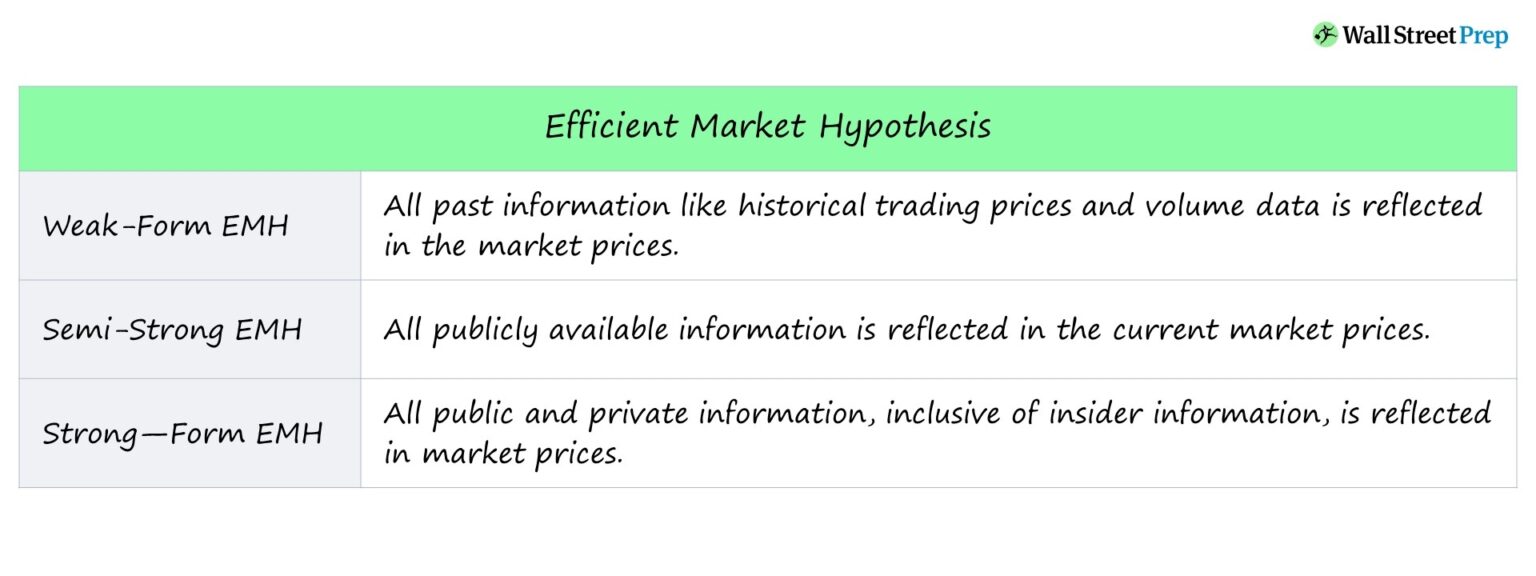
Eugene Fama classified market efficiency into three distinct forms:
Learn how institutional investors identify high-potential undervalued stocks. Enrollment is open for the upcoming cohort.
Broadly put, there are two approaches to investing:
As EMH has grown in widespread acceptance, passive investing has become more common, especially for retail investors (i.e. non-institutions).
Index investing is perhaps the most common form of passive investing, whereby investors seek to replicate and hold a security that tracks market indices.
In recent times, some of the main beneficiaries of the shift from active management to passive investing have been index funds such as:
The widely held belief among passive investors is that it's very difficult to beat the market, and attempting to do so would be futile.
Plus, passive investing is more convenient for the everyday investor to participate in the markets – with the added benefit of being able to avoid high fees charged by active managers.
Long story short, hedge fund professionals struggle to “beat the market” despite spending the entirety of their time researching these stocks with more data access than most retail investors.
With that said, it seems like the odds are stacked against retail investors, who invest with fewer resources, information (e.g. reports), and time.
One could make the argument that hedge funds are not actually intended to outperform the market (i.e. generate alpha), but to generate stable, low returns regardless of market conditions – as implied by the term “hedge” in the name.
However, considering the long-term horizon of passive investing, the urgency of receiving high returns on behalf of limited partners (LPs) is not a relevant factor for passive investors.
Typically, passive investors invest in market indices tracking products with the understanding that the market could crash, but patience pays off over time (or the investor can also purchase more – i.e. a practice known as “dollar-cost averaging”, or DCA).
The “random walk theory” arrives at the conclusion that attempting to predict and profit from share price movements is futile.
According to the random walk theory, share price movements are driven by random, unpredictable events – which nobody, regardless of their credentials, can accurately predict.
For the most part, the accuracy of predictions and past successes are more so due to chance as opposed to actual skill.
By contrast, EMH theorizes that asset prices, to some extent, accurately reflect all the information available in the market.
Under EMH, a company’s share price can neither be undervalued nor overvalued, as the shares are trading precisely where they should be given the “efficient” market structure (i.e. are priced at their fair value on exchanges).
In particular, if the EMH is strong-form efficient, there is essentially no point in active management, especially considering the mounting fees.
Since EMH contends that the current market prices reflect all information, attempts to outperform the market by finding mispriced securities or accurately timing the performance of a certain asset class come down to "luck" as opposed to skill.
One important distinction is that EMH refers specifically to long-term performance – therefore, if a fund achieves "above-market" returns – that does NOT invalidate the EMH theory.
In fact, most EMH proponents agree that outperforming the market is certainly plausible, but these occurrences are infrequent over the long term and not worth the short-term effort (and active management fees).
Thereby, EMH supports the notion that it is NOT feasible to consistently generate returns in excess of the market over the long term.


No comments yet.