What is a Callable Bond?
A Callable Bond contains an embedded call provision, in which the issuer can redeem a portion (or all) of the bonds prior to the stated maturity date.

A Callable Bond contains an embedded call provision, in which the issuer can redeem a portion (or all) of the bonds prior to the stated maturity date.
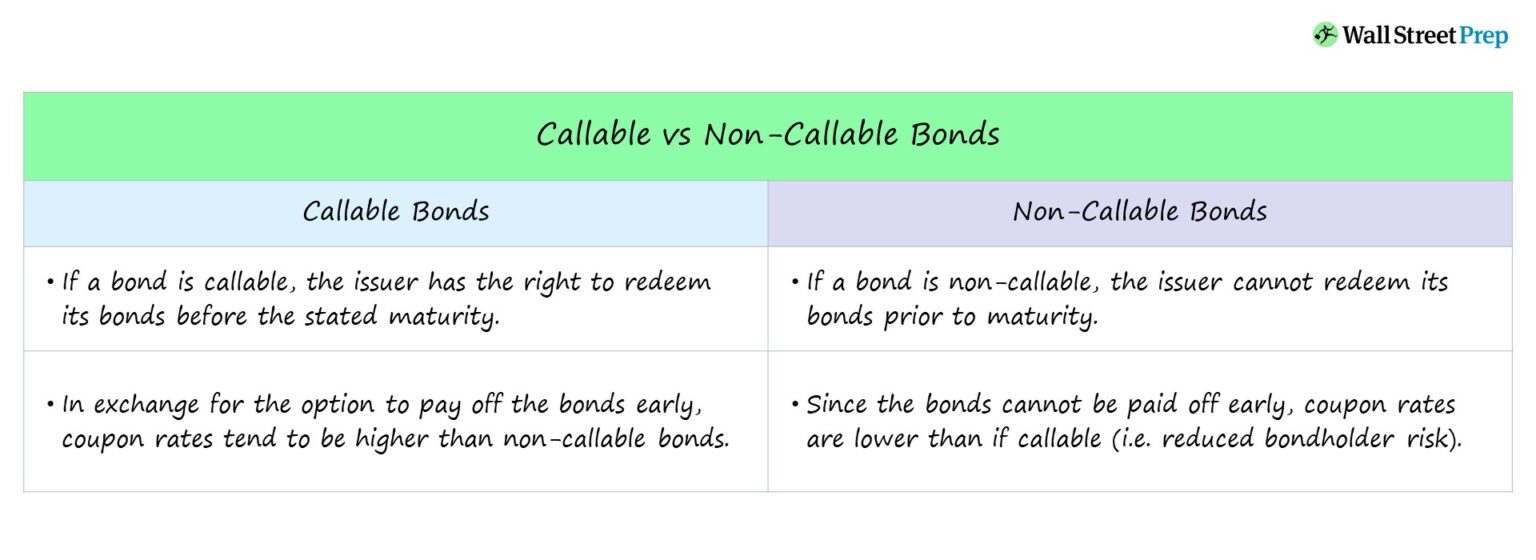
Callable bonds give an issuer the option to redeem a bond earlier than the stated maturity date.
The right to redeem a bond early is allowed by a call provision, which, if applicable, will be outlined in the bond’s indenture along with its terms.
If current interest rates drop below the interest rate on the bond, the issuer is more likely to call the bonds to refinance them at a lower interest rate, which can be profitable over the long run.
If callable, the issuer has the right to call the bond at specified times (i.e. “callable dates”) from the bondholder for a specified price (i.e. “call prices”).
Although callable bonds can result in higher costs to the issuer and uncertainty to the bondholder, the provision can benefit both parties.
Issuers can buy back the bond at a fixed price, i.e. the "call price,” to redeem the bond.
The call price is often set at a slight premium in excess of the par value.
The excess of the call price over par is the “call premium,” which declines the longer the bond remains uncalled and approaches maturity.
The inclusion of the call premium is meant to compensate the bondholder for potentially lost interest and reinvestment risk.
For example, a bond issued at par (“100”) could come with an initial call price of 104, which decreases each period after that.
There is a set period when redeeming the bonds prematurely is not permitted, called the call protection period (or call deferment period).
Often, the call protection period is set at half of the bond’s entire term but can also be earlier.
Nowadays, most bonds are callable – the differences lie in the duration of the call protection period and the associated fees.
For instance, if a bond’s call status is denoted as “NC/2,” the bond cannot be called for two years.
After the call protection period, the call schedule within the bond debenture states the call dates and the call price corresponding to each date.
On the other hand, bonds restricted from being called early for the entirety of the lending term are noted as "non-call for life," i.e. “NC/L.”
In addition, calling a bond early can trigger prepayment penalties, helping offset part of the losses incurred by the bondholder stemming from the early redemption.
A non-callable bond cannot be redeemed earlier than scheduled, i.e. the issuer is restricted from prepayment of the bonds.
If a bond is called early by the issuer, the yield received by the bondholder is reduced.
Why? The maturity of the bonds was prematurely cut, resulting in less income via coupon (i.e. interest) payments.
Additionally, the bondholder must now reinvest those proceeds, i.e. find another issuer in a different lending environment.
If the yield to worst (YTW) is the yield to call (YTC), as opposed to the yield to maturity (YTM), the bonds are more likely to be called.
Several variations of callable bonds exist, but in particular, the two distinct types that we’ll discuss are:
Callable bonds protect issuers, so bondholders should expect a higher coupon than for a non-callable bond in exchange (i.e. as added compensation).
If a bond is structured with a call provision, that can complicate the expected yield to maturity (YTM) due to the redemption price being unknown.
The potential for the bond to be called at different dates adds more uncertainty to the financing (and impacts the bond price/yield).
Therefore, a callable bond should provide a higher yield to the bondholder than a non-callable bond – all else being equal.
A step-by-step course designed for those pursuing a career in fixed income research, investments, sales and trading or investment banking (debt capital markets).


No comments yet.