What is Coupon Rate?
The Coupon Rate is multiplied by the par value of a bond to determine the annual coupon payment owed by the issuer to a bondholder until maturity.

The Coupon Rate is multiplied by the par value of a bond to determine the annual coupon payment owed by the issuer to a bondholder until maturity.
The pricing of the coupon on a bond issuance is used to calculate the dollar amount of coupon payments paid, i.e. the periodic interest payments by the issuer to bondholders.
The coupon rate, or nominal yield, is the rate of interest paid to a bondholder by the issuer.
Coupons are the periodic interest payments received by bondholders from the original date of a bond issuance until the date of maturity – which is determined by the coupon rate as part of the bond issuance agreement.
Bonds are a form of raising capital for government entities and corporates alike, often for meeting liquidity needs and/or funding day-to-day operations.
As part of the bond indenture (i.e. the lending agreement), the issuer has a contractual obligation to service periodic coupon payments to the bondholder.
Originally, the name “coupon” comes from when coupons were physically attached to the documentation as a formal certificate, noting the amounts and dates of when interest payments come due.
The coupon rate on a bond issuance can be calculated using the following four-step process:
The amount of interest due is based on the original principal of the bond (or initial investment), which will be stated on the bond security certificate.
Until the date of maturity, each periodic coupon payment must be paid on time, per the lending schedule.
At maturity, the face value (i.e. the par value) of the bond is returned in full to the bondholder, marking the end of the coupon payments.
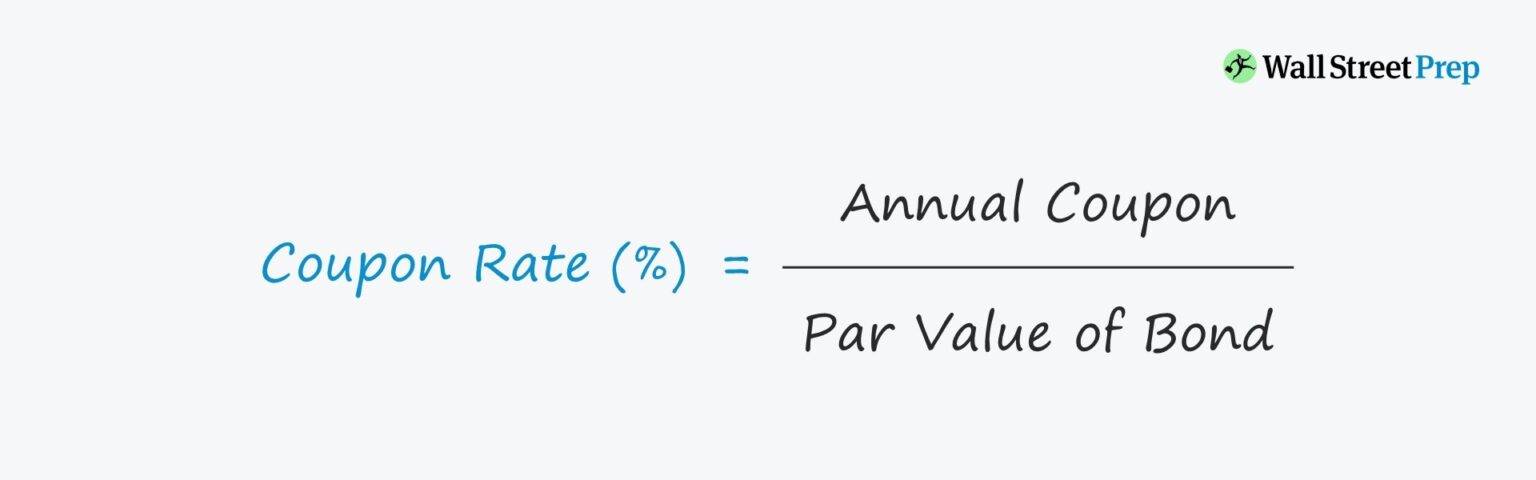
The formula for the coupon rate consists of dividing the annual coupon payment by the par value of the bond.
For example, if the interest rate pricing on a bond is 6% on a $100k bond, the coupon payment comes out to $6k per year.
Since most bonds pay interest semi-annually, the bondholder receives two separate coupon payments of $3k each year for as long as the bond is still outstanding.
The stated interest rate can be structured in the form of either:
Generally, for most fixed income instruments such as corporate bonds and municipal bonds, the fixed-coupon rate tends to be far more common.
We’ll now move to a modeling exercise, which you can access by filling out the form below.

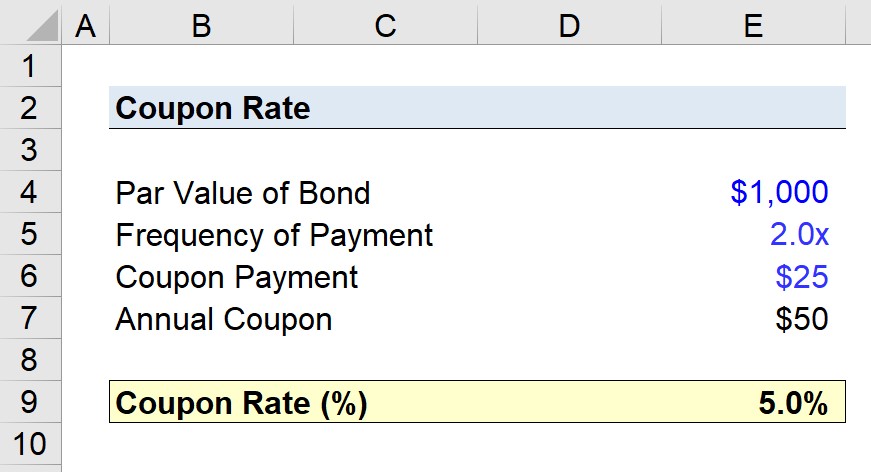
In our illustrative scenario, we’ll calculate the coupon rate on a bond issuance with the following assumptions.
The frequency of the coupon payment is 2x per year, so the bond pays coupons semi-annually.
If we multiply the coupon payment by the frequency of the coupon, we can calculate the annual coupon.
With all the inputs ready, we can now calculate the coupon rate by dividing the annual coupon by the par value of the bonds.
Therefore, the bond is priced at a coupon rate of 5% on a $1 million par value, resulting in two semi-annual payments of $25,000 per year until the bond reaches maturity.
Wall Street Prep’s globally recognized certification program prepares trainees with the skills they need to succeed as a Fixed Income Trader on either the Buy Side or Sell Side.


What if I hold a $1000 series i bearer bond issued in 1931 with all the coupons still attached?
Hi, Jarrod,
First of all, I would say that is pretty cool that you have a bond that old with coupons attached. As for how to redeem them, I found this article which may help: https://finance.zacks.com/redemption-bearer-bonds-1208.html. But you may also consider keeping or selling it as a collectible.
BB
I need more calculation to be remitted
Hi, Paul,
Could you explain what you mean by needing more calculations to be remitted? More examples?
BB