What is Simple Interest?
Simple Interest refers to a interest rate pricing structure in which the amount of interest owed is based only on the original principal value.

Simple Interest refers to a interest rate pricing structure in which the amount of interest owed is based only on the original principal value.
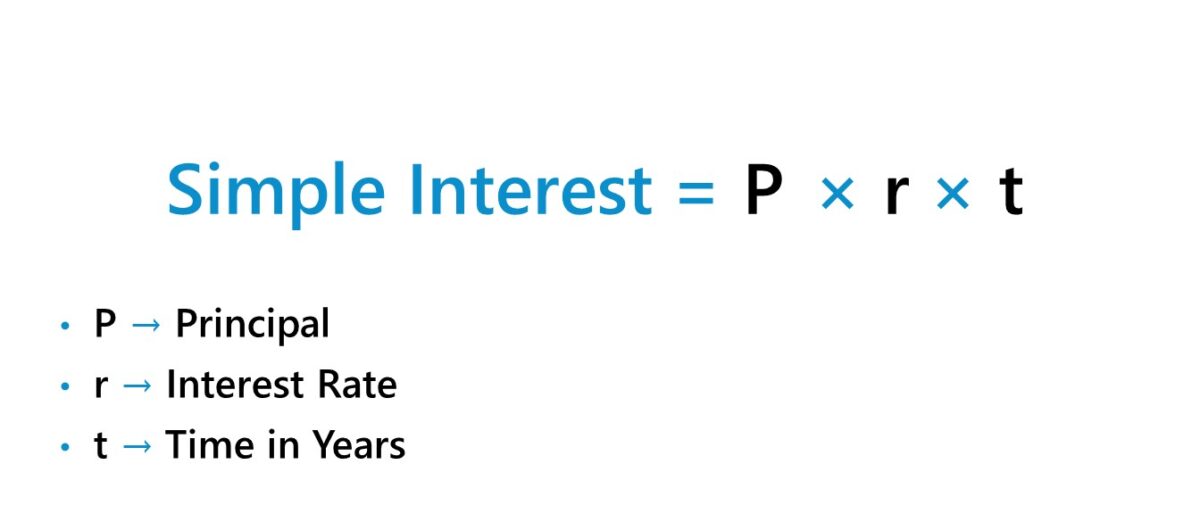
Simple interest, or “non-compounding interest”, is a type of interest rate pricing wherein the amount of interest owed is determined only by the principal of the debt obligation, such as a loan.
In order to calculate the interest owed (or earned) under simple interest, the following three inputs are required:
In practice, simple interest rate pricing is not particularly common. However, financial instruments with simple interest tend to be those with shorter maturities, where the effects of compounding are negligible.
The formula to calculate the simple interest is as follows.
Where:
For example, if a lender offers a $1 million loan with a 5.0% annual interest rate and 2-year maturity, the simple interest is $200,000.
To calculate the final value – i.e. Principal + Interest – the following formula is used.
Where:
In short, simple interest neglects the effects of compounding, which can be best described as “interest on interest”.
Therefore, the interest owed under simple interest (or “earned” depending on the perspective, i.e. borrower vs. lender) remains the same for each period until maturity – assuming that the principal and the interest rate remain constant.
In contrast, the interest owed (or earned) under compound interest increases after each period, since the interest is added to the principal.
The calculation of compound interest is based on two components:
Since interest is a function of the outstanding principal as of the corresponding date, the gradual increase in the principal causes the interest payments to rise in tandem.
The interest owed will be greater under compound interest pricing than under simple interest pricing – all else being equal.
While simple interest is more prevalent for short-term securities, compound interest is far more common for longer-term securities, as the effects of compounding become more pronounced over long time frames.
We’ll now move on to a modeling exercise, which you can access by filling out the form below.


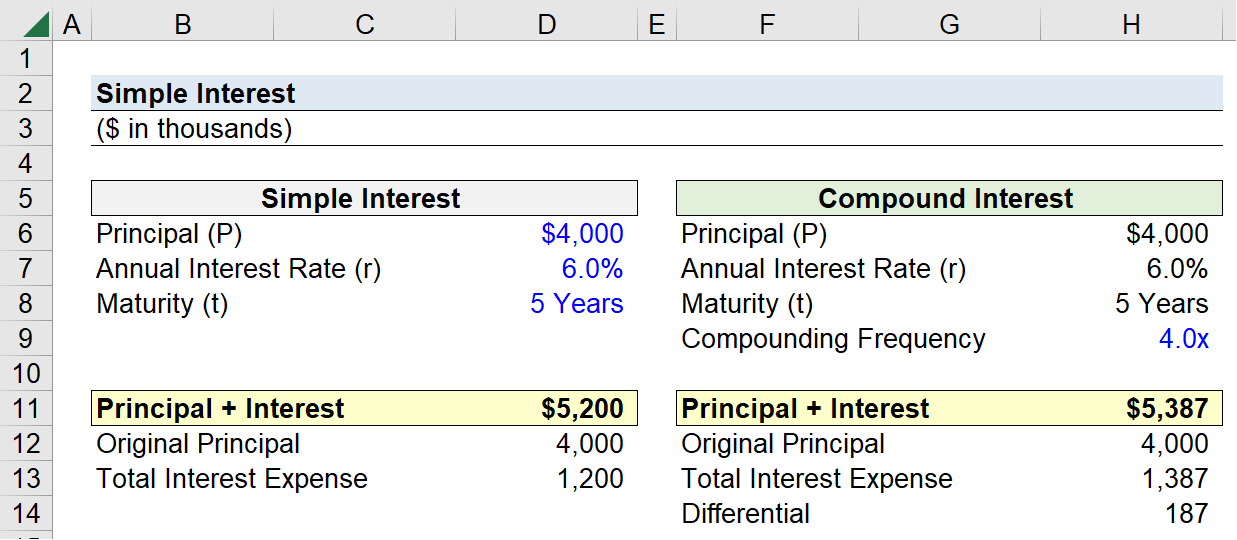
Suppose we’re tasked with calculating the principal and interest payment amounts under a simple interest and a compound interest pricing structure.
To start, we’ll list out the assumptions for our simple interest calculation.
The total interest owed across the term of the borrowing and the return of the original principal on the date of maturity is $5.2 million.
Since we already know that the principal is $4 million, we can deduct that amount from $5.2 million to determine the interest component.
Conversely, we can utilize the formula we discussed earlier.
In the next part of our exercise, we’ll now calculate the payment values inclusive of the effects of compounding.
We’ll use the same assumptions as the prior section, but with one additional assumption.
Our compounding frequency assumption of 4.0x means that the interest compounds on a quarterly basis.
Upon doing so, we arrive at a value of approximately $5.4 million for the amount of “Principal + Interest” under compound interest.
Adjustments made in the formula to the interest rate and the number of compounding periods are to ensure consistency is maintained in the periodicity of each input.
The interest component if there were no compounding would be $1.2 million (i.e. the simple interest component). With that said, the excess interest attributable to the effects of compounding is roughly $200k (or $187k, to be precise), which was calculated by taking the difference between the two calculated interest expense amounts.

Enroll in The Premium Package: Learn Financial Statement Modeling, DCF, M&A, LBO and Comps. The same training program used at top investment banks.


No comments yet.